Astronomy Picture of the Day Features a Haunting Display of Aurora Borealis Over the Volcanic Fumaroles of Hverir Iceland

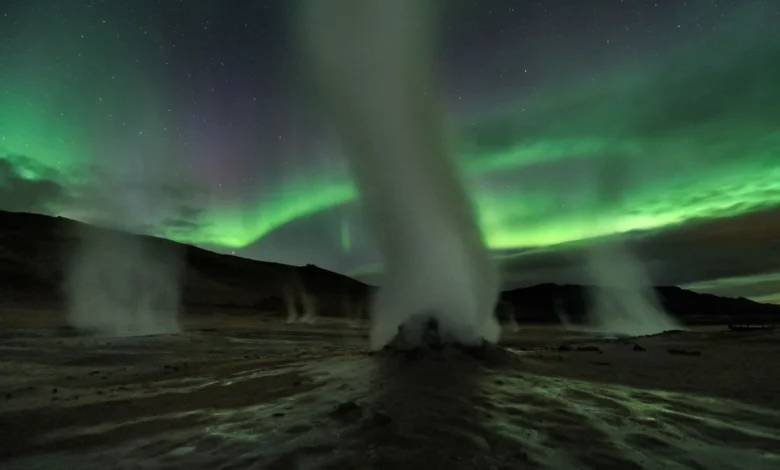
As the world observes the transition into late autumn and the cultural celebrations surrounding Halloween, the cosmos has provided a visual spectacle that bridges the gap between terrestrial geology and high-energy space weather. NASA’s Astronomy Picture of the Day (APOD) for October 31, 2026, showcases a chillingly beautiful photograph captured by Stéphane Vetter at Hverir, a highly active geothermal site in northeastern Iceland. The image depicts plumes of steam rising from volcanic fumaroles, illuminated against a backdrop of vibrant, greenish aurorae. This convergence of Earth’s volatile subterranean activity and the atmospheric consequences of solar cycles serves as a stark reminder of the planet’s position within a dynamic, interconnected solar system.
The Geothermal Landscape of Hverir
The setting of this photograph, Hverir, is situated in the Krafla volcanic system, a region defined by intense geothermal energy. Hverir is characterized by its stark, lunar-like terrain, where mud pots and fumaroles continuously vent sulfuric steam and gases from beneath the Earth’s crust. These features are the surface expressions of the immense heat generated by the Krafla caldera, which has been the site of numerous volcanic episodes throughout history.
For observers at the site, the combination of thick, billowing steam—which often carries the pungent scent of sulfur—and the ethereal glow of the aurora creates an atmosphere that feels otherworldly. The interplay between the ground-level gas emissions and the high-altitude light displays provides a rare photographic opportunity where the "spooky" qualities of the landscape are accentuated by the rhythmic pulses of the northern lights.
Solar Activity and the Mechanism of Aurorae
The aurorae captured in Vetter’s photograph are the direct result of geomagnetic storms triggered by solar activity. When the Sun is in a period of high activity, it frequently ejects clouds of charged particles—electrons and protons—known as coronal mass ejections (CMEs) or through high-speed solar wind streams. These particles traverse the vacuum of space, eventually reaching Earth’s magnetosphere.
Earth’s magnetic field acts as a shield, funneling these charged particles toward the poles. As they enter the upper atmosphere, they collide with gas molecules such as oxygen and nitrogen. These collisions excite the atoms, causing them to emit light at specific wavelengths. Green, the most common color observed in the aurora, is the result of oxygen atoms being excited at altitudes of approximately 100 to 300 kilometers.
The timing of this display coincides with the current phase of the solar cycle. The Sun operates on an approximately 11-year cycle of magnetic activity, characterized by fluctuations in the number of sunspots, solar flares, and CME frequency. As of late 2026, the Sun is in the early stages of its decline from the peak of its solar maximum. This period remains a time of elevated geomagnetic activity, ensuring that auroral displays are more frequent and intense than they would be during a solar minimum.
Chronology of the 2026 Solar Maximum
The recent heightened activity can be traced back to the onset of the solar maximum, which began to dominate space weather reports in late 2024 and throughout 2025. During this timeframe, scientific institutions like NASA and the National Oceanic and Atmospheric Administration (NOAA) reported a steady increase in M-class and X-class solar flares.
- Mid-2025: Scientists noted a consistent rise in the F10.7 index, a measure of solar radio flux that serves as a proxy for solar activity.
- Early 2026: Geomagnetic storms became frequent enough to trigger visible auroral displays at lower latitudes than usual, sparking global public interest.
- October 2026: Leading up to the Halloween period, a series of moderate-to-strong geomagnetic storms (G2 to G3 level) provided the necessary conditions for high-latitude displays, such as the one observed in Iceland.
Scientific Implications and Space Weather Monitoring
While the aurora provides a breathtaking visual experience, the solar events that drive them have broader implications for modern infrastructure. Intense geomagnetic storms can induce electrical currents in long-distance power grids, potentially causing voltage fluctuations or equipment damage. Furthermore, these storms can disrupt satellite communications, GPS navigation, and high-frequency radio transmissions.

Space weather experts, including those from NASA’s Goddard Space Flight Center and the ASD (Astrophysics Science Division), monitor these phenomena to mitigate risks to technological systems. The study of the aurora is not merely an aesthetic endeavor; it is a critical component of heliophysics. By analyzing the interaction between the solar wind and the Earth’s magnetosphere, researchers can improve predictive models for space weather, which is essential for protecting the assets of the space industry and maintaining the stability of global energy grids.
Perspectives from the Scientific Community
Professional astronomers and educators involved in the APOD project emphasize that these events serve as an entry point for public science engagement. The inclusion of the Hverir image is part of a broader educational mission to "discover the cosmos."
"Each image we select is intended to reveal a facet of our universe that might otherwise remain hidden or misunderstood," noted a spokesperson associated with the APOD editorial team. "The Hverir photograph is particularly effective because it connects the familiar—the landscape of our own planet—with the cosmic forces that shape our atmosphere. It encourages the viewer to look up and understand that we are living on a planet that is constantly interacting with its star."
The inclusion of cultural references, such as the timing of the image on Halloween, is a strategic choice designed to foster interest in astronomy among non-scientists. By framing scientific phenomena within the context of human experience, the project aims to demystify complex space physics.
Looking Toward the Future of Solar Observation
As the solar cycle continues its descent toward the next minimum, the frequency of such spectacular displays is expected to taper off, though it will not disappear entirely. The scientific community is currently leveraging this period of high activity to gather unprecedented data. Projects like the Parker Solar Probe and the Solar Orbiter continue to provide insights into the mechanisms of the solar corona, helping scientists understand how the Sun accelerates particles to such high velocities.
For those residing in high-latitude regions like Iceland, Scandinavia, and parts of Canada, the coming months will likely offer further opportunities to witness these phenomena. However, as noted in the APOD summary, these events are reminders that Earth’s "spooky" or awe-inspiring atmospheric displays are part of a predictable, yet powerful, natural cycle.
Conclusion: A Connected Universe
The image of steam rising against the aurora at Hverir serves as a microcosm of the relationship between Earth and the Sun. The volcanic energy beneath the soil is a reminder of the heat generated by the planet’s formation and its radioactive interior, while the light in the sky is the signature of the Sun’s ongoing nuclear fusion and magnetic volatility.
As we move past the peak of the current solar maximum, the public is encouraged to continue monitoring space weather reports. While the "ghostly apparitions" of the aurora may be tied to the cold, dark nights of late October in this particular instance, the science behind them is a constant, year-round endeavor that helps humanity better navigate the hazards and wonders of the solar system. For observers, the message remains clear: the universe is active, dynamic, and ever-changing, and a better understanding of these processes is the key to appreciating our place within the vast expanse of space.