Amazon Bedrock AgentCore Runtime Introduces Runtime Instances for Persistent Multi-Agent Workloads

As artificial intelligence development shifts decisively from rapid prototyping to enterprise-grade production deployment, engineering teams are encountering severe infrastructure bottlenecks. Standard serverless and containerized microVM solutions, while efficient for short-lived, stateless API calls, often falter when tasked with managing complex, multi-step agentic workflows that span several hours or days. Autonomous AI agents frequently require persistent operational states, shared contextual memory, direct access to the underlying operating system, and hardware acceleration via Graphics Processing Units (GPUs) for heavy computational tasks like code compilation, vulnerability scanning, and neural network inference.
To bridge this operational gap, Amazon Web Services (AWS) has announced the official launch of runtime instances within the Amazon Bedrock AgentCore Runtime ecosystem. This new compute option provides fully managed, persistent Amazon Elastic Compute Cloud (Amazon EC2) infrastructure purpose-built for demanding, long-running, and collaborative multi-agent workloads. By integrating natively with existing AgentCore application programming interfaces (APIs), security controls, and observability frameworks, the new capability aims to eliminate the complex overhead previously required to self-manage infrastructure for advanced enterprise AI applications.
Background and Context in Enterprise AI Infrastructure
Historically, scaling autonomous agents beyond simple conversational interfaces has forced development teams to build and maintain bespoke orchestration infrastructure from the ground up. To support agents that must execute prolonged computational tasks, developers typically provisioned raw EC2 instances, configured complex networking topologies, engineered custom session management databases, and stitched together disparate monitoring tools. This heavy operational burden diverted engineering talent away from core model tuning and prompt engineering.

The introduction of Amazon Bedrock AgentCore Runtime instances directly addresses these operational hurdles. While AgentCore Runtime microVMs remain ideal for lightweight, fast-scaling orchestrator agents that handle API routing and task dispatching for durations up to eight hours, runtime instances offer a heavier, dedicated compute environment. These instances support workloads running continuously for up to 14 days, accommodate GPU-accelerated computing nodes, and allow multiple collaborating agents to operate on the same host machine with synchronized file systems and persistent session storage.
Core Architectural Capabilities and Technical Specifications
Runtime instances provide AWS-managed EC2 infrastructure where organizations can deploy multiple independent AI agents within a single unified runtime environment. Each deployed agent maintains its own distinct dependencies and artifact types while retaining the ability to collaborate directly with peer agents on the same underlying host.
Key technical characteristics of the new service include:
- Extended Session Persistence: Workflows can persist uninterrupted for up to 14 days, making them suitable for iterative development loops, deep research tasks, and long-term automated data processing.
- Flexible Hibernation: Administrators can programmatically stop and restart sessions during idle periods to significantly reduce infrastructure compute costs without losing active session context.
- GPU Acceleration: Dedicated instances can leverage GPU hardware to execute compute-intensive tasks, such as machine learning model training, bulk data ingestion, GUI automation, and complex code compilation.
- Shared File Systems and Storage Integration: Runtime instances pair naturally with Amazon Elastic Block Store (Amazon EBS) and AgentCore Memory, enabling long-term recall across sessions and giving collaborating agents instant read-write access to shared working directories.
- Framework Agnosticism: Development teams are not locked into proprietary software stacks; the infrastructure supports popular agentic orchestration frameworks including CrewAI, LangGraph, LlamaIndex, and Strands, alongside any chosen foundational large language model.
Step-by-Step Implementation and Multi-Agent Collaboration
To demonstrate the practical mechanics of runtime instances, AWS engineers outlined a collaborative multi-agent pattern involving a code writer agent and a code reviewer agent. In this architecture, both agents operate within the same session ID and share a common file system directory. The code writer generates Python code from natural language prompts and writes the output directly to disk. Simultaneously, the code reviewer accesses that exact file path to perform automated static analysis, bug detection, and style evaluations without requiring explicit API calls or data transmissions between the agents.
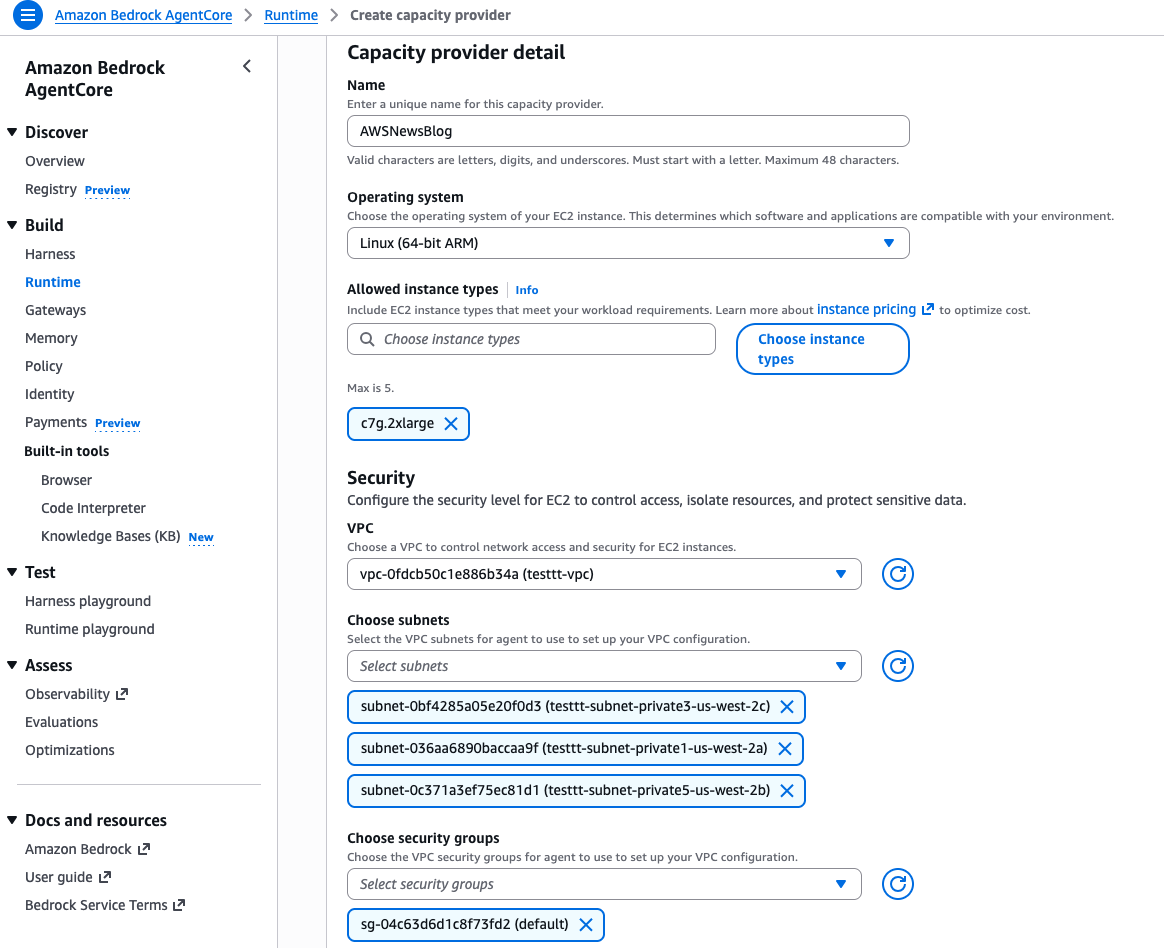
Deploying this architecture involves a structured, multi-step process utilizing either the AWS Management Console, the AgentCore Command Line Interface (CLI), or standard infrastructure-as-code tooling.
Step 1: Configuring the Capacity Provider
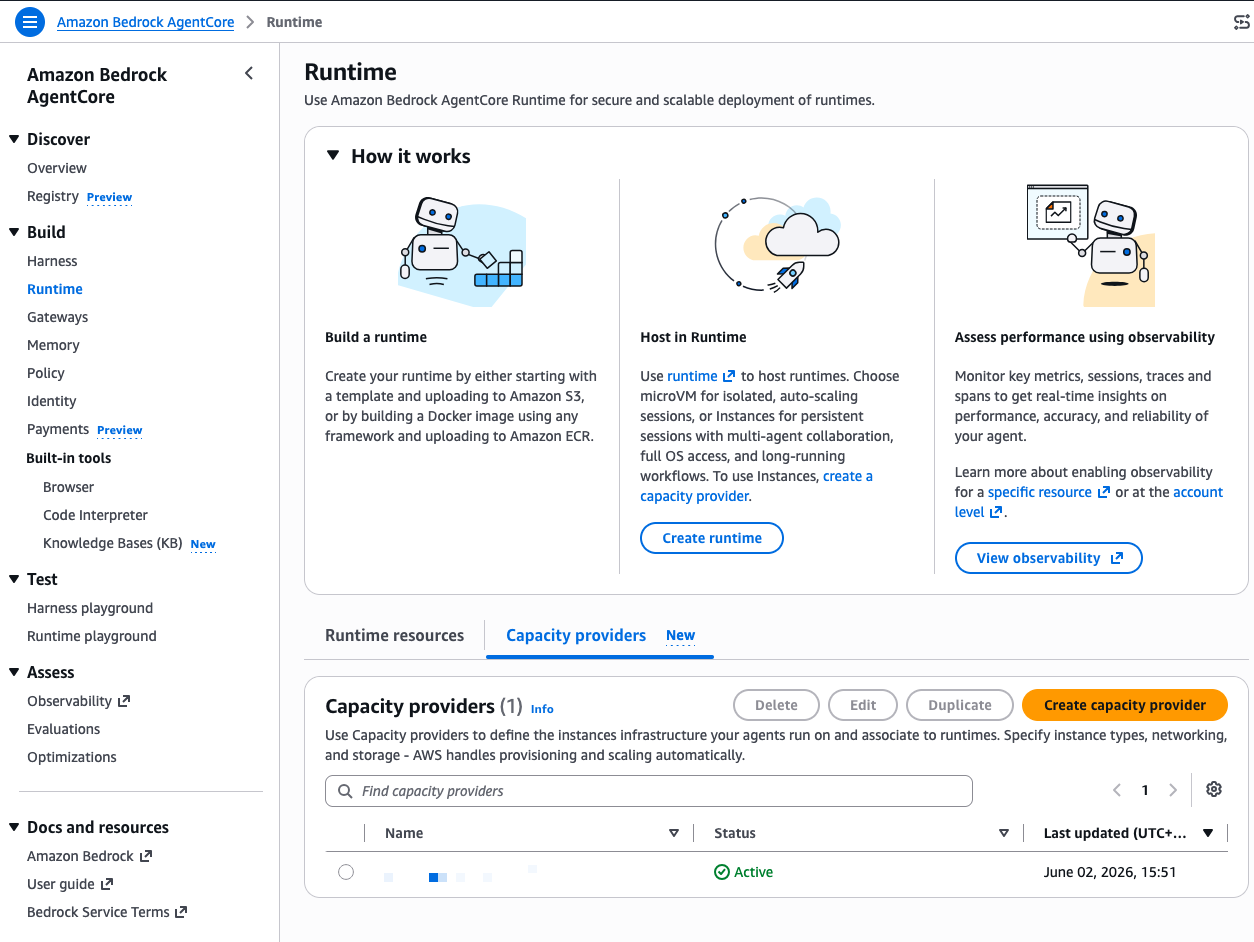
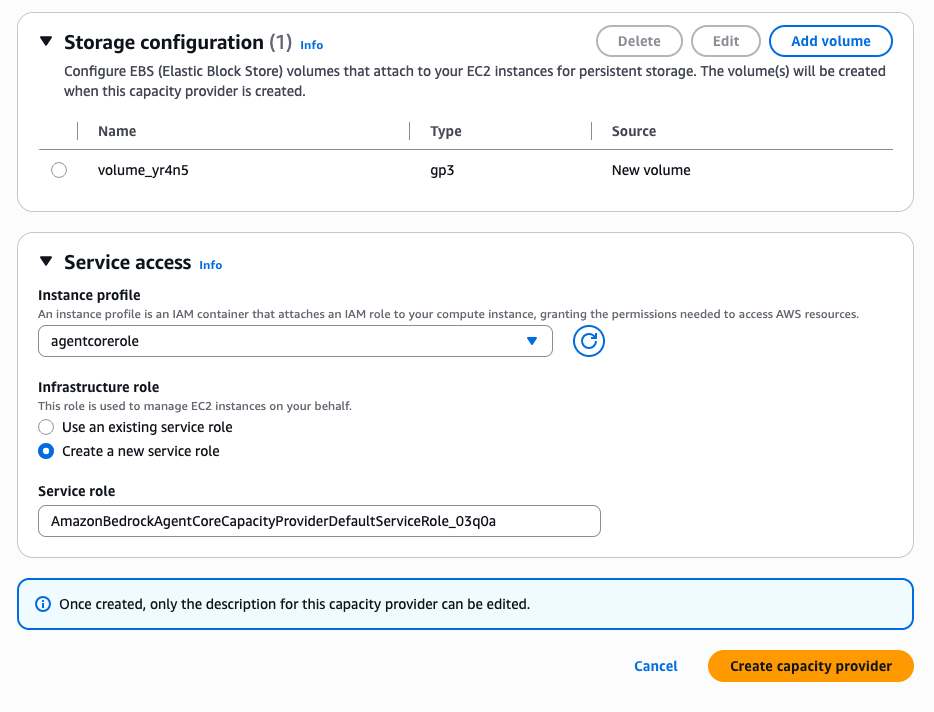
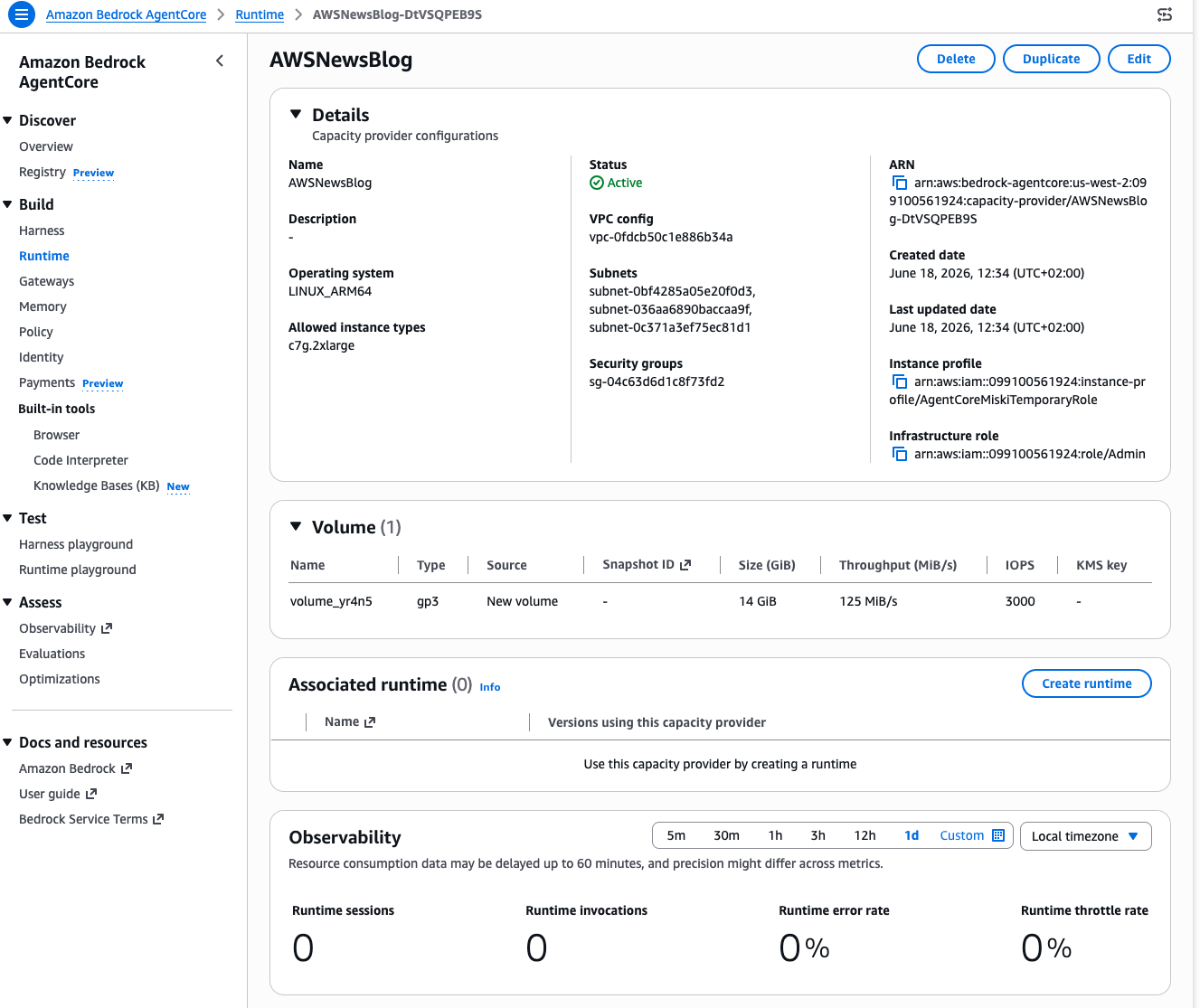
Administrators begin by establishing a capacity provider, which defines the underlying EC2 hardware configuration. Within the Amazon Bedrock AgentCore console, operators select the capacity providers menu and specify parameters such as the operating system—such as 64-bit ARM Linux—and allowed instance types like c7g.2xlarge, which supplies 8 vCPUs and 16 GiB of memory. Network configurations, including Virtual Private Clouds (VPCs), subnets, security groups, and automated service IAM roles, are defined during this phase to secure the environment.
Step 2: Creating Runtimes and Deploying Agent Artifacts
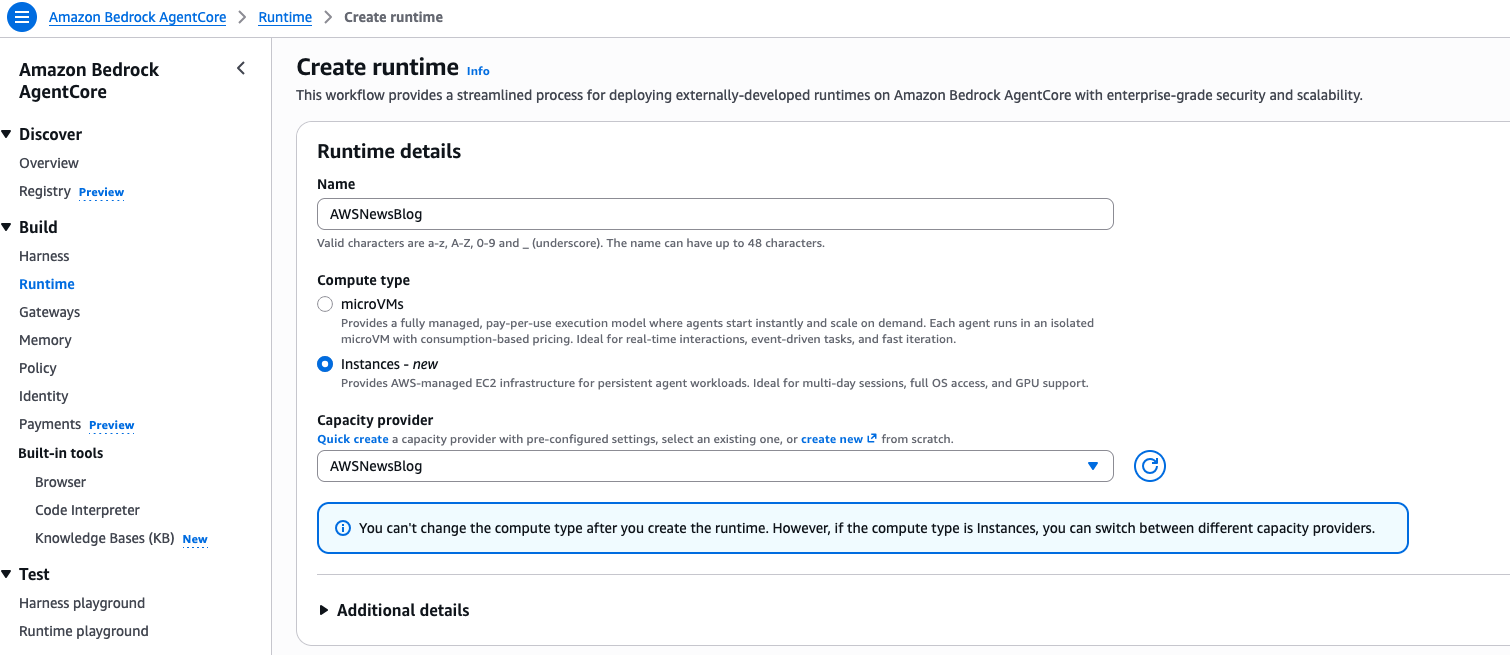
Once the capacity provider is active, developers create separate runtimes for each specialized agent. Agents are packaged minimally as zip files or container images containing an @app.entrypoint decorator. Developers upload the deployment package to Amazon S3, specify the language runtime environment (such as Python 3.13), designate the entry point script, and assign execution permissions via default AWS Identity and Access Management (IAM) roles.
Step 3: Execution and Cross-Agent Session Management
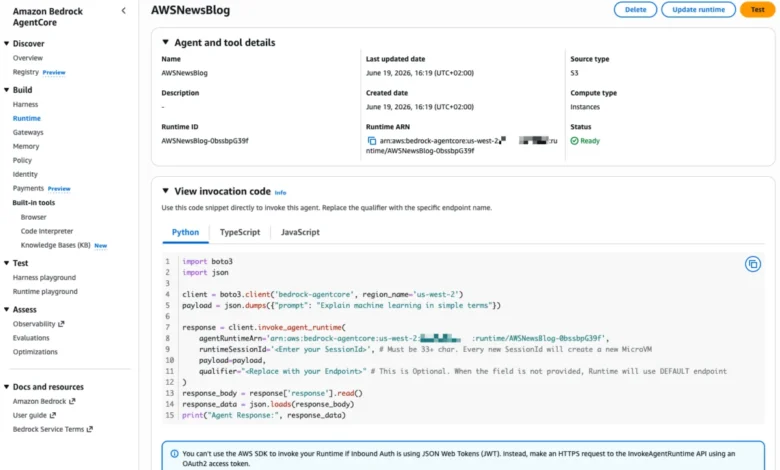
During execution, the AgentCore Runtime playground or programmatic API invokes the primary agent using a defined session identifier. The primary agent processes the task and writes artifacts to a secure session directory managed by the underlying storage layer. When a secondary agent is invoked within that exact same session identifier, it automatically inherits access to the shared storage directory, allowing seamless handoffs and multi-stage autonomous workflows.
Industry Implications and Strategic Analysis
Market analysts note that the release of Bedrock AgentCore runtime instances signals a maturation phase in the enterprise generative AI sector. As organizations move past simple proof-of-concept deployments, the demand for deterministic, stateful, and secure multi-agent systems has intensified. By abstracting the heavy lifting of EC2 fleet management, storage provisioning, and cross-agent synchronization, AWS is lowering the barrier to entry for complex enterprise automation.
Furthermore, the complementary design philosophy—combining lightweight, fast-scaling microVMs for orchestration with robust, GPU-enabled runtime instances for heavy execution—provides a scalable blueprint for modern cloud architectures. Orchestrators can dynamically route tasks based on computational weight, optimizing both latency and cost.
Outlook and Availability
The new runtime instances are available immediately within Amazon Bedrock AgentCore Runtime. Engineering organizations seeking to transition their autonomous agent fleets from ephemeral testing environments to production-grade, long-running architectures can access comprehensive deployment guides and configuration tutorials directly through the official Amazon Bedrock documentation portal. As enterprises continue to experiment with autonomous multi-agent systems, managed infrastructure solutions of this caliber are expected to become foundational pillars of modern cloud-native artificial intelligence deployment strategies.