IFixit Teardown of the Touchscreen PROLED MacBook Pro Reveals Advanced OLED Integration, Repairability Hurdles, and Weight-Shedding Engineering

The landscape of professional computing
underwent a significant shift in late 2026 with the introduction of Apple’s long-anticipated touch-enabled OLED notebook lineup. Known officially as the PROLED MacBook Pro rather than the heavily speculated "MacBook Ultra," this new generation of high-end portables combines cutting-edge display technology with classic pro-tier performance. Following the device’s late-October debut, the hardware analysts at iFixit have completed a comprehensive teardown of the new machine. Their detailed inspection offers a rare, microscopic look at how Apple successfully integrated multi-touch capabilities into a high-end desktop replacement, engineered a modern glowing rear logo without traditional display backlights, and achieved substantial weight reductions across the entire chassis.
The teardown reveals a complex mix of innovative engineering triumphs and traditional repairability obstacles. While the device introduces clever modular improvements and maintains a surprisingly modular software pairing environment for logic board swaps, it also underscores the enduring challenges of modern laptop miniaturization. As consumers and enterprise buyers weigh the costs and benefits of upgrading to Apple’s latest hardware, the iFixit teardown provides crucial data regarding the device’s internal architecture, component modularity, and long-term serviceability.
Chronology and Context: The Road to the PROLED MacBook Pro
The journey toward a touch-enabled, OLED-equipped MacBook Pro spanned several years of intense industry speculation, patent filings, and supply chain rumors. For decades, Apple famously resisted bringing touchscreens to its macOS ecosystem, arguing that vertical touch interfaces were ergonomically flawed and that the iPad lineup was better suited for touch-driven workflows. However, technological breakthroughs in tandem with advanced panel manufacturing finally shifted the company’s calculus.
In October 2026, speculation surrounding a potential "MacBook Ultra" branding nomenclature was definitively put to rest when Apple distributed media invitations for an exclusive hardware showcase in Los Angeles. Featuring the tagline "Pro and tell," the event set the stage for the official unveiling on October 28, 2026. Apple announced the new high-end MacBook Pro in both 14-inch and 16-inch form factors, highlighting its state-of-the-art PROLED XDR display—featuring integrated touch capabilities—alongside a modernized, glowing rear Apple logo. Pricing for the flagship notebooks was established at a starting point of $2,899 for the 14-inch variant and $3,399 for the 16-inch configuration.
Just days prior to this flagship announcement, Apple had also refreshed its standard consumer-tier lineup with a traditional 14-inch MacBook Pro powered by the standard M6 chip. This created a clear segmentation in the market: standard M6 models catering to traditional performance seekers, and the PROLED tier targeting creative professionals, digital artists, and power users demanding the ultimate visual fidelity and touch interaction. By early November 2026, the first wave of retail units reached consumers, prompting iFixit to acquire the hardware and initiate their rigorous teardown protocol.
Inside the Display and the Return of the Glowing Logo
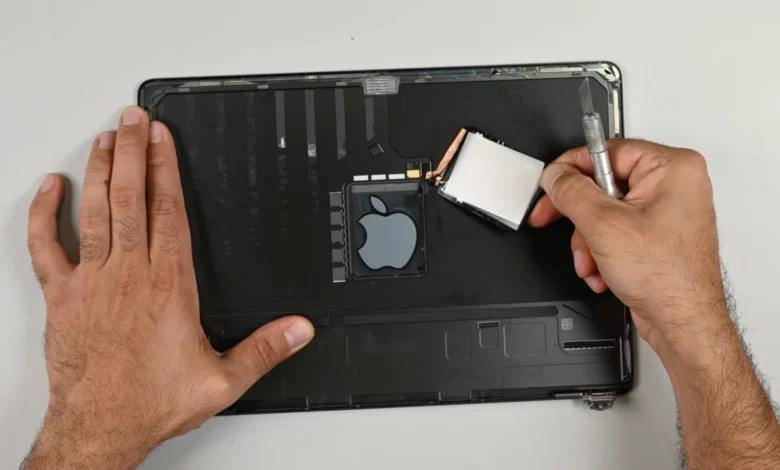
One of the most visually striking exterior features of the PROLED MacBook Pro is the return of the iconic glowing Apple logo on the rear of the display enclosure, a design element that had been absent from modern MacBook lines for years in favor of a polished, flush stainless steel emblem.
Because modern OLED panels emit their own light at the pixel level and do not utilize a traditional liquid crystal display backlight, Apple engineers had to devise an alternative methodology to illuminate the exterior logo. The iFixit teardown revealed that Apple accomplished this using a sophisticated assembly comprising four discrete LEDs, a specialized reflective layer, and an internal optical diffuser. This system distributes light evenly across the logo cavity. Furthermore, when the computer is powered down or the backlight LEDs are inactive, a dual-purpose two-way mirror coating imparts a sleek, highly reflective finish to the logo.
Accessing this luminous assembly for maintenance or repair, however, presents a formidable hurdle for technicians. Because the logo infrastructure is positioned deep behind the delicate display layers, any catastrophic failure of the logo requires the complete removal and replacement of the entire screen assembly. During their evaluation, iFixit technicians inadvertently destroyed the OLED panel itself when the protective glass cover separated from the underlying semiconductor layers during disassembly, underscoring the extreme fragility inherent in modern ultra-thin display engineering.
Engineering for Touch: Hinge Dynamics and Weight Reduction
Integrating a touch-sensitive interface into a high-performance laptop requires careful mechanical balancing. Users interacting with a vertical screen naturally apply physical force that can cause unwanted display wobble. Apple asserted during the product launch that the PROLED MacBook Pro was equipped with a completely redesigned hinge explicitly engineered to accommodate touch gestures.
However, iFixit’s physical inspection offered a more nuanced assessment. According to the teardown analysis, the fundamental architecture of the hinge is nearly identical to the hardware found in the standard 14-inch M6 MacBook Pro. The primary distinction lies in tension calibration: the PROLED hinge utilizes significantly stiffer mechanical resistance. This increased rigidity effectively stabilizes the display panel, preventing excessive bouncing or shifting when users tap or swipe at the top edge of the screen.
Despite the addition of multi-touch sensor layers and the optical components required for the glowing logo, Apple achieved remarkable weight reductions throughout the device. Through precise computer numerical control (CNC) machining, engineers carved out microscopic pockets of aluminum from the lower chassis. Consequently, the lower case of the PROLED model weighs a remarkably light 364 grams, compared to 456 grams for the equivalent M6 MacBook Pro chassis.
Surprisingly, the display assembly itself is 101 grams lighter than its predecessor generation, aided by advances in panel substrate thinning. Even the internal lithium-ion battery was marginally optimized, shedding two grams. These holistic weight-saving measures ensure that the inclusion of advanced display technologies does not compromise the portability expected of a modern professional laptop.
Modularity, Component Architecture, and Repairability
The internal layout of the PROLED MacBook Pro continues Apple’s ongoing evolution toward more modular internal components while maintaining certain hard architectural limits.
Crucial input/output components, including the primary Thunderbolt/USB-C ports and the internal cooling fans, remain modular and physically replaceable. However, accessing them requires the complete removal of the primary logic board, adding steps to the repair workflow. Other critical high-speed connectivity interfaces—most notably the dedicated HDMI port and the physical SDXC card reader—are permanently soldered directly onto the logic board substrate, preventing simple modular swaps if damaged. Similarly, the system memory (RAM) and solid-state storage (SSD) remain unified and soldered to the silicon package, precluding post-purchase hardware upgrades.
In an encouraging development for independent repair technicians and sustainability advocates, iFixit successfully interchanged logic boards between two separate PROLED MacBook Pro hardware units. Following the physical swap, technicians utilized Apple’s proprietary Repair Assistant software. The diagnostic utility successfully verified and calibrated all swapped hardware components, restoring full functionality to complex subsystems including the integrated multi-touch digitizer layer and the Touch ID biometric authentication sensor. Notably, the introduction of touchscreen functionality did not introduce onerous new component-pairing roadblocks or software locks that would completely cripple unverified third-party hardware swaps.
Scoring and Industry Implications
At the conclusion of their evaluation, iFixit awarded the PROLED MacBook Pro a repairability score of 5 out of 10. This numerical rating represents a modest one-point improvement over the M5 MacBook Pro generation and sits precisely one point below the consumer-focused MacBook Neo.
This score reflects a balanced industry compromise. On one hand, Apple has made commendable strides in making certain structural elements accessible, improving battery removal procedures, and streamlining the software calibration process via Repair Assistant. On the other hand, soldered storage, integrated display-level fragility, and permanently affixed peripheral ports continue to drag down overall serviceability metrics.
The broader implications of the PROLED MacBook Pro’s internal architecture extend far beyond simple repair metrics. By demonstrating that multi-touch capabilities can be introduced to professional-grade macOS laptops without severely penalizing chassis weight or imposing draconian software locks, Apple has established a new benchmark for premium portable computing. As competitors analyze these engineering choices, the industry may see a broader convergence of tablet-class interactive convenience and laptop-class thermal and processing performance, permanently reshaping user expectations for high-end professional workstations.
Related posts: