The USS LST-325 remains the last operational witness to the D-Day landings as a fully functional museum ship

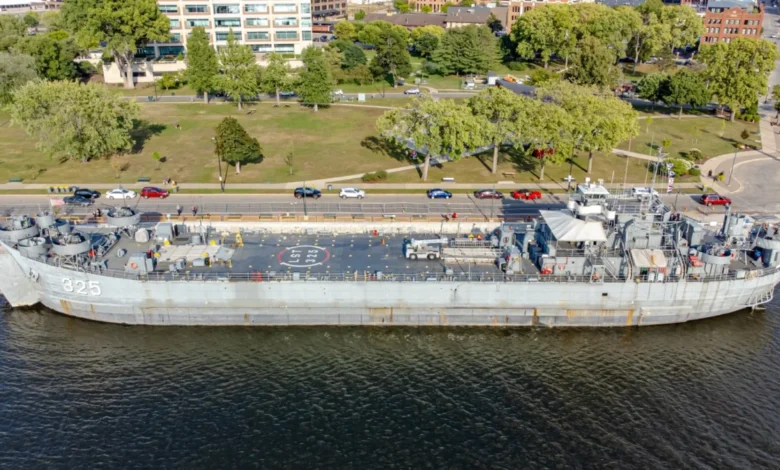
The history of the United States Navy during the Second World War is often characterized by the grandeur of aircraft carriers and the imposing silhouettes of battleships. However, the logistical backbone that enabled the Allied victory was built upon a fleet of specialized vessels designed for the singular, grueling task of beaching in hostile territory. Among these, the Landing Ship Tank (LST) was perhaps the most vital, yet least glamorous, asset in the naval arsenal. While thousands of these ships were constructed to support the global conflict, only one remains afloat and fully operational today: the USS LST-325.
The Engineering of the Large Slow Target
Commissioned on February 1, 1943, the USS LST-325 was a marvel of utilitarian engineering. Built by the Dravo Corporation in Pittsburgh, Pennsylvania, the vessel was specifically designed to transport tanks, heavy vehicles, and thousands of tons of supplies directly onto open beaches where port facilities were nonexistent or destroyed. The LST featured a unique design, including a massive bow door and a retractable ramp that allowed equipment to drive directly onto the sand.
Despite their vital contributions, the ships were affectionately and self-deprecatingly nicknamed "Large Slow Targets" by the crews who manned them. This moniker highlighted the inherent vulnerability of the vessel; with a top speed of approximately 11 knots and a flat-bottomed hull that made it susceptible to heavy seas, the LST was a sitting duck for enemy aircraft and coastal artillery. Despite these risks, the LST-325 completed 43 round trips across the English Channel, proving that the ship’s durability was as significant as its logistical capacity.
Chronology of a Wartime Survivor
The service record of the LST-325 is a testament to the intensity of the European Theater of Operations. Its most historic deployment occurred in June 1944. On June 7, one day after the initial Allied landings at Normandy, the LST-325 arrived at Omaha Beach. In a single operation, the ship successfully unloaded 59 vehicles and 400 personnel, reinforcing the Allied perimeter during a critical juncture of the invasion.
Following the cessation of hostilities in Europe, the vessel continued its service until July 2, 1946, when it was officially decommissioned. However, the ship’s life was far from over. In the post-war era, the United States government transferred the LST-325 to the Greek Navy under the Mutual Defense Assistance Program. Renamed the Syros (L-144), the vessel served the Greek military for several decades, receiving various modifications and modernizations that allowed it to remain seaworthy long after its American contemporaries had been scrapped or sunk as artificial reefs.
In the late 1990s, a group of dedicated veterans and maritime enthusiasts in the United States began the arduous process of repatriating the ship. In 2000, the vessel was officially returned to American soil, beginning a new chapter as a floating memorial to the men who served on the LSTs.
The Mechanics of a Mobile Museum
What distinguishes the USS LST-325 from virtually every other historic naval vessel in the United States is its mobility. While the U.S. Navy maintains an array of decommissioned battleships and aircraft carriers as museum ships, these vessels are permanently moored, effectively serving as static exhibits. In contrast, the LST-325 retains its original engines and navigational systems, allowing it to function as a "living" museum.
This mobility is not merely a technical curiosity; it is a vital component of the ship’s operational and financial model. By maintaining the ability to sail, the organization behind the LST-325 can bring history directly to communities that would otherwise never have the opportunity to experience a World War II vessel.
For instance, a recent month-long cruise along the Tennessee River serves as a prime example of this mission. During this tour, the ship made stops in Hendersonville, Ashland City, and Clarksville. The initiative proved immensely successful, drawing over 44,000 visitors who were able to tour the decks, explore the tank hold, and interact with the volunteer crew. This level of engagement provides a visceral connection to history that static displays cannot replicate.
Economic and Educational Implications
The logistical challenge of maintaining a vessel that is over 80 years old cannot be overstated. According to Ken Rupp, the ship’s cruise director, the LST-325 remains docked in Evansville, Indiana, for 11 months of the year, serving as a permanent fixture of the city’s riverfront. However, the annual one-month excursion is essential to the ship’s continued survival.
The revenue generated from these mobile tours is critical for the ship’s maintenance, which includes dry-docking, hull integrity checks, and engine repairs. As the ship ages, the cost of parts and specialized labor continues to rise. The fact that the ship remains operational is a tribute to the commitment of its volunteer crew, many of whom are retired mariners or veterans themselves. They perform the necessary maintenance to keep the vessel compliant with modern maritime safety regulations, ensuring that it remains one of the few places on earth where one can experience the authentic mechanical environment of a 1940s-era landing ship.
A Legacy of Strategic Necessity
The broader impact of the LST-325’s existence lies in its ability to educate the public on the reality of industrial warfare. World War II was won not only on the battlefield but also in the factories and through the massive logistical movements that enabled sustained combat operations. The LST-325 represents the unsung heroes of the naval war—the sailors who navigated treacherous waters to deliver the tools of victory to the front lines.
Historians often emphasize that the success of the Normandy invasion was contingent upon the rapid buildup of supplies following the initial landings. The LSTs were the literal bridge between the supply ships in the English Channel and the soldiers on the beaches. By keeping the LST-325 in sailing condition, the foundation ensures that the story of these supply lines remains part of the public discourse.
Challenges and Future Prospects
As the generation that fought in the Second World War passes, the role of museum ships like the LST-325 shifts from a place for veterans to reflect to a place for future generations to learn. The ship is more than just a collection of steel and machinery; it is an artifact of a bygone era of global cooperation and industrial might.
The maintenance of the vessel is an ongoing battle against corrosion and obsolescence. The organization faces the constant task of sourcing spare parts for machinery that has been out of production for decades. Despite these hurdles, the success of their outreach tours demonstrates a strong public interest in the preservation of maritime heritage.
The USS LST-325 stands as a final, floating representative of the thousands of vessels that defined the victory of the Allied forces. By maintaining its mobility, the museum does more than just preserve a ship; it preserves the ability to tell the story of the Second World War in a dynamic, tangible, and profoundly impactful way. Whether docked in the Ohio River or navigating the inland waterways of the United States, the ship continues its mission, serving as a reminder of the fragility of peace and the immense sacrifice required to restore it. Through the dedicated efforts of its crew and the support of the public, the "Large Slow Target" has defied the odds, proving itself to be anything but obsolete.
Related posts: