When the Heavens Shifted: How Tycho’s Star Shattered Renaissance Dogma and Redefined Modern Astronomy

On November 6, 1572, German astronomer Wolfgang Schuler looked up at the night sky and witnessed a celestial event that would permanently alter humanity’s understanding of the universe. Positioned within the constellation Cassiopeia, a brilliant, unfamiliar point of light had suddenly materialized. Rivaling the planet Venus in sheer luminosity, the mysterious object was so intensely bright that it could be seen clearly with the naked eye even in broad daylight.
To the astronomers of the 16th century, the appearance of this stellar intruder was nothing short of deeply unsettling. At the time, European science and philosophy were still largely tethered to ancient Aristotelian dogma, which dictated that the celestial sphere was perfect, eternal, and entirely immutable. The stars above were believed to be fixed, unchanging, and divine. Yet, here was an undeniable anomaly—a massive, blazing star that seemed to have materialized out of nowhere, challenging the foundational certainty of an unvarying cosmos.
Although Schuler holds the historical distinction of being the first to record the sighting, the event became globally synonymous with the celebrated Danish astronomer Tycho Brahe. Brahe conducted exhaustive, meticulous studies of the object, tracking its gradual shifts in brightness and color over many months. He subsequently compiled his observations into a comprehensive and influential book titled De Stella Nova (Latin for "On the New Star"). Because of his rigorous documentation, the stellar explosion became universally known to history as "Tycho’s Star."
Chronology of a Cosmic Cataclysm
Understanding the timeline of Tycho’s Star requires bridging the gap between historical human observation and deep-space physics. Though the light of the explosion reached Earth in the late autumn of 1572, the actual cataclysm occurred approximately 13,000 years prior. Because light travels at a finite speed across the vast expanses of space, the photons carrying the visual evidence of the stellar death journeyed through the vacuum for millennia before finally intersecting with Earth’s line of sight.
The chronological progression of the event as experienced by 16th-century observers unfolded over an extended period:
- Early November 1572: Independent observers across Europe and Asia, including Wolfgang Schuler and Tycho Brahe, notice an abnormally bright new star in the constellation Cassiopeia.
- Mid-November 1572: The object reaches peak brightness, matching or exceeding the brilliance of Venus. It remains visible to the naked eye during daytime hours for roughly two weeks.
- Late 1572 to March 1574: The supernova slowly and steadily dims over a 16-month period, eventually fading entirely from naked-eye visibility as its expanding debris field diffuses into the interstellar medium.
- 1940s: Modern astrophysics finally classifies the historical anomaly as a supernova, moving past centuries of categorization as a mere "new star" or atmospheric phenomenon.
- 2004: Advanced computational analysis of Brahe’s historical records by modern astronomers, led by researchers at the University of California, Berkeley, successfully identifies the precise "light signature" of the explosion as a Type Ia supernova.
Scientific Analysis: Unveiling the Nature of SN 1572
For centuries following Brahe’s pioneering work, the true nature of Tycho’s Star remained an enigma. The term "supernova" did not exist in the 16th century, and early scientists could only speculate about whether the phenomenon occurred within Earth’s atmosphere or deep within the distant stellar realms.
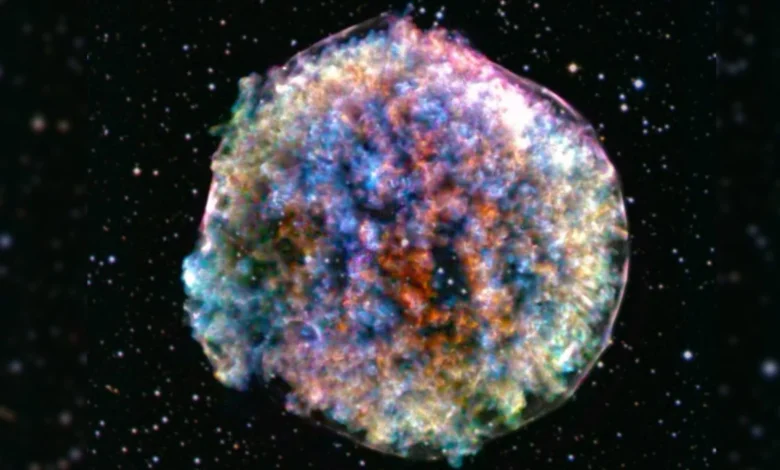
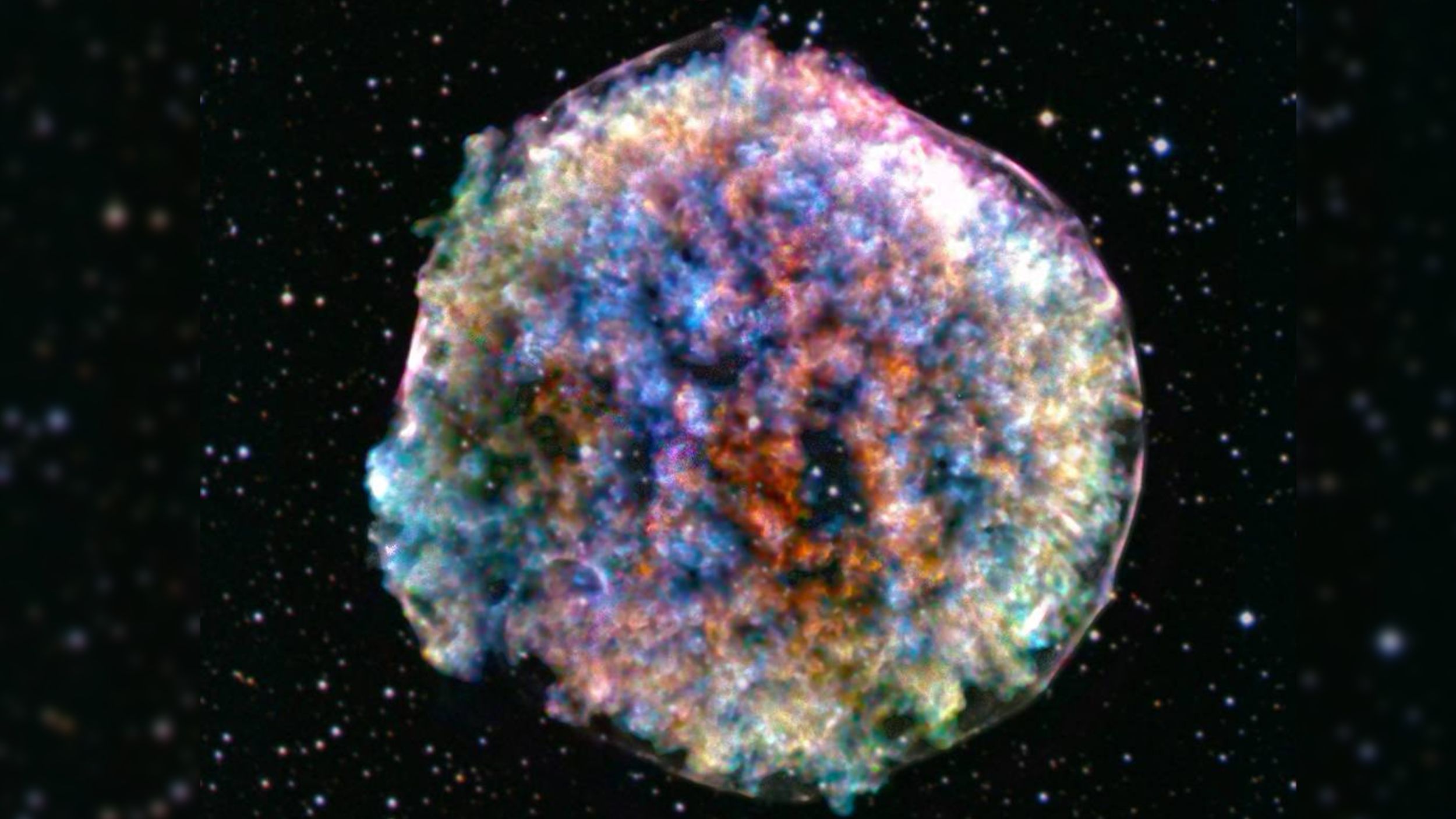
It was not until the mid-20th century that astronomers formally categorized SN 1572 as a supernova—a titanic explosion marking the death of a star. Decades later, advanced space-based observatories, including NASA’s Chandra X-ray Observatory, began imaging the expanding shell of debris left in the wake of the blast, known technically as the Tycho supernova remnant.
Modern astrophysical analysis has revealed that SN 1572 was a specific category of stellar explosion known as a Type Ia supernova. These energetic events occur exclusively within binary star systems—systems where two stars orbit a common center of gravity. In the case of Tycho’s Star, the system consisted of a companion star and a white dwarf, which is the dense, carbon-oxygen core left behind after a medium-sized star exhausts its nuclear fuel.
Over millions of years, the white dwarf gravitationally pulled matter away from its companion star, accumulating mass. Once the white dwarf’s mass crossed a critical threshold known as the Chandrasekhar limit (roughly 1.4 times the mass of our sun), runaway thermonuclear fusion ignited within its core. The resulting blast utterly obliterated the white dwarf, hurling stellar material outward at thousands of kilometers per second and releasing an incomprehensible amount of energy.
Broader Impact and Historical Implications
The arrival of Tycho’s Star carried profound philosophical and scientific implications that helped pull Europe out of the intellectual stagnation often associated with the late medieval period.
Prior to 1572, the prevailing Aristotelian-Ptolemaic worldview maintained a strict dichotomy between the terrestrial realm—characterized by change, decay, and corruption—and the celestial realm, which was presumed to be divinely perfect and permanently unchanging. Comets, meteors, and atmospheric weather phenomena were thought to occur exclusively below the moon in the Earth’s atmosphere, while the stars themselves were untouchable and immutable.
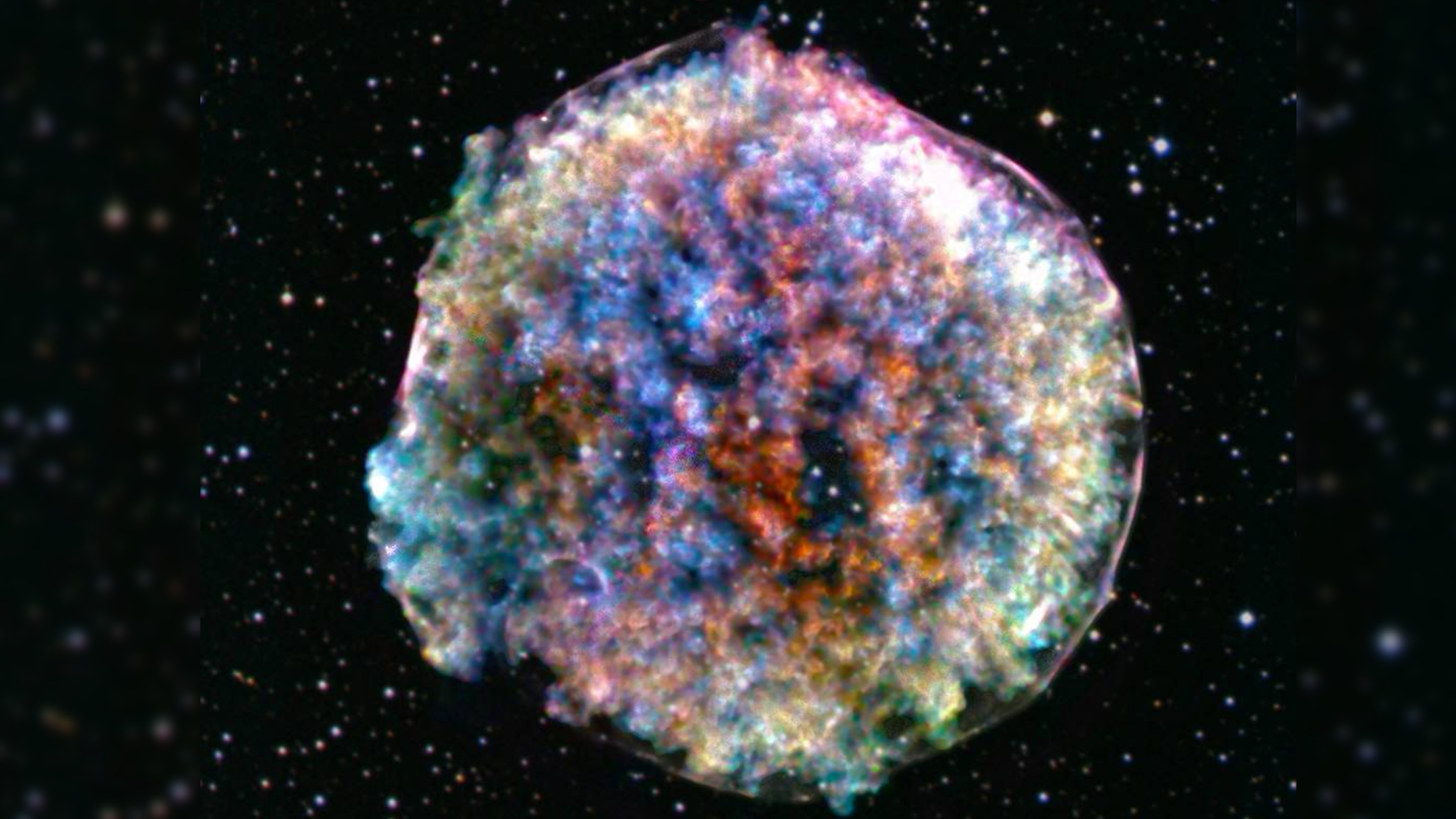
When Tycho Brahe demonstrated that the new star in Cassiopeia exhibited no discernible parallax—meaning it did not shift position relative to other stars when viewed from different points on Earth’s orbit—he proved mathematically that the object lay far beyond the moon, deep in the distant realm of the fixed stars.
Reflecting on the monumental shift in perspective, astronomer Alex Filippenko of the University of California, Berkeley, noted during a 2004 retrospective study on the event that these observations provided definitive, empirical evidence that the heavens were not immutable. The discovery dismantled centuries of dogma, clearing the intellectual path for the impending Scientific Revolution championed by figures like Johannes Kepler and Galileo Galilei, who would soon use improved telescopes to further dismantle the geocentric universe.
Modern Parallels: Anticipating the Next Great Eruption
Nearly 450 years after Tycho Brahe documented SN 1572, contemporary astronomers continue to monitor the cosmos for similar transient events that might offer a window into stellar mechanics. Interest has increasingly focused on a recurring nova system known as T Corona Borealis, frequently referred to as the "Blaze Star."
Located roughly 3,000 light-years from Earth in the constellation Corona Borealis, T Corona Borealis is a binary system comprising a white dwarf and a red giant star. Unlike Type Ia supernovas, which completely destroy the white dwarf in a single cataclysmic detonation, recurrent novas experience smaller thermonuclear surface explosions that repeatedly blast accumulated material into space without destroying the underlying star.
T Corona Borealis is one of only a small handful of known recurring novae with outburst cycles spanning approximately 80 years. Having previously exhibited notable explosions in 1866 and 1946, the system has shown precursors indicating that it may be on the verge of another eruption. Modern astronomers utilize a global network of ground-based telescopes and space observatories to track its subtle photometric fluctuations, hoping to capture high-resolution data that will deepen human understanding of stellar life cycles.
From the naked-eye observations of Wolfgang Schuler and Tycho Brahe in the 16th century to modern X-ray imaging by space telescopes, humanity’s study of stellar explosions has evolved from philosophical debate into precise quantitative science. Events like SN 1572 remind observers that the night sky is not a static painting, but a dynamic, evolving tapestry governed by physical laws waiting to be uncovered.
Related posts: