On November 18, 2026, NASA’s Voyager 1 spacecraft achieved a monumental milestone in the history of human space exploration, crossing the one-light-day threshold. Located approximately 16.1 billion miles (25.9 billion kilometers) from the Sun, the probe has traveled further from Earth than any human-made object in history. This achievement marks 49 years since the spacecraft’s launch, underscoring the enduring legacy of a mission originally designed for a four-year tour of the gas giants.
The Grand Tour: A Rare Alignment
The mission began in 1977, a year chosen for a rare celestial geometry. The four outer planets—Jupiter, Saturn, Uranus, and Neptune—aligned in a configuration that occurs only once every 175 years. This alignment allowed NASA engineers to execute the “Grand Tour” by utilizing gravity-assist maneuvers. By swinging around each planet, the spacecraft gained kinetic energy from the planet’s orbital motion, essentially “slingshotting” them deeper into the solar system without the need for excessive onboard propellant.
Voyager 2 visited all four giants, while Voyager 1 focused on Jupiter and Saturn before its trajectory carried it out of the ecliptic plane. This series of maneuvers provided the first high-resolution images of these worlds, revealing active volcanism on Jupiter’s moon Io and the complex, braided structure of Saturn’s rings.
Chronology of a Deep Space Odyssey
The journey of the Voyager probes is characterized by a series of critical operational phases:
- 1977: Voyager 2 launches on August 20, followed by Voyager 1 on September 5.
- 1979: Voyager 1 encounters Jupiter, capturing images of the Great Red Spot and discovering active volcanoes on Io.
- 1980: Voyager 1 completes its Saturn flyby, gaining critical insights into the planet’s moon, Titan.
- 1989: Voyager 2 completes the final leg of the Grand Tour with a successful flyby of Neptune.
- 1990: Voyager 1 captures the “Family Portrait” of the solar system, including the iconic “Pale Blue Dot” image.
- 2012: Voyager 1 crosses the heliopause, becoming the first human-made object to enter interstellar space.
- 2018: Voyager 2 crosses the heliopause.
- 2026: Voyager 1 reaches the one-light-day distance from the Sun.
The Golden Record: A Message to the Cosmos
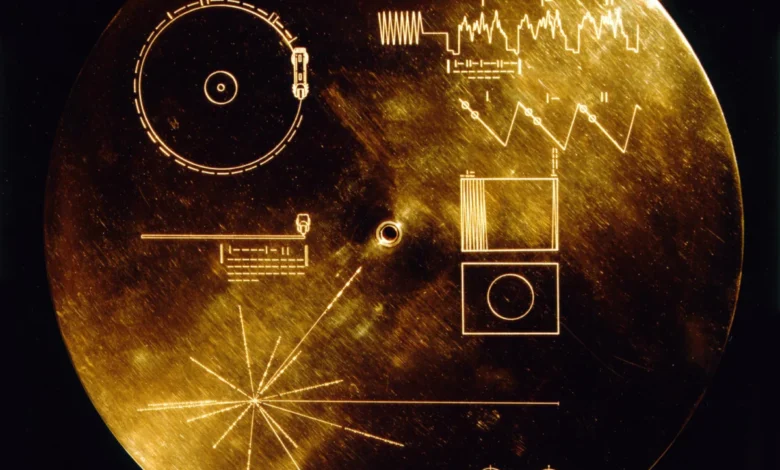
Central to the mission’s philosophy is the Golden Record, a 12-inch gold-plated copper phonograph disk designed to serve as a time capsule for potential extraterrestrial civilizations. The record is a curated selection of humanity’s existence, containing 116 images, a variety of natural and human-made sounds, and greetings in 55 languages.
The physical construction of the record is a feat of material science. To ensure the message survives the harsh environment of interstellar space, the record is protected by an aluminum cover electroplated with uranium-238. With a half-life of 4.468 billion years, the uranium serves as a radioactive clock, allowing any potential discoverers to calculate how long the probe has been traveling. The cover also features a pulsar map, providing the location of the Sun relative to 14 known pulsars, effectively creating a map of our home in the galaxy.
Understanding Distance: Light-Days and Interstellar Space
The concept of a "light-day" is often confused with time, but in astronomical terms, it is a unit of distance—specifically the distance light travels in a vacuum over 24 hours, which is approximately 16.1 billion miles.
Reaching this distance highlights the sheer scale of the heliosphere, the vast bubble created by the solar wind. Voyager 1 exited this bubble in 2012 when it crossed the heliopause, the boundary where the pressure of solar wind is overwhelmed by the interstellar medium. Since then, the spacecraft has been traveling through the cold, sparse environment of interstellar space.
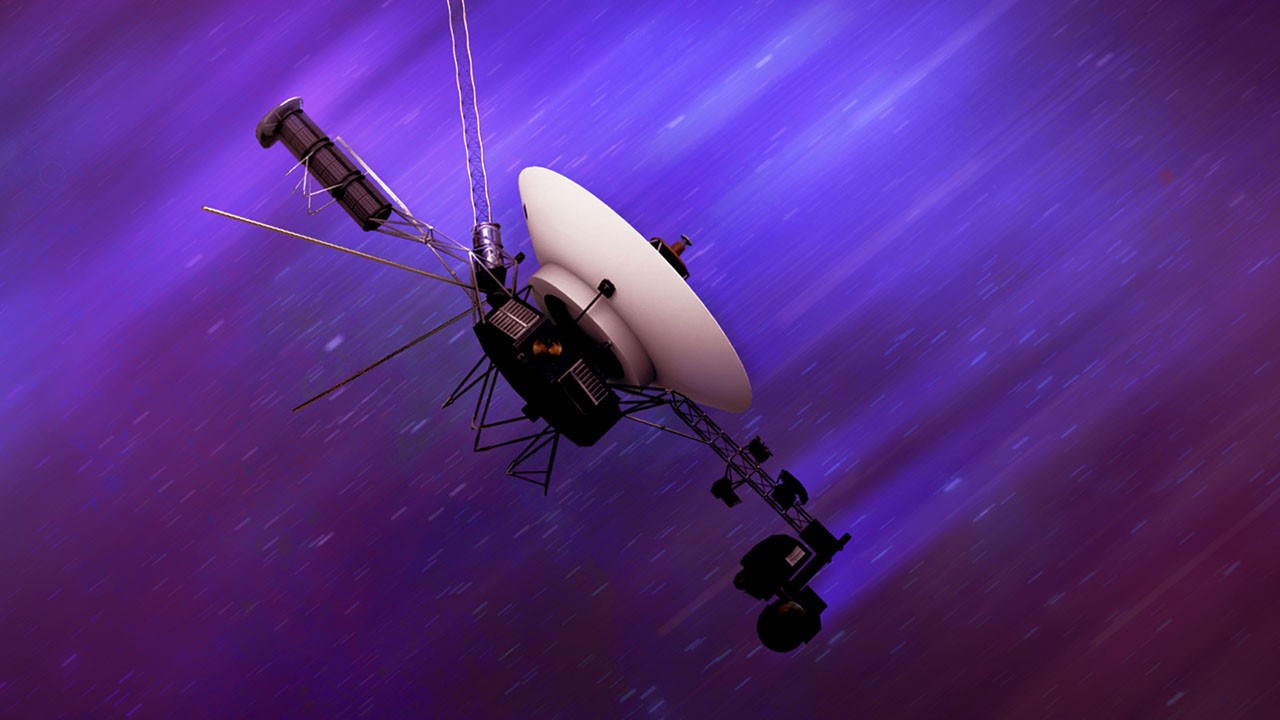
Communication remains a primary challenge. Signals from Voyager 1, traveling at the speed of light, take over 24 hours to reach Earth. NASA’s Deep Space Network (DSN)—a global array of giant radio antennas located in California, Spain, and Australia—is the only system capable of maintaining contact. Despite the immense distance, the DSN continues to receive faint telemetric data from the probe’s aging instruments.
Technical Resilience and Operational Challenges
Operating a spacecraft launched in the 1970s requires extraordinary ingenuity. Voyager 1’s systems, including its memory and power supply, are vastly inferior to modern consumer electronics. The spacecraft is powered by Radioisotope Thermoelectric Generators (RTGs), which convert the heat from the decay of plutonium-238 into electricity.
As the RTGs age, the power output continues to decline. NASA engineers have implemented aggressive power management strategies, including turning off non-essential instruments and heaters, to ensure the most critical sensors remain operational for as long as possible. The longevity of the mission is widely considered one of the greatest engineering achievements in the history of the aerospace industry.
Broader Implications for Science and Society
The mission of Voyager 1 has fundamentally shifted the scientific understanding of the solar system’s outer reaches. Data returned from the interstellar medium has provided researchers with the first direct measurements of the density and composition of the space between stars.
Beyond the scientific data, the Voyagers represent a unique cultural marker. They serve as a testament to the period in the 20th century when space exploration was defined by a spirit of discovery and international cooperation. The “Pale Blue Dot” photograph, in particular, has become a philosophical symbol of Earth’s fragility, often cited by scientists and environmentalists alike to illustrate the necessity of protecting the only home humanity has ever known.
Official Perspective and Future Outlook
While NASA has not set a specific date for the termination of the mission, officials acknowledge that the spacecraft will eventually go silent. The primary goal for the current operations team is to extend the life of the probes until the power levels fall below the threshold required to maintain data transmission.
In a statement regarding the ongoing mission, NASA representatives noted that every day of operation is a bonus. The data currently being transmitted—despite its slow arrival and low signal-to-noise ratio—remains the only ground-truth information humanity possesses about the interstellar environment.
As Voyager 1 continues its journey into the uncharted territory of the Oort Cloud and beyond, it remains a solitary beacon of human innovation. The one-light-day milestone is not merely a number; it is a marker of how far human curiosity can reach when supported by rigorous science, meticulous engineering, and a commitment to understanding our place in the universe. Whether the record is ever discovered is unknown, but the mission has already succeeded in its primary objective: expanding the horizons of human knowledge to the very edge of our solar system and into the vast, silent reaches of the galaxy.
Related posts: