Astronomy Picture of the Day Exploring the Enigmatic Architecture of Dark Matter in Our Universe

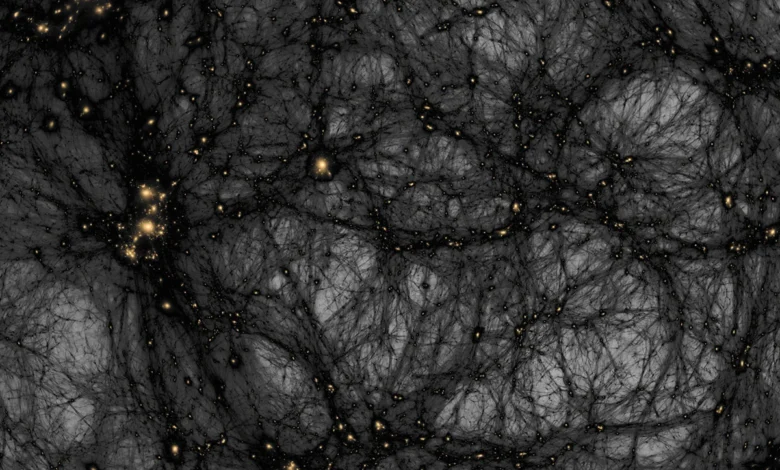
The quest to understand the structural composition of the cosmos has led astronomers to a profound realization: the visible universe, comprised of stars, planets, gas, and dust, accounts for only a small fraction of the total matter present. Through decades of observation and sophisticated computer modeling, scientists have identified a pervasive, invisible scaffolding known as dark matter. This substance, which does not emit, absorb, or reflect light, acts as the primary gravitational architect of the universe. High-resolution visualizations, such as those featured by the American Museum of Natural History’s Hayden Planetarium in their "Dark Universe" presentation, illustrate a cosmic web of dark matter filaments that dictate the distribution of all known baryonic matter.
The Invisible Framework: Evidence for Dark Matter
The existence of dark matter was first posited in the early 20th century to explain discrepancies between the observed mass of galaxy clusters and the gravitational effects witnessed within them. By the 1970s, pioneering work by astronomers such as Vera Rubin provided robust evidence that galaxies were rotating far too rapidly to be held together by the gravity of their visible stars alone. These "flat rotation curves" suggested that galaxies are embedded within massive, invisible halos of dark matter.
This gravitational influence extends beyond individual galaxies to the largest scales of the universe. Observations of gravitational lensing—where the light from distant background galaxies is bent and distorted by the gravity of massive foreground objects—consistently reveal that there is far more mass present than what is visible through electromagnetic radiation. Without the presence of this "dark" mass, galaxy clusters would lack the gravitational cohesion to form the structures we observe today. Current estimates based on data from the Planck satellite indicate that dark matter constitutes approximately 27% of the universe’s total energy-matter density, while baryonic matter accounts for less than 5%.
Chronology of Cosmic Understanding
The history of dark matter research is a progression of increasing scale and sensitivity. In the 1930s, Fritz Zwicky applied the virial theorem to the Coma Cluster, noting that the observed galaxies were moving so fast they should have flown apart unless there was significant "dunkle Materie" (dark matter) providing additional gravitational pull. For several decades, this remained a fringe hypothesis.
By the 1980s, the scientific community shifted its focus toward the Cold Dark Matter (CDM) model. This theory posits that dark matter consists of slow-moving, non-baryonic particles that interact only through gravity and the weak nuclear force. Throughout the 1990s and 2000s, large-scale sky surveys like the Sloan Digital Sky Survey (SDSS) mapped the three-dimensional distribution of galaxies, confirming that they align with the filaments predicted by CDM simulations.
The 2010s marked the era of high-fidelity simulations, such as the Illustris and Bolshoi projects. These simulations utilize supercomputers to model the evolution of the universe from the Big Bang to the present day. By incorporating dark matter particles into these environments, researchers have successfully replicated the "cosmic web"—a vast, porous network where dense filaments of dark matter intersect at nodes, effectively acting as gravitational cradles for galaxy formation.
Technical Analysis: The Simulation of a Web
The image featured in recent astronomical communications serves as a critical data visualization tool. In these simulations, the "dark" filaments are not merely empty space; they represent the density distribution of dark matter. Baryonic matter, which is subject to electromagnetic forces, gathers in the high-density regions of these dark matter filaments. Over billions of years, this gas cools and collapses, leading to the ignition of stars and the birth of galaxies.
The contrast in these simulations—where dark matter is often rendered in muted tones and baryonic matter is highlighted in bright oranges—serves a specific pedagogical purpose. It highlights that the "visible" universe is essentially the "decoration" on a much larger, invisible structure. The spider-web-like distribution is not random; it is the inevitable result of gravitational instability, where initial quantum fluctuations in the early universe were amplified over cosmic time.

The Rise of Dark Energy: A New Gravitational Challenge
While dark matter acts as an attractive force that pulls the universe together, a more perplexing phenomenon has emerged in recent years: dark energy. Identified in the late 1990s through the study of Type Ia supernovae, dark energy is the force responsible for the accelerated expansion of the universe. Unlike dark matter, which acts as a gravitational "glue," dark energy acts as a repulsive force, pushing galaxies away from one another.
Scientific consensus currently holds that dark energy makes up approximately 68% of the universe. The interplay between these two forces is the defining characteristic of our modern cosmological model, often referred to as the Lambda-CDM model. If dark matter is the builder of the cosmic web, dark energy is the force that eventually tears the web apart by increasing the distance between its filaments. This revelation has shifted the focus of modern astrophysics from merely identifying what is "out there" to understanding the fundamental nature of the vacuum itself.
Institutional Responses and Scientific Implications
Leading research institutions, including the National Aeronautics and Space Administration (NASA), the European Space Agency (ESA), and the American Museum of Natural History, emphasize that the study of dark matter is essential to understanding our origins. The "Dark Universe" project at the Hayden Planetarium, for instance, serves as a bridge between complex supercomputer data and the public’s understanding of the cosmos.
Dr. Neil deGrasse Tyson and other prominent astrophysicists involved in such outreach programs have noted that the "haunting" nature of dark matter is a testament to the limitations of human perception. Because our senses and technology are primarily tuned to detect electromagnetic radiation, we are effectively blind to the majority of the universe’s substance. This necessitates the use of indirect detection methods, such as deep-underground particle detectors (like LUX-ZEPLIN) and space-based observatories (like the James Webb Space Telescope), to search for the elusive particles that might comprise dark matter.
The Broader Impact on Cosmology
The implications of these findings are foundational. If the universe were composed entirely of the matter we can see, it would behave in a radically different manner. The existence of dark matter and dark energy suggests that our current understanding of physics—specifically the Standard Model of particle physics and Einstein’s General Relativity—is incomplete. The search for a "Theory of Everything" that can reconcile gravity with quantum mechanics often centers on these two dark entities.
From a structural perspective, the cosmic web provides a roadmap for the evolution of the universe. By mapping the density of dark matter, scientists can predict where new galaxies will form and how existing clusters will merge. This predictive power has turned astronomy into a high-precision science, where the distribution of matter acts as a time-capsule, preserving the conditions of the early universe.
Furthermore, the challenge of dark matter has spurred advancements in computational science. The ability to simulate billions of years of cosmic evolution requires the development of algorithms that can handle petabytes of data, providing spin-off benefits for fields ranging from climate modeling to medical imaging.
Conclusion
The "haunting" architecture of our universe, as displayed in modern dark matter maps, is a reminder of the vast, unseen mechanisms that govern our reality. While we have yet to directly detect a dark matter particle, the evidence for its existence is woven into the very structure of the galaxies that populate the night sky. As technology advances, the transition from theoretical modeling to empirical detection remains the ultimate goal of 21st-century cosmology. Whether through the lens of a space telescope or the output of a supercomputer, the study of dark matter continues to refine our place in a universe that is far more expansive, mysterious, and interconnected than the light of the stars alone would suggest. As we look toward future missions and deeper observational surveys, the focus remains on untangling the complex, web-like geometry that sustains the universe, ensuring that the legacy of astronomical discovery continues to push the boundaries of human knowledge.
Related posts: