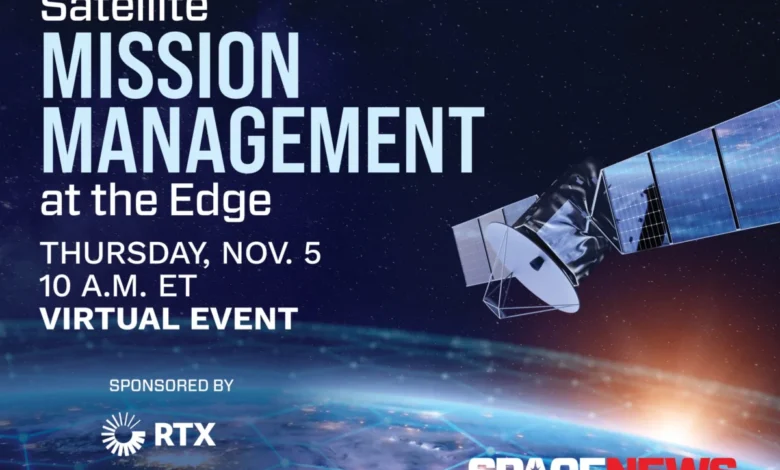
As modern orbital architectures grow increasingly complex and contested, the demands placed on national security space operators have never been higher. To maintain a strategic advantage in an era marked by fast-evolving orbital threats and rapid technological shifts, defense and intelligence agencies are pivoting away from rigid, legacy ground control systems. Instead, the focus has shifted toward advanced mission management frameworks that prioritize real-time autonomy, cloud-native scalability, and edge computing.
Addressing this critical paradigm shift, SpaceNews is partnering with aerospace and defense giant RTX to host an exclusive virtual event titled "Satellite Mission Management at the Edge." Scheduled for Thursday, November 5, from 10:00 a.m. to 10:45 a.m. Eastern Time, the online forum will convene industry experts, defense leaders, and technology innovators to examine how emerging commercial capabilities are fundamentally redefining the mechanics of national security space operations.
The Evolution of Satellite Operations and the Imperative for Edge Computing
Historically, satellite mission operations relied heavily on centralized ground stations that processed massive streams of telemetry, tracking, and control (TT&C) data before sending commands back up to spacecraft. While effective for traditional constellations in geostationary or low-Earth orbits, this centralized model introduces latency and creates single points of failure. In dynamic operational environments where spacecraft must react autonomously to space weather, orbital debris, or active threats, waiting for a round-trip data transmission to a ground-based control center is no longer viable.
The upcoming SpaceNews and RTX virtual event will delve directly into this challenge, exploring how edge computing—processing data onboard the satellite rather than routing it back to Earth—empowers spacecraft to make split-second decisions. By decentralizing data processing, operators can drastically reduce bandwidth constraints, enhance spacecraft resilience, and ensure uninterrupted tactical awareness even if communication links with the ground are disrupted or jammed.
Furthermore, the discussion will highlight the integration of automation and artificial intelligence (AI) within mission management architectures. Modern constellations, particularly proliferated low-Earth orbit (pLEO) networks comprising hundreds or thousands of individual satellites, generate unprecedented volumes of data. Managing these constellations manually or through legacy software is economically and operationally unsustainable. Automation and machine learning algorithms enable operators to streamline constellation management, optimize resource scheduling, and predict maintenance needs before anomalies escalate into critical failures.

Navigating the Transition from Legacy Systems to Cloud-Native Architectures
One of the most persistent hurdles facing defense agencies and commercial operators alike is the challenge of modernizing legacy infrastructure without compromising mission assurance. Many national security space programs were built on proprietary, decades-old architectures that resist seamless integration with modern software solutions.
During the November 5 session, panel speakers are expected to address the complexities of bridging this gap. The conversation will examine modular approaches that allow agencies to incrementally upgrade their capabilities, incorporating commercial cloud-native architectures and software-defined networking without having to scrap existing investments entirely.
Modular design principles—ranging from standardized spacecraft buses to open-architecture ground software—play a vital role in accelerating technology insertion. By adopting open standards, military and commercial operators can foster a plug-and-play ecosystem where software applications can be rapidly developed, tested, and deployed to orbit. This agility not only strengthens overall mission resilience but also drives down costs through increased competition and commercial off-the-shelf (COTS) adoption.
Event Logistics and Participant Information
The virtual briefing is designed to be concise, highly focused, and accessible to defense officials, industry executives, aerospace engineers, and space policy analysts.
Event Details:

- Event Satellite Mission Management at the Edge
- Date: Thursday, November 5
- Time: 10:00 a.m. to 10:45 a.m. ET
- Format: Virtual seminar via Zoom
- Registration: Attendees can sign up through the SpaceNews platform. Upon registration, participants will receive a unique access link. A comprehensive recording of the event will be made publicly available on the SpaceNews website shortly after the broadcast concludes.
The partnership with RTX underscores the company’s prominent role in shaping the future of defense technology. Headquartered in Arlington, Virginia, RTX boasts a massive global workforce exceeding 180,000 employees and reported sales surpassing $88 billion in fiscal year 2025. As a global leader in aerospace and defense systems, RTX continues to invest heavily in advanced manufacturing, integrated defense solutions, and next-generation space technologies designed to help government and commercial customers navigate their most intricate operational challenges.
Broader Implications for National Security Space
The themes explored in this upcoming virtual discussion reflect a broader, irreversible trend across global defense sectors. Space is increasingly recognized by major military powers as a contested operational domain. Consequently, the Department of Defense and allied space agencies are accelerating initiatives to build disaggregated, resilient, and responsive space architectures.
The ability to manage missions at the edge represents a cornerstone of this resilience strategy. If a satellite can autonomously detect and evade a hostile maneuver, process its own imagery to identify high-value targets before downlinking, or dynamically reroute communications around a jammed channel, the entire constellation becomes exponentially harder to neutralize.
Furthermore, as budgetary pressures mount, the commercialization of space technologies offers a pathway to unprecedented affordability. By leveraging commercial cloud infrastructure, software development practices, and mass-produced commercial hardware, defense agencies can acquire capabilities faster and at a fraction of the cost historically associated with custom military space programs.
The SpaceNews and RTX event on November 5 provides a timely and essential forum for stakeholders looking to understand the technical, strategic, and economic dimensions of this ongoing transformation. As the industry moves closer to fully autonomous, edge-enabled satellite operations, insights shared during this briefing will help chart the course for the next generation of national security space architecture.