AWS Announces Enhanced Custom Event Bus in Amazon EventBridge to Simplify Multi-Account Serverless Architectures

As organizations increasingly embrace serverless computing, architectural complexity has often shifted away from infrastructure management and toward inter-service communication and event routing. For years, development teams building event-driven applications on Amazon EventBridge have typically commenced their journeys with a single custom event bus housed within a solitary AWS account. While this minimalist approach is highly effective for smaller projects or isolated teams, it frequently encounters bottlenecks as cloud adoption scales across larger enterprise environments. To address these operational friction points, Amazon Web Services (AWS) has officially announced the launch of an enhanced custom event bus in Amazon EventBridge, a feature purpose-built to streamline event-driven architectures across multi-account organizational landscapes.
The rollout of this capability marks a significant evolution in how cloud architects design, govern, and scale serverless applications. By introducing centralized event sharing, native ordering guarantees, simplified subscriber management, and an updated economic model, AWS aims to eliminate the complex workarounds that developers have historically relied upon to bridge communication gaps between disparate corporate divisions.
Background Context and Structural Challenges of Legacy Multi-Account Event Buses
To understand the necessity of the enhanced custom event bus, one must examine the standard lifecycle of cloud maturity within modern enterprises. Industry best practices mandated by AWS have long recommended a multi-account structure, wherein distinct teams operate within their own isolated AWS accounts for security, billing, and operational autonomy.
However, when these isolated teams need to route events across account boundaries, the initial simplicity of Amazon EventBridge begins to fray. Historically, developers were forced to create multiple independent event buses connected through intricate cross-account rules or complex bus-to-bus configurations. This workaround inadvertently reintroduces the very operational complexity that serverless architectures are ostensibly designed to eliminate.
Furthermore, this fragmented design yields several distinct challenges. Platform engineering teams rapidly lose overarching visibility into operational lineage—making it arduous to track precisely which teams are subscribing to specific events. Concurrently, cross-account and bus-to-bus routing charges compound quickly, driving up cloud expenditures unpredictably. Finally, teams requiring strict capabilities such as event sequencing were frequently compelled to construct cumbersome custom workarounds—such as inserting intermediary queueing services—or adopt entirely disparate messaging technologies altogether.
Core Innovations of the Enhanced Custom Event Bus

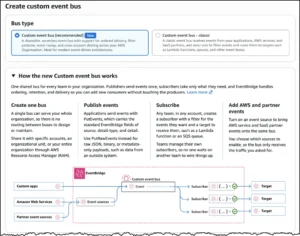
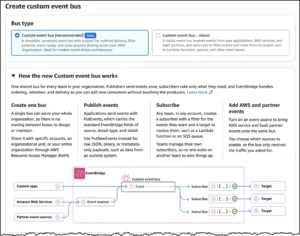
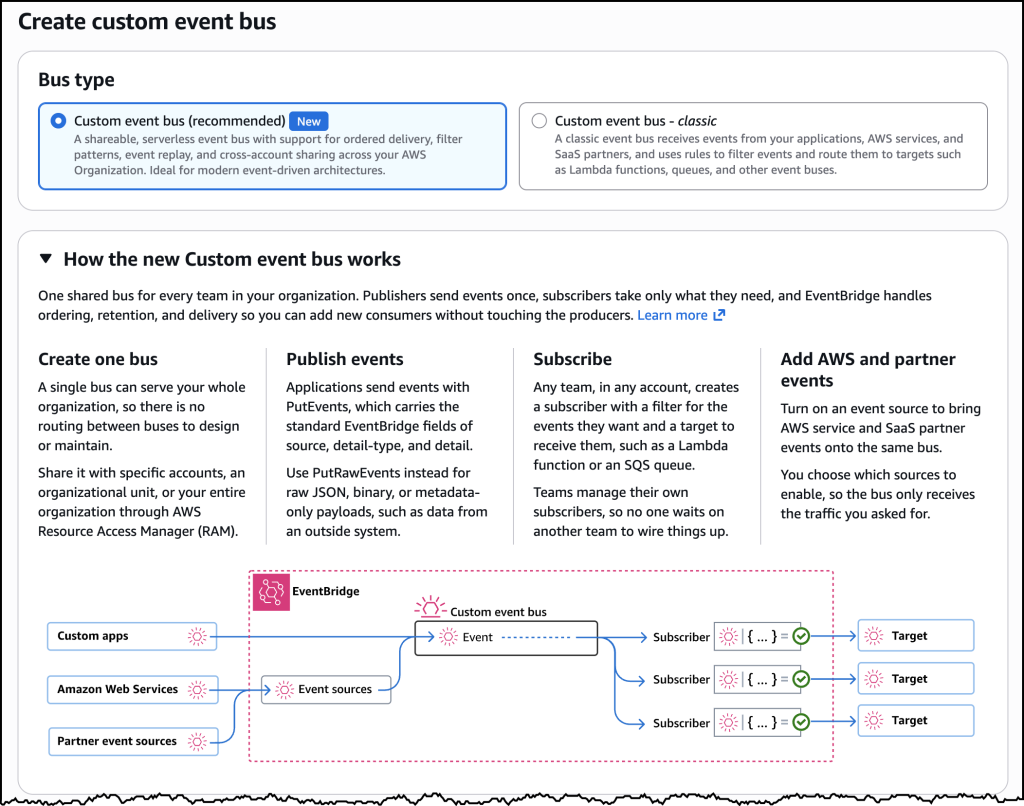
The newly introduced enhanced custom event bus directly targets these multi-account pain points by providing a unified architectural foundation. Rather than deploying fragmented pipelines across separate accounts, organizations can now deploy a single, centralized event bus shared across all AWS accounts within an enterprise framework.
Central to this new offering is seamless integration with AWS Resource Access Manager (AWS RAM). Platform administrators can configure resource sharing directly within the AWS Management Console, establishing permissions that allow teams to publish and consume events on the same centralized bus without manually engineering cross-account resource policies or intricate routing rules. Sharing can be restricted to specific AWS accounts, organizational units, or designated AWS Identity and Access Management (IAM) roles and users, ensuring rigorous security posture and granular access governance.
Chronology and Deployment Mechanics
The introduction of the enhanced custom event bus follows a multi-phase evolution of Amazon EventBridge as a foundational pillar of serverless integration. The feature has been rolled out globally across a robust footprint of AWS Regions, including US East (N. Virginia, Ohio), US West (Oregon), Europe (Ireland, Frankfurt, Stockholm, Spain), and Asia Pacific (Hong Kong, Malaysia, Mumbai, Singapore, Sydney, Thailand, Tokyo).
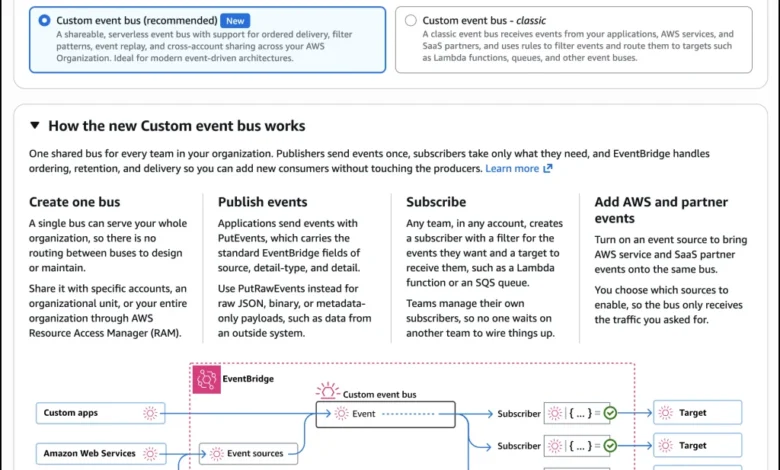
When interacting with the updated AWS Management Console, users are presented with a clear dichotomy when initiating a new resource: they may select the recommended "Custom event bus" (the new enhanced option) or opt for the legacy "Custom event bus – classic." Crucially, AWS has ensured backward compatibility; existing classic event buses will continue to function precisely as they always have, receiving events and routing them via traditional rules and targets without requiring immediate migration. Enterprises can thus adopt the enhanced custom event bus at their own measured operational pace.
Solving Sequencing and Delivery Complexities with Event Ordering
One of the most technically demanding hurdles in asynchronous architectures has been the management of event sequencing. Event-driven systems fundamentally thrive on asynchronous models where chronological order is theoretically irrelevant. Yet, real-world enterprise applications—such as logistics platforms tracking real-time vehicular telemetry, financial transaction processors, or inventory management systems—frequently depend on strict sequential processing. Out-of-sequence telemetry can cause routing algorithms to execute decisions based on stale or contradictory data states.
The enhanced custom event bus resolves this tension by natively supporting both ordered and unordered consumption paradigms on the same shared bus. Publishers can attach an optional EventGroupId parameter to outgoing payloads. EventBridge subsequently ensures that events sharing the identical EventGroupId are delivered in strict sequential order to subscribers that have opted into ordered delivery. Simultaneously, other consumers on that very same bus can ingest those exact events asynchronously without ordering constraints.

To facilitate reliable ordered processing, the enhanced custom event bus introduces synchronous invocation support for targets such as AWS Lambda. In synchronous mode, EventBridge confirms successful target execution before acknowledging the event payload. This architectural refinement eliminates the historical necessity of provisioning intermediary buffering services—such as Amazon Simple Queue Service (Amazon SQS)—purely to guarantee processing reliability between an event bus and compute functions.
Streamlining Governance via the Subscriber Resource
Governance and maintainability are further enhanced through the introduction of the new Subscriber resource. In legacy EventBridge implementations, achieving robust filtering, target routing, retry policies, and dead-letter queue configurations required developers to manage a constellation of separate rules, targets, and settings distributed across multiple resources.
The Subscriber resource consolidates these distinct elements into a single, cohesive, and easily manageable entity. Each consumer defines its precise operational parameters within one resource: specifying precisely which events to filter, where to deliver them, and how to govern execution failures. Furthermore, subscribers benefit from variable start time options, significantly simplifying the onboarding of new consumers, the execution of event replays during disaster recovery scenarios, or the population of newly initialized downstream applications.
Advanced Event Evaluation and Transformation Capabilities
Data hygiene and transformation have also received substantial engineering upgrades. The enhanced custom event bus introduces native content-based deduplication. When enabled, EventBridge automatically inspects event payloads to detect and suppress duplicate retries caused by network timeouts or partial execution failures. By hashing meaningful elements of the payload and collapsing matching arrivals within a five-minute window, EventBridge delivers true exactly-once delivery semantics for erratic sources, sparing developers from manually generating, tracking, and validating custom idempotency tokens.
For downstream compatibility, subscribers can leverage built-in JSONata expressions to reshape event payloads dynamically before they reach a designated target. Consumers can extract specific fields, rename variables, or compute derived values on the fly when legacy or third-party APIs demand alternative data schemas. Additionally, for organizations processing events formatted in Apache Avro or Protocol Buffers, EventBridge can natively deserialize these specialized payloads into standard JSON. This enables subscribers to execute fine-grained filtering and routing over the complete payload structure without necessitating custom parsing logic on the consumer side.
A Scalable, Predictable Pricing Architecture
Financial predictability is a paramount concern for enterprise platform engineering teams operating at massive scale. The enhanced custom event bus introduces a modernized ingress and egress throughput pricing model designed to optimize economics for high-volume environments. Under this structure, publishers incur costs based on events ingested, while subscribers pay for events delivered.
This model directly supersedes the legacy per-event cost framework, which historically saw cross-account and bus-to-bus routing charges compound exponentially in multi-bus architectures. By decoupling ingestion from distribution and removing intermediate routing overhead, organizations gain clearer cost allocation visibility, aligning cloud expenditure directly with business value creation.
Industry Implications and Strategic Analysis
From an architectural standpoint, the release of the enhanced custom event bus reflects a broader industry trend toward simplifying distributed enterprise software without sacrificing isolation or security. Industry analysts note that as serverless adoption matures, the primary engineering bottleneck has transitioned from raw infrastructure provisioning to inter-team governance, event schema discovery, and data routing efficiency.
By centralizing event backbones while retaining decentralized team autonomy, AWS provides a middle ground that accommodates both platform governance and rapid developer velocity. Platform teams retain critical oversight over organization-wide event flows, security boundaries, and quota allocations—such as the default quota of 10,000 Subscribers per bus—while application developers can provision endpoints and iterate independently without bureaucratic delays.
As enterprises continue migrating mission-critical workloads to cloud-native, event-driven paradigms, capabilities that reduce operational toil while fortifying data consistency will remain indispensable. The deployment of the enhanced custom event bus in Amazon EventBridge represents a vital step forward in maturing the operational maturity model of modern serverless infrastructure.