U.S. Space Force and Commercial AI Partners Revolutionize Battlefield Intelligence and Surveillance

NATIONAL HARBOR, Md. — In an era defined by rapid technological adaptation and escalating geopolitical tensions, the United States military finds itself navigating an unprecedented deluge of orbital data. Recent remarks by political leadership, including statements from President Donald Trump highlighting the nation’s unparalleled space-based monitoring capabilities over strategic adversaries like Iran, have thrust the U.S. Space Force and its partner agencies into the public spotlight. While commanders emphasize that the nation "sees everything" from orbit, behind the scenes, a profound operational evolution is underway. This transformation is driven not merely by the deployment of more advanced hardware, but by the integration of artificial intelligence and commercial analytics that fundamentally redefine how space intelligence is gathered, synthesized, and acted upon.
The convergence of military necessity, commercial space expansion, and advanced machine learning has shifted the primary challenge of modern warfare. For decades, the bottleneck in military intelligence was acquisition—simply getting a clear picture of a contested area. Today, as commercial satellite constellations proliferate and open-source intelligence expands exponentially, the challenge has pivoted from data scarcity to data overload. To address this, the Department of Defense is increasingly relying on agile commercial partnerships, spearheaded by initiatives like the Tactical Surveillance, Reconnaissance, and Tracking (TacSRT) program, to turn raw streams of multi-domain data into actionable decision-making tools.
The Evolution of Space-Based Visibility and Strategic Oversight
President Trump’s recent public assertions regarding the nation’s orbital surveillance capabilities underscore the high-stakes environment in which modern military planners operate. Discussing strategic monitoring activities over sites such as Iran’s Pickaxe Mountain nuclear facility, political leaders have repeatedly pointed to the extraordinary clarity provided by American space assets. When questioned about these sweeping assessments, Gen. Douglas Schiess, the chief of space operations for the U.S. Space Force, noted the vital, synergistic relationship between the military’s newest branch and the National Reconnaissance Office (NRO), which historically oversees the United States’ classified fleet of overhead reconnaissance and spy satellites.
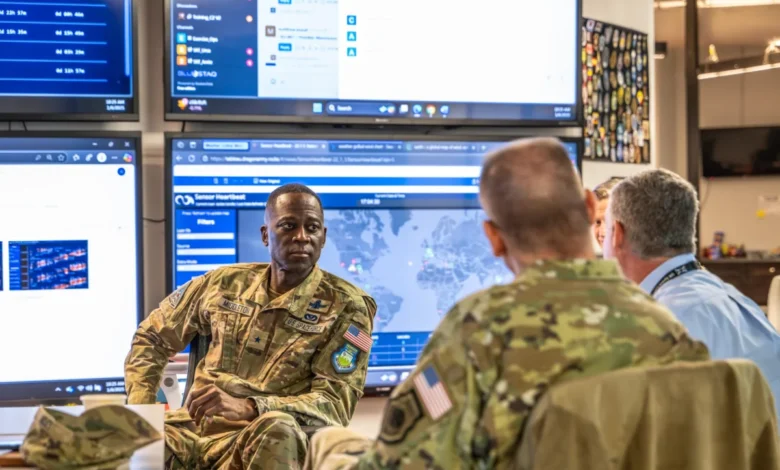
Speaking at the Air & Space Forces Association’s annual conference in National Harbor, Maryland, Gen. Schiess explained that the military’s collective overhead architecture delivers critical visibility tailored to the demands of the president, the broader intelligence community, and regional combatant commanders. However, Schiess and industry experts alike acknowledge that maintaining tactical and strategic awareness on a global scale requires moving beyond legacy paradigms. The sheer volume of incoming data—ranging from high-resolution optical imagery and synthetic aperture radar to maritime tracking signals, localized weather feeds, and real-time open-source news reports—demands automated processing capabilities that only advanced software can provide.
Bridging the Gap: The Rise of Commercial AI and Data Fusion
As space-based intelligence becomes more widely accessible to both government operators and commercial entities, specialized technology firms are stepping in to bridge the gap between raw data collection and operational execution. Among these is Danti, an Atlanta-based software provider specializing in artificial intelligence tools tailored for defense and intelligence customers. According to Danti Chief Executive Jesse Kallman, the accessibility of space-based intelligence has undergone a revolutionary shift over the past five years, transforming what was once a highly technical niche for a handful of specialized analysts into a ubiquitous asset across multiple operational echelons.

While proprietary details regarding specific operations remain classified, Kallman confirmed that Danti’s AI platforms supported Pentagon analysts and military operators during recent heightened engagements involving Iran. The core utility of these advanced software suites lies in their ability to perform data fusion—synthesizing space-based imagery with maritime tracking data, signals intelligence, and open-source intelligence to contextualize events as they unfold.
Rather than relying on isolated data points, modern defense analysts utilize platforms that continuously cross-reference disparate information streams to flag anomalous activities, identify significant environmental changes, and explain the underlying strategic implications. This capability extends far beyond traditional visual reconnaissance, encompassing a comprehensive view of the operational theater that operates continuously in the background.
Transforming Operational Workflows and Intelligence Production
One of the most profound impacts of artificial intelligence integration within the Space Force ecosystem is the shifting horizon of workflow automation. Until recently, AI applications in military intelligence were largely restricted to search and retrieval functions—acting as sophisticated search engines where human analysts could query databases for specific imagery or signal intercepts. Today, machine learning models participate actively in the analytical workflow.
Industry developers note that modern defense software can track developing events in real time, autonomously discovering new information and compiling structured reports intended directly for tactical operators and commanders. A prime example of this operational shift is the modernization of routine intelligence production, such as the traditional commander’s morning briefing.
Historically, assembling a comprehensive morning intelligence brief required teams of analysts to work overnight or arrive hours before dawn to manually parse incoming reports, evaluate imagery changes, and construct presentations. Modern AI integration streamlines this process significantly. By continuously assessing newly incoming information, the software generates real-time snapshots of regional developments and constructs foundational briefing packets. Human operators can then query these automated summaries directly, drastically reducing administrative latency and allowing intelligence professionals to focus on higher-level strategic evaluation and predictive analysis.
This integration significantly enhances the utility and responsiveness of space assets for frontline commanders. However, industry leaders emphasize that automation is designed to augment, rather than replace, human expertise. Reports generated through AI platforms are explicitly labeled as machine-processed and must undergo rigorous review and approval by human analysts before official dissemination to decision-makers.

Institutionalizing Commercial Integration: The TacSRT Program
The institutional framework supporting this technological leap has evolved significantly through formalized Department of Defense acquisition and operational pathways. Central to this integration is the Space Force’s Tactical Surveillance, Reconnaissance, and Tracking (TacSRT) program. Designed specifically to rapidly deliver unclassified commercial sensing and analytics capabilities directly to combatant commands, TacSRT bridges the traditional gap between lengthy military procurement cycles and the fast-paced innovation of the commercial space sector.
In May 2025, the Space Force and the broader intelligence community reached a critical milestone by formalizing collaborative procedures for the TacSRT framework, establishing clear guidelines on how military commands and intelligence agencies share and leverage commercial capabilities. Under this expanding framework, numerous commercial vendors supply specialized software, imagery, and analytics to the defense sector.
Demonstrating the ongoing expansion of these programs, Danti recently secured a $2.1 million contract expansion from the Space Force. This funding directly supports the deployment and scaling of advanced geospatial analytics tools across multiple U.S. combatant commands, ensuring that regional military leaders maintain immediate access to cutting-edge commercial capabilities.
Strategic Implications and Future Outlook
The fusion of Space Force oversight, commercial satellite constellations, and advanced artificial intelligence represents a watershed moment for modern military strategy. By decentralizing access to geospatial data and automating the labor-intensive aspects of intelligence analysis, the Department of Defense is building a more resilient, responsive, and transparent operational network.
As geopolitical flashpoints around the globe continue to evolve at a rapid pace, the ability to rapidly make sense of complex data environments will remain a decisive competitive advantage. The collaborative model forged between the U.S. military and innovative commercial technology providers highlights a broader structural shift within the defense enterprise—one where agility, commercial-off-the-shelf integration, and human-AI collaboration form the bedrock of national security in the 21st century. Through these sustained advancements, the Space Force is cementing its role not merely as a guardian of orbital assets, but as an indispensable provider of holistic, real-time intelligence for forces operating across land, sea, air, cyberspace, and space.