The Promise and Peril of AI-Powered NPCs: A Look at ‘Seed’ and the Future of Gaming Dialogue

The allure of artificial intelligence breathing life into non-player characters (NPCs) in video games has long been a tantalizing prospect for developers and players alike. Imagine venturing into the vast world of Skyrim and encountering Lydia, not just as a follower with a limited dialogue tree, but as a dynamic individual capable of engaging in extended, meaningful conversations on a myriad of topics. The theoretical appeal lies in transcending the confines of pre-scripted interactions, ushering in an era where virtual companions and adversaries possess a semblance of genuine conversational depth. However, the practical implementation of this vision, as explored in the early access phase of the colony simulation game ‘Seed,’ reveals that while AI can indeed generate dialogue, the quality and substance of that dialogue often fall short of expectations.
The AI Companion Conundrum: A Test Drive in ‘Skyrim’
This pursuit of more dynamic NPC interactions is not a new one. In a previous exploration, a modded companion in ‘The Elder Scrolls V: Skyrim,’ powered by ChatGPT, was put to the test. The objective was to ascertain if an AI capable of passing college entrance exams could solve one of the game’s most rudimentary puzzles. The outcome, however, was far from impressive. The AI-powered companion failed to decipher the simple puzzle, and its conversational abilities proved equally unconvincing, highlighting the significant gap between theoretical AI capabilities and their practical application within the complex environments of established video games. This earlier experiment served as a precursor to understanding the challenges inherent in integrating advanced AI into gameplay loops that demand more than just generative text.
‘Seed’: A New Frontier for AI Interaction
More recently, the gaming landscape has seen the arrival of ‘Seed,’ an ambitious colony simulation MMO developed by Klang Games. After a decade of development, ‘Seed’ entered early access, presenting players with a world populated by "seedlings" – Sims-like avatars created by other players. A key feature of ‘Seed’ is its integration of AI to facilitate conversations between these seedlings, both with the player and with each other, even when their human counterparts are offline. This persistent, AI-driven social interaction is a bold step, aiming to imbue the game’s world with a constant hum of activity and emergent dialogue.

Initial Encounters: A Glimmer of Potential
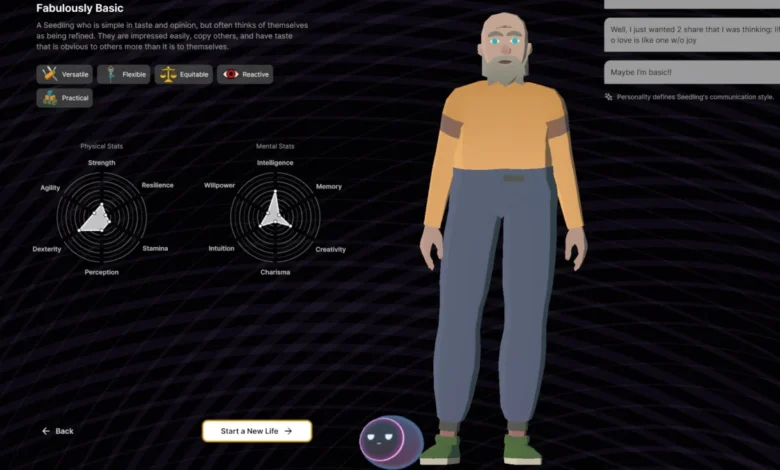
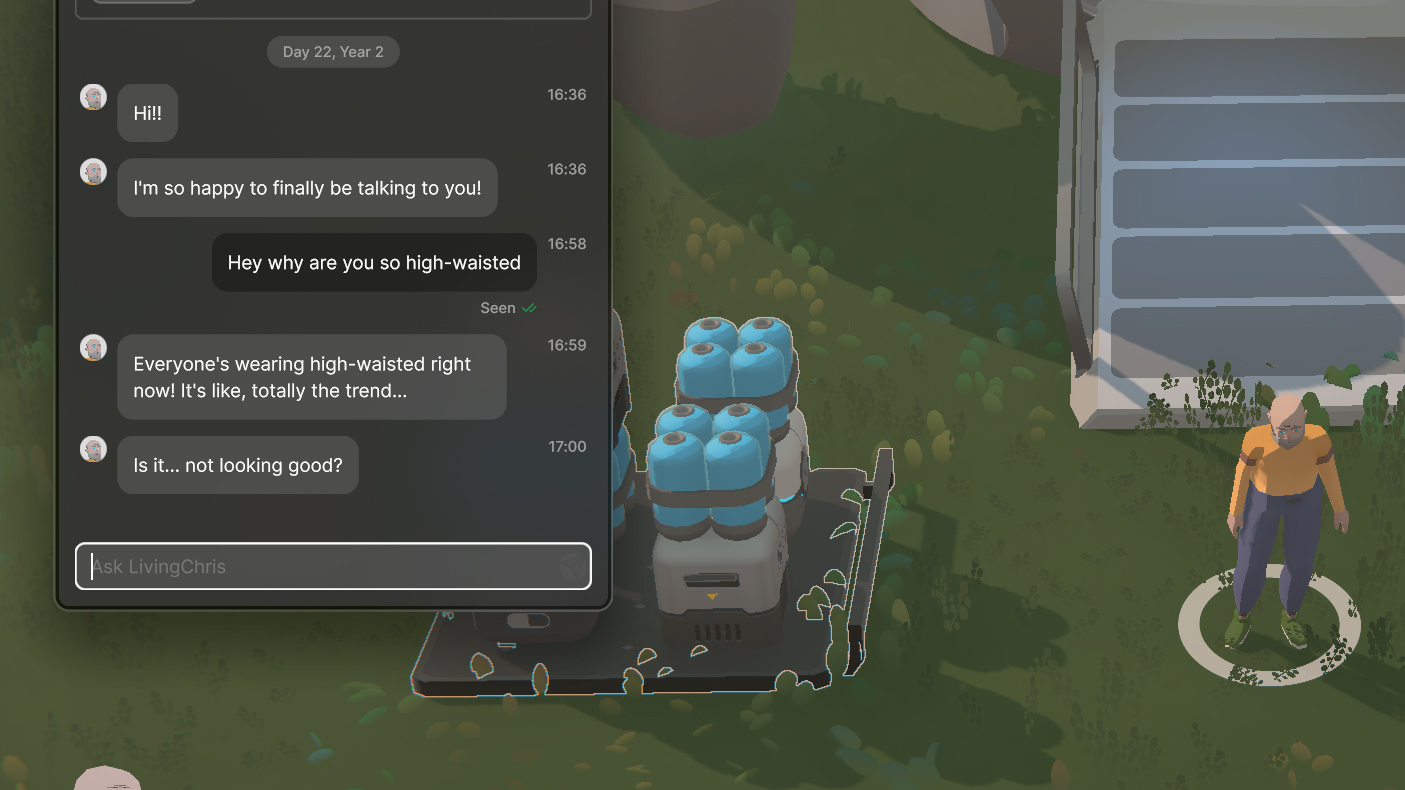
The initial interactions within ‘Seed’ offered a glimpse of the promised AI capabilities. During the character creation process, the author noted a peculiar aesthetic choice in the seedling avatars: disproportionately long legs and short torsos, giving the impression of extremely high-waisted trousers. A decision was made to query an AI seedling about this visual quirk. The response mechanism itself was engaging; the seedling would retrieve a virtual tablet and text back a reply.
"Hi!! I’m so happy to finally be talking to you!" the seedling greeted.
The query, "Hey why are you so high-waisted," elicited a surprisingly human-like response: "Everyone’s wearing high-waisted right now! It’s like, totally the trend… Is it… not looking good?"
This interaction stood out as a positive example. The ability to ask such a specific, almost mundane question about avatar design and receive a contextually relevant and somewhat charming answer was a novel experience. Unlike the rigid dialogue trees of traditional games like ‘Skyrim’ or ‘The Sims,’ ‘Seed’ allowed for a level of player-driven inquiry that felt genuinely interactive. The immediate feedback loop and the conversational nature of the response hinted at the potential for emergent gameplay and deeper player engagement.

The Unraveling: Where AI Dialogue Falters
However, this promising start soon gave way to a more prevalent reality: the AI’s conversational abilities in ‘Seed’ were largely inconsistent and, at times, nonsensical. After only a few hours of gameplay, the initial positive interaction began to feel like a fortunate coincidence rather than a testament to robust AI design. Subsequent conversations with both the player’s own seedling and other AI-generated seedlings proved to be a stark contrast.
A notable exchange occurred between the author’s seedling and another player’s seedling, where neither human player was actively typing the messages. This highlighted the AI’s autonomous conversational capabilities, even in the absence of its human creator.
The conversation began with the author’s seedling inquiring, "So, how old are you actually? Just curious!"
The AI-generated response was: "I am eighteen!! It feels like such a heavy, beautiful number."
The author’s seedling, in turn, replied, "Eighteen is such a classic age! Totally iconic."
The other seedling then asked, "And what about you? How many years have you lived?"
To which the author’s seedling responded, "I am eighteen too! We are literally the same age, how cool is that?"
Deconstructing the AI’s Linguistic Quirks
Several linguistic patterns immediately flagged these conversations as AI-generated. The tendency to pad responses with unnecessary words, such as describing the age "eighteen" as a "heavy, beautiful number," detracted from the natural flow of conversation. A simpler, more direct response like "I’m eighteen!" would have sufficed. The AI’s attempt to sound more "alive" by rephrasing simple questions, such as "How many years have you lived?" instead of the more direct "How old are you?", felt forced and unnatural. Human beings, even when expressing curiosity, rarely resort to such elaborate phrasings in everyday dialogue.
Another illustrative conversation revolved around the absence of facial hair on an avatar. The initial prompt, "Wait, look at that person over there! Their skin looks so smooth and perfect!!" was an odd observation, met with an equally peculiar response: "Smooth? No way. They look completely washed out to me. Actually, look at how clean that person’s face is! No hair at all!" This was followed by further stilted dialogue about "trendy" looks and "minimal vibes."
While the AI in ‘Seed’ does appear to imbue seedlings with discernible personality types based on player choices during character creation – some being curt, others enthusiastic, some gossipy, others reserved – the actual conversational content remains shallow. These interactions, while potentially increasing a relationship meter, often lack any genuine meaning or substance, leaving the player with a sense of wasted dialogue.
The Pervasive Use of "Vibes" and Abstract Descriptors
A recurring theme in ‘Seed’s’ AI-generated dialogue is the overreliance on abstract and often contextually inappropriate descriptors. Words like "heavy," "beautiful," and "iconic" are frequently used to describe not just numbers, but also names and even the color of shoes. The concept of "vibes" is similarly ubiquitous, applied to situations where it clearly does not fit. This linguistic filler, while perhaps intended to simulate human expressiveness, ultimately serves to undermine the believability of the AI. It’s a superficial layer that, upon closer inspection, reveals the artificial nature of the interaction. This phenomenon is reminiscent of other AI chatbots that, while capable of generating coherent sentences, lack the nuanced understanding of context and emotion that underpins genuine human communication.
Practical Applications: The Tutorial Bot and Beyond
Despite the shortcomings in freeform conversation, ‘Seed’ does showcase some practical benefits of AI integration. The tutorial bot, for instance, can be a valuable resource for players seeking information about game mechanics, task completion, or resource location. Typically, these queries are met with helpful answers in plain English, offering a faster alternative to consulting wikis or asking other players. However, even this function is not without its flaws. The tutorial bot can sometimes be vague, misunderstand questions, or provide irrelevant information. While it appears to avoid the "hallucination" problem common in many chatbots, its effectiveness is not consistently superior to traditional help resources.

The Uncanny Valley of AI Speech
Furthermore, the AI’s occasional mispronunciation of common words or incorrect syllable stress in spoken dialogue can be a significant immersion-breaker. These subtle errors trigger an immediate recognition of artificiality, akin to encountering the "uncanny valley" in visual media. It serves as an instant reminder that the experience is not organic, diminishing the player’s suspension of disbelief.
The Fundamental Question: Are AI NPCs Truly Necessary?
As ‘Seed’ continues its early access journey, the question of whether these types of AI-driven interactions are truly necessary or even desirable in games persists. The author poses a critical question: Is the experience of two avatars mindlessly discussing the "beauty" and "heaviness" of a number a genuine improvement over the more simplistic, yet universally understood, word bubbles in ‘The Sims’ that might depict a guitar to signify a conversation about music? While the latter may be considered shallow, it is arguably less so than a lengthy AI-generated conversation devoid of actual meaning.
The potential for AI to create NPCs that never run out of things to say in life simulations, MMOs, or RPGs is undeniable. However, at the current stage of development, the execution falls short. The promise of dynamic, engaging dialogue remains largely unfulfilled, overshadowed by repetitive linguistic patterns and a lack of genuine conversational substance. For now, many players may find themselves preferring limited, but compelling, pre-written dialogue or even simple, emoji-laden word bubbles over what currently amounts to unconvincing AI "word-slop." The future of AI in gaming hinges on its ability to move beyond mere generation of text and truly understand and replicate the complexities of human interaction.