Major software engineering improvements put Opus 5 closer to Anthropic’s top model

Anthropic has officially launched Claude Opus 5, its latest iteration of a frontier artificial intelligence model designed for sophisticated tasks such as coding, in-depth research, and complex business operations. The company has announced that Opus 5 represents a significant leap in performance compared to its predecessor, Claude Opus 4.8, while maintaining the same API pricing. Crucially, Anthropic asserts that Opus 5 now rivals Claude Fable 5, a previously top-tier model, on certain coding and computer-interaction benchmarks, all at a substantially lower operational cost.
This strategic release positions Opus 5 as the default AI model for users subscribed to Claude Max and as the most advanced option available within the Claude Pro subscription. This move signals Anthropic’s commitment to democratizing access to high-performance AI capabilities, making them more accessible to a broader user base without compromising on quality or increasing costs. The availability across Claude’s various applications and API ensures seamless integration for developers and end-users alike.

Opus 5: Bridging the Gap with Fable 5
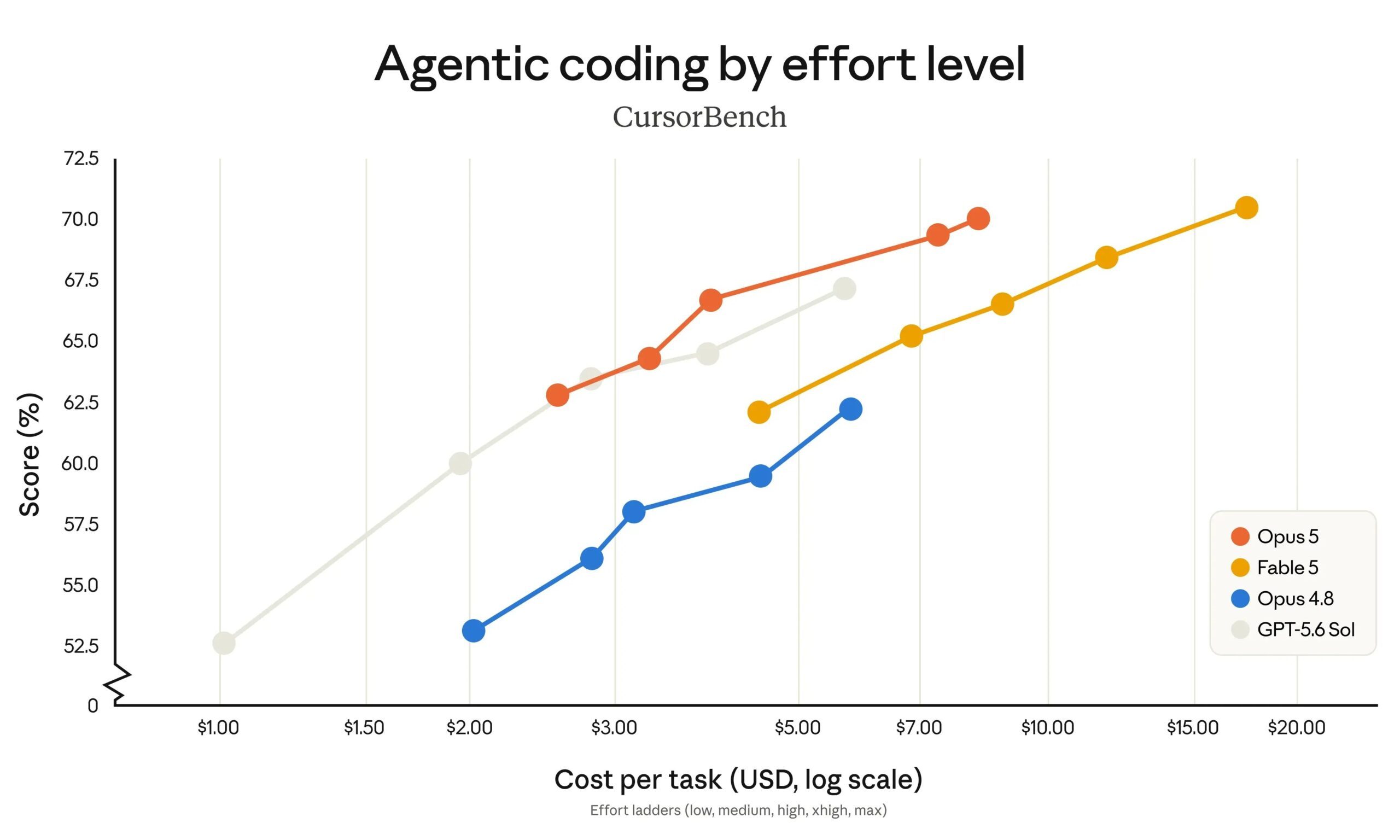
The performance metrics released by Anthropic highlight Opus 5’s impressive capabilities, particularly when compared to the more specialized Fable 5 model. On CursorBench 3.2, a benchmark designed to evaluate AI agents in real-world software development scenarios, Opus 5 achieved a score within a mere 0.5% of Fable 5’s peak performance when operating at maximum effort. This near-parity is particularly noteworthy given Anthropic’s claim that Opus 5 accomplished these tasks at approximately half the cost per task. This cost-efficiency is a critical factor for businesses and developers looking to scale AI-driven workflows.
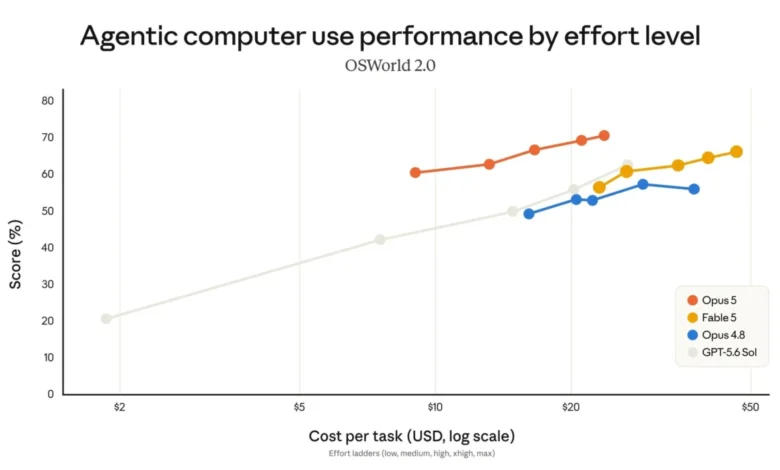
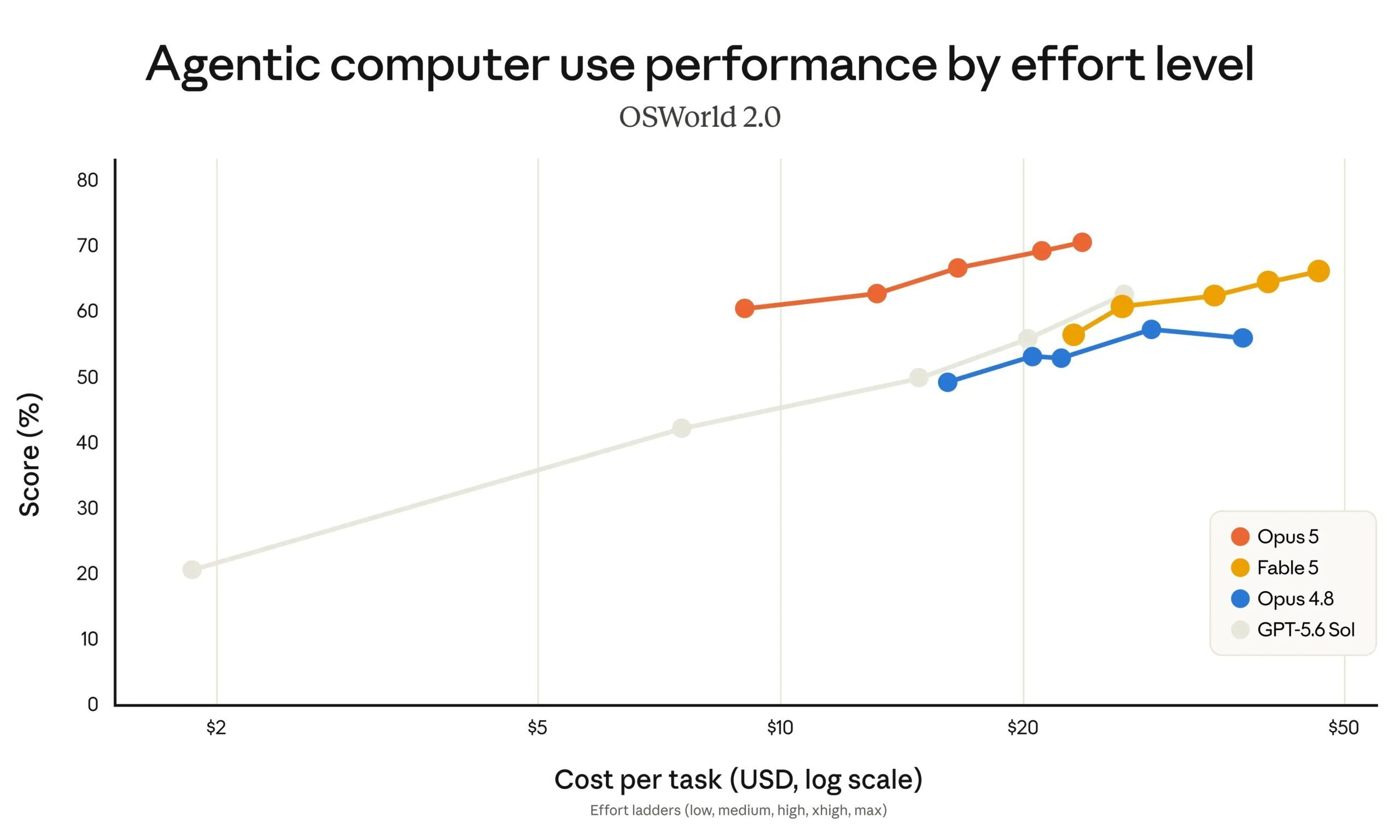
Further underscoring Opus 5’s prowess, the model outperformed Fable 5’s best results on the OSWorld 2.0 benchmark. This benchmark is designed to assess an AI agent’s ability to effectively navigate and operate computer systems, including managing applications and files. The achievement on OSWorld 2.0, especially at just over a third of the cost associated with Fable 5, suggests Opus 5 offers a more versatile and economically viable solution for tasks requiring complex system interaction.
The timing of Opus 5’s release is also significant. For users of Claude Pro and standard Team subscriptions, Opus 5 is poised to fill a crucial gap. This gap was created by the recent transition of Claude Fable 5 to a pay-as-you-go credit system, which began on July 20th. By offering a model that closely matches Fable 5’s capabilities at a more accessible price point for subscription users, Anthropic ensures continuity and value for its existing customer base.
Quantifiable Improvements: Opus 5 vs. Opus 4.8
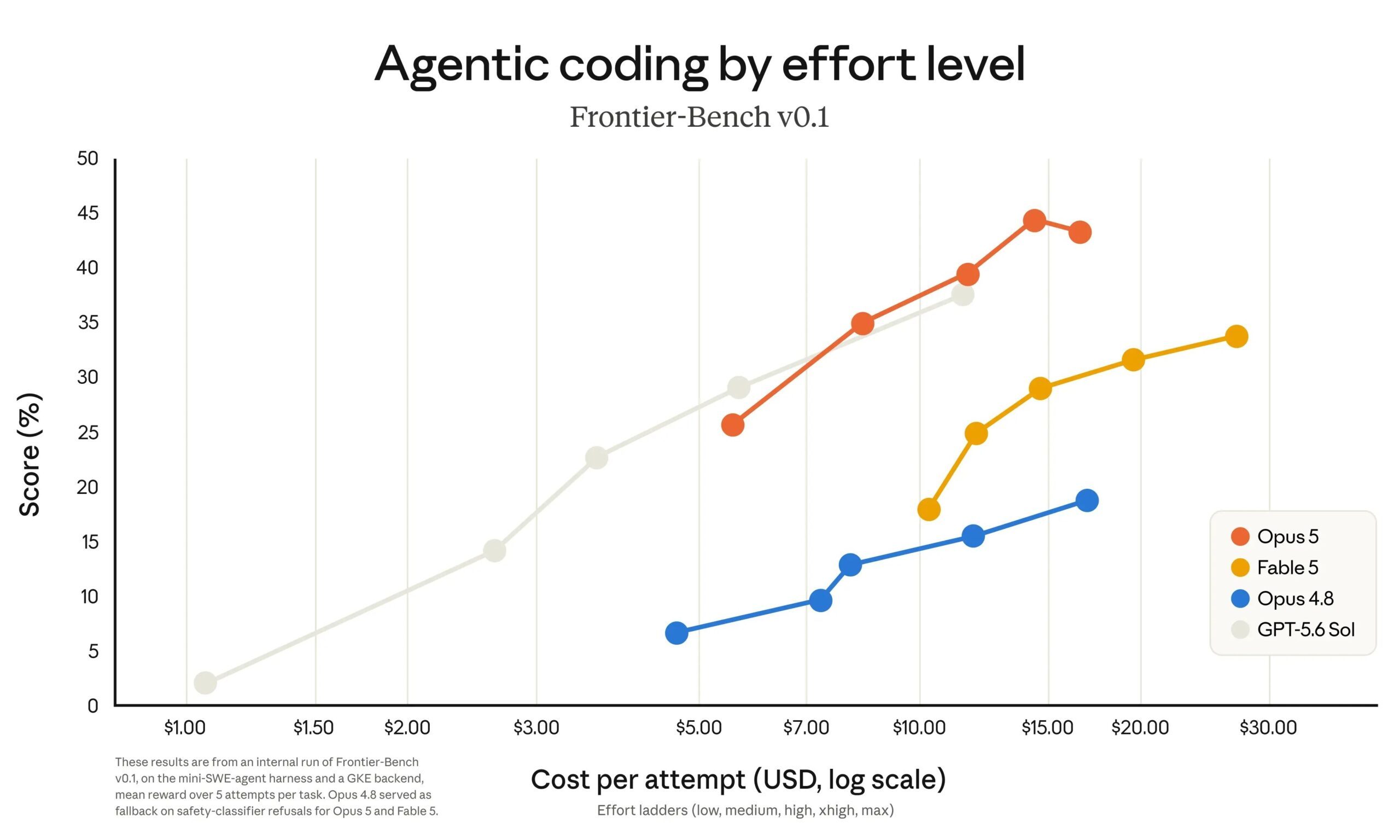
Beyond its competitive standing with Fable 5, Opus 5 demonstrates substantial advancements over its immediate predecessor, Opus 4.8. Anthropic reports that Opus 5 more than doubled the score of Opus 4.8 on Frontier-Bench, a rigorous benchmark specifically designed to test the capabilities of AI agents in demanding software engineering tasks. This dramatic improvement indicates enhanced problem-solving, code generation, and debugging abilities.
The benchmarks also reveal that Opus 5 achieved these superior results at a lower average cost than Opus 4.8. This dual improvement in performance and efficiency is a testament to the underlying architectural and algorithmic enhancements made by Anthropic’s engineering teams.
Anthropic has provided specific examples of Opus 5’s enhanced functionality, particularly in its ability to meticulously review its own work, accurately identify the root causes of bugs, and persevere through complex, multi-stage tasks rather than terminating prematurely after a superficial fix. In one notable instance, Opus 5 successfully identified an edge case that had been overlooked by an existing community-developed patch, showcasing its advanced analytical and diagnostic capabilities.
The cost structure for Claude Opus 5 remains consistent with Opus 4.8, priced at $5 per million input tokens and $25 per million output tokens. This pricing stability, coupled with the significant performance gains, makes Opus 5 a compelling upgrade for existing users and an attractive entry point for new customers seeking state-of-the-art AI assistance.
Technical Advancements and Development Timeline
The development of Claude Opus 5 represents a culmination of ongoing research and engineering efforts at Anthropic. While specific details regarding the exact architectural changes remain proprietary, the performance leaps suggest significant advancements in areas such as model architecture, training methodologies, and reinforcement learning techniques. The focus on "software engineering improvements" mentioned by Anthropic points towards refined capabilities in logical reasoning, code understanding, and complex task decomposition.
The timeline for the development and release of AI models like Opus 5 typically involves extensive periods of research, experimentation, and rigorous testing. This process often begins with fundamental research into neural network architectures and training algorithms, followed by the development of prototype models. These prototypes undergo iterative refinement, with performance metrics constantly monitored and improved upon. Benchmarking against established models like Fable 5 and industry-standard tests like CursorBench and OSWorld is a critical part of this validation process.
Anthropic’s strategic approach to AI development emphasizes safety and reliability alongside performance. While not explicitly detailed in the initial announcement, it can be inferred that Opus 5 has undergone extensive safety evaluations to ensure responsible deployment, particularly given its enhanced capabilities in complex task execution. The company’s long-standing commitment to AI safety likely played a significant role in shaping the model’s development trajectory.
Broader Implications for the AI Landscape
The launch of Claude Opus 5 has several important implications for the broader artificial intelligence market. Firstly, it intensifies the competition among leading AI developers. By offering a model that approaches the performance of a previously premium-tier offering at a more accessible price, Anthropic is raising the bar for cost-effectiveness and performance parity. This could pressure other AI providers to re-evaluate their pricing strategies and accelerate their own model development cycles.
Secondly, the increased accessibility of high-performance AI for coding and complex operational tasks has the potential to democratize advanced software development and business process automation. Smaller businesses, startups, and individual developers who may have previously found cutting-edge AI tools prohibitively expensive can now leverage Opus 5 to enhance their productivity and innovation. This could lead to a surge in AI-assisted development and a more diverse range of AI-powered applications entering the market.

The improved performance in benchmarks like OSWorld 2.0 also signals a maturing of AI agents capable of interacting with digital environments. This has profound implications for areas such as automated IT support, digital assistants, and complex workflow automation. As AI models become more adept at understanding and manipulating computer systems, the potential for streamlining operations and reducing manual labor across various industries increases significantly.
Anthropic’s strategy of maintaining API pricing while enhancing model capabilities is a clear indicator of their focus on customer value and market penetration. This approach could set a new industry standard, shifting the competitive landscape from solely focusing on raw performance to a more balanced consideration of performance, cost, and accessibility.
Future Outlook and Continued Innovation
The release of Claude Opus 5 is not an endpoint but rather a milestone in Anthropic’s ongoing pursuit of advanced AI. The company’s consistent track record of innovation suggests that further refinements and new models are likely on the horizon. The focus on "major software engineering improvements" hints at a deep understanding of the complexities involved in creating AI that can effectively contribute to the software development lifecycle.

As AI technology continues to evolve at an unprecedented pace, the benchmarks and metrics used to evaluate these models will also need to adapt. The continuous development of more challenging and nuanced benchmarks, such as CursorBench and OSWorld, is essential for pushing the boundaries of AI capabilities and ensuring that these models can meet the increasingly complex demands of real-world applications.
The competitive landscape in AI is dynamic, with companies like Google, OpenAI, and Meta also making significant strides. Anthropic’s strategic moves with models like Opus 5 underscore their ambition to remain at the forefront of this technological revolution. The emphasis on both performance and economic viability suggests a long-term vision for making powerful AI tools a ubiquitous part of the digital ecosystem. The impact of Opus 5 will likely be felt across various sectors, from software development and research to business operations and creative industries, as users begin to harness its enhanced capabilities.