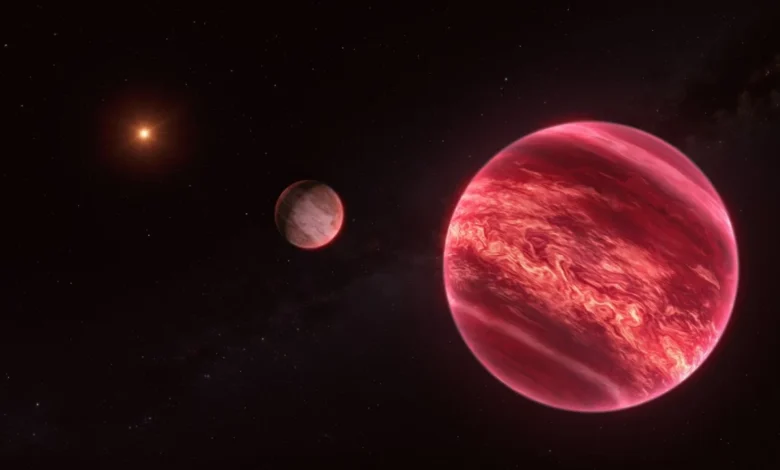
The discovery of a Jupiter-sized object orbiting a brown dwarf, which in turn orbits a distant red dwarf star, has sent ripples through the astrophysical community, fundamentally challenging the traditional taxonomies used to classify celestial bodies. Published in the journal Nature, the study titled "Planetary-mass exosatellite detected around the substellar companion of a star" details the detection of the first confirmed "exo-satellite"—a world that functions as a moon to a substellar object but possesses the mass and physical characteristics of a major planet. This discovery, centered on the star system CD-35 2722, provides a rare glimpse into the complex hierarchical structures of star systems and highlights the growing inadequacy of current definitions regarding stars, planets, and moons.
Located approximately 70 light-years from Earth, the CD-35 2722 system consists of an M-type red dwarf star and its massive companion, CD-35 2722b. The system has long been a subject of interest for astronomers due to its proximity and the nature of its secondary component. However, recent spectral observations and high-contrast imaging have revealed that CD-35 2722b is not alone. It is orbited by a third, smaller body with a mass roughly equivalent to that of Jupiter. This configuration—a planet-sized object orbiting a brown dwarf, which itself orbits a primary star—represents a middle ground in celestial mechanics that defies easy categorization under the current International Astronomical Union (IAU) guidelines.
The Taxonomy Crisis: Redefining the Celestial Hierarchy
The debate over what constitutes a planet is not a new phenomenon in astronomy, but the CD-35 2722 system brings the conversation to a much larger scale. For decades, the broad definitions were considered settled: stars generate light through nuclear fusion, planets orbit stars, and moons orbit planets. This simplicity began to erode in 2006 when the IAU officially demoted Pluto to "dwarf planet" status. The decision was based on the requirement that a planet must "clear its orbital neighborhood," a criterion Pluto failed due to its presence in the Kuiper Belt alongside objects like Ceres and Eris.
The discovery of the CD-35 2722b satellite complicates this further. If a Jupiter-sized body orbits an object that is not quite a star but is much larger than a planet, does that body qualify as a moon or a planet? Our own Moon is larger than Pluto, yet it is classified as a satellite because of its primary orbit. Conversely, if the brown dwarf CD-35 2722b were a free-floating object in interstellar space, its Jupiter-sized companion would undoubtedly be classified as a planet. By existing within a triple-tiered system, the new object occupies a "grey area" that suggests the size and mass of a body may be less important to its definition than its gravitational relationship with its neighbors.
Characteristics of the CD-35 2722 System
The primary star of the system, CD-35 2722, is an M-type red dwarf. These stars are the most common in the Milky Way, characterized by their low mass, cool surface temperatures, and incredibly long lifespans. Despite their ubiquity, their low luminosity makes them difficult to study at great distances. At 70 light-years away, CD-35 2722 is close enough for modern instruments to detect the subtle "wobble" caused by the gravitational pull of its companions.
The first companion, CD-35 2722b, was identified through radial velocity measurements. Based on the star’s movement, researchers estimated that this companion has a mass between 29 and 38 times that of Jupiter. This mass range places it firmly in the category of a brown dwarf. Brown dwarfs are often referred to as "failed stars" because they are more massive than the largest planets but lack the necessary mass—roughly 75 to 90 Jupiter masses—to sustain the fusion of hydrogen in their cores. However, they are massive enough (above 13 Jupiter masses) to fuse deuterium, a heavier isotope of hydrogen. This ability to generate internal heat through deuterium fusion places them in a transitional state between planetary and stellar physics.
The most recent breakthrough came when spectral observations of CD-35 2722b itself revealed a secondary periodic wobble. Further analysis and direct imaging conducted by the European Southern Observatory’s (ESO) Very Large Telescope (VLT) confirmed the presence of a planetary-mass object in orbit around the brown dwarf. This object, which shares the mass of Jupiter, is the first confirmed "exo-satellite" of its kind.
Technical Methodology and Direct Imaging
The detection of a planet-sized satellite around a brown dwarf is a feat of extreme precision. The research team, led by K. Hoy and A. Zurlo, utilized a combination of Doppler spectroscopy and high-contrast imaging. While the radial velocity method (measuring the "wobble" of the parent body) provided the initial evidence for the satellite’s existence, the VLT’s ability to image the system directly was crucial for confirmation.
Brown dwarfs are unique in that they emit their own infrared radiation, albeit much less than a true star. The largest brown dwarfs can have surface temperatures as high as 2,000 Kelvin, glowing with a dull red or magenta hue. The mid-sized CD-35 2722b is cool enough that a Jupiter-sized companion can be distinguished from the brown dwarf’s own thermal signature using advanced coronagraphs, which block the light of the primary star to reveal the fainter objects nearby.
The VLT’s SPHERE (Spectro-Polarimetric High-contrast Exoplanet REsearch) instrument played a pivotal role. By filtering out the glare from the M-type red dwarf, astronomers were able to isolate the light from the brown dwarf and its satellite. This allowed for a more accurate calculation of the satellite’s mass and orbital period, confirming that the system is gravitationally stable and that the satellite is indeed a permanent fixture of the brown dwarf’s environment.
Chronology of Discovery
The journey to identifying the CD-35 2722 system’s full architecture spanned several years of observation and data refinement:
- Initial Star Survey (Early 2020s): CD-35 2722 was identified as a candidate for high-resolution study due to its status as a relatively nearby M-dwarf. Early surveys noted a slight irregularity in its motion, suggesting a massive companion.
- Identification of CD-35 2722b (2023-2024): Researchers confirmed the presence of a brown dwarf companion. Initial mass estimates placed it in the 30-Jupiter mass range. It was noted for its wide orbit around the red dwarf, which provided enough "clearing" for more sensitive instruments to look for smaller companions.
- The Secondary Wobble (2025): Detailed spectral analysis of the brown dwarf’s own light revealed a secondary periodic shift. This indicated that the brown dwarf was being tugged by an even smaller body.
- Direct Imaging and Confirmation (2026): Using the VLT, the research team successfully captured photons from the satellite. The study was finalized and published in Nature, marking the first time a planetary-mass object has been confirmed orbiting a substellar object within a larger star system.
Implications for Astrobiology and Habitable Zones
One of the most intriguing aspects of this discovery is the potential for habitability. While the primary red dwarf star has its own habitable zone, brown dwarfs also generate heat. A planet-sized satellite orbiting a brown dwarf would experience tidal heating and receive infrared radiation from its host.
If an exo-satellite like the one in the CD-35 2722 system were positioned at the right distance, it could theoretically maintain liquid water on its surface. However, the environment would be vastly different from Earth’s. The "sun" in this sky would be a massive, glowing brown dwarf, and the primary red dwarf star would appear as a bright, distant point of light. The satellite would essentially be a moon of a "failed star," yet it could possess the atmosphere and geophysics of a major planet.
The existence of such systems suggests that "moons" could be just as likely to host life as "planets." In our own solar system, moons like Europa and Enceladus are considered prime candidates for life due to subsurface oceans. The CD-35 2722 satellite represents a "super-version" of this concept—a world with the mass of Jupiter that could potentially host its own system of smaller moons or maintain a thick, life-sustaining atmosphere.
Scientific Reaction and Future Research
The astronomical community has reacted with a mixture of excitement and a call for a revision of planetary nomenclature. Dr. P.A. Peña R, a co-author of the study, noted that the discovery "forces us to move away from a star-centric view of the universe." The team suggests that as our imaging technology improves, we may find that brown dwarfs frequently host planetary-mass satellites, creating "miniature solar systems" within larger ones.
Future research will focus on the atmospheric composition of the CD-35 2722 satellite. With the James Webb Space Telescope (JWST) and the upcoming Extremely Large Telescope (ELT), scientists hope to perform transmission spectroscopy on the satellite. This would allow them to detect water vapor, methane, or carbon dioxide in its atmosphere, providing clues about its formation and potential for habitability.
Furthermore, the discovery raises questions about the formation of such systems. Did the Jupiter-sized satellite form from a disk of material surrounding the brown dwarf (similar to how the Galilean moons formed around Jupiter), or was it a planet captured by the brown dwarf’s gravity? The circularity of the satellite’s orbit suggests the former, which would imply that brown dwarfs have their own "protoplanetary" disks during their formation.
Conclusion
The detection of a planetary-mass exo-satellite in the CD-35 2722 system is a landmark event in modern astronomy. It serves as a definitive example of the complexity inherent in the cosmos, where the lines between stars, planets, and moons are frequently blurred. As the first confirmed world of its kind, the CD-35 2722 satellite is likely just the beginning of a new chapter in exoplanetary science. It challenges our definitions, expands our understanding of where life might exist, and reminds us that the universe is rarely as simple as our categories suggest. The only certainty is that this exo-satellite will not be the last, and each subsequent discovery will bring us closer to a more nuanced understanding of the hierarchical structures that define our galaxy.