Russia Returns World’s Most Heavily-Armed Warship To The Sea After $5B Facelift

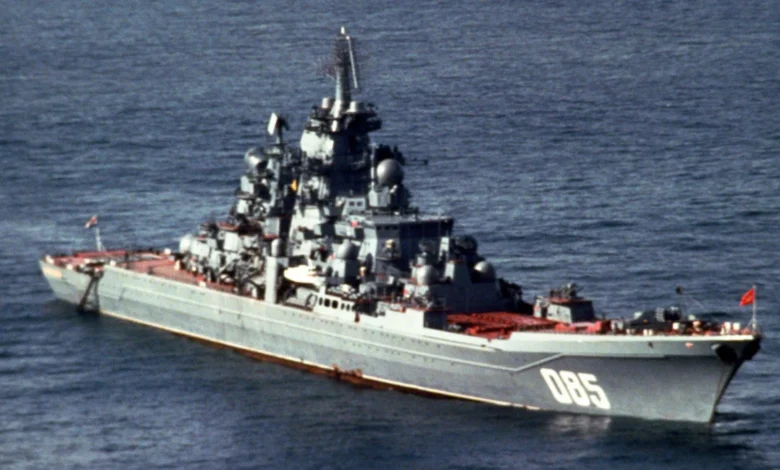
A Legacy Reborn: The Kirov-Class and its Origins
The Admiral Nakhimov belongs to the Kirov class of heavy nuclear-powered guided-missile cruisers, a designation that technically places them as battlecruisers due to their immense size and armament. Originally conceived in the late Cold War era, these ships were designed to counter American carrier battle groups and were the largest surface combatants built by any navy since World War II, excluding aircraft carriers. The class was renowned for its sheer scale, unprecedented firepower, and nuclear propulsion, offering virtually unlimited range.
The Admiral Nakhimov, initially named Kalinin, was the third ship of this class, entering service with the Soviet Navy in 1988. At approximately 28,000 tons full load displacement and stretching 823 feet (250 meters) in length, it remains one of the largest non-carrier surface warships ever built. Its two pressurized water nuclear reactors, capable of generating an impressive 140,000 horsepower, propel the vessel to speeds estimated around 32 knots (36.8 mph or 59 km/h), a speed comparable to or exceeding many modern large warships, including U.S. Navy aircraft carriers.
Following the dissolution of the Soviet Union, the Russian Navy faced severe financial constraints, leading to the early decommissioning or long-term layup of many advanced vessels. The Kalinin, renamed Admiral Nakhimov in 1992, was no exception. By 1997, it was taken out of service and laid up in Severomorsk, the primary base for the Northern Fleet, before being towed to the Sevmash shipyard in Severodvinsk for what was initially envisioned as a relatively modest refit. However, for many years, progress was minimal, emblematic of the broader challenges facing the Russian military industrial complex during that period.
The Protracted Modernization: A $5 Billion Endeavor
The serious modernization effort for the Admiral Nakhimov did not commence until 2014, signaling a renewed commitment by the Russian state to naval power projection. The refit, estimated to have cost upwards of $5 billion, evolved from a planned maintenance and upgrade program into a near-complete overhaul, touching almost every aspect of the ship’s design and functionality. This extensive work, which has spanned over a decade since its serious commencement and nearly three decades since the ship was first taken out of service, dwarfs the construction time of even the most advanced modern warships. For instance, the USS Gerald R. Ford, the world’s most advanced aircraft carrier, took approximately 12 years from keel laying to commissioning.
The delays encountered during the Nakhimov’s refit have been numerous and complex, attributed to a combination of factors:
- Funding Challenges: Despite the substantial budget, consistent allocation and disbursement of funds have been a recurring issue.
- Technical Complexity: Modernizing a Cold War-era nuclear-powered vessel to contemporary standards presented immense engineering challenges, requiring significant redesign and integration of new systems.
- Industrial Capacity: The Russian shipbuilding industry, while robust, has faced pressures from other naval projects and the impact of Western sanctions, which have affected the availability of certain components and technologies.
- Scope Creep: What began as a moderate upgrade expanded significantly as the navy opted for more comprehensive modernization to ensure the ship’s relevance for decades to come.
Key milestones in this marathon refit included the refurbishment and refueling of its two nuclear reactors, both of which were reported to be back online by February 2025. This critical step enabled the vessel to begin its power plant testing and prepare for sea trials. The satellite sighting in Kola Bay on June 25, 2026, performing maneuvers indicative of initial sea trials, represents the most tangible evidence yet of the project’s nearing completion and the ship’s imminent return to active service.
A Modern Arsenal: Enhanced Capabilities of the Admiral Nakhimov
The heart of the Admiral Nakhimov’s modernization lies in its vastly upgraded combat systems, transforming it from a formidable Cold War behemoth into a multi-role combatant tailored for 21st-century naval warfare. While full details remain classified, significant improvements have been publicly discussed or credibly inferred:
- Propulsion System: The two nuclear reactors, while not replaced, underwent extensive refurbishment and were refueled. This ensures the ship retains its signature virtually unlimited range and high-speed capabilities, critical for operations across vast oceanic expanses.
- Armament Transformation: The most significant change is the complete overhaul of its offensive missile capabilities. The original P-700 Granit (SS-N-19 Shipwreck) anti-ship missile system, a powerful but specialized weapon, was removed. In its place, the ship has been fitted with 10 universal launch modules, each housing eight UKSK (Universal Shipborne Firing System) vertical launch system (VLS) cells, totaling 80 VLS cells. These versatile cells can deploy a wide array of Russian precision-guided missiles, including:
- Kalibr (SS-N-27 Sizzler/SS-N-30A): A family of land-attack cruise missiles, anti-ship missiles, and anti-submarine missiles, offering significant strike capabilities against diverse targets.
- Oniks (SS-N-26 Strobile): A supersonic anti-ship cruise missile, highly effective against large surface combatants.
- 3M22 Zircon (SS-N-33): The world’s fastest hypersonic missile, capable of speeds exceeding Mach 9. Its inclusion provides the Nakhimov with an unparalleled anti-ship and land-attack capability, designed to overcome even the most advanced air defenses.
- Air Defense Systems: The ship’s air defense capabilities have been dramatically enhanced. It is believed to have been fitted with the S-400 equivalent naval variant, likely the S-300FM "Fort-M" system, offering long-range area air defense against aircraft and ballistic missiles. Additionally, shorter-range point-defense systems such as the Pantsir-M (navalized Pantsir-S1) and Palash (or Kashtan) close-in weapon systems (CIWS) are expected to provide multi-layered protection against incoming missiles and drones.
- Sensors and Electronics: The refit includes comprehensive upgrades to its radar systems, electronic warfare suites, and command and control systems. This integration of modern sensors and networking capabilities will improve situational awareness, target acquisition, and overall combat effectiveness.
Strategic Significance: Flagship of the Northern Fleet
Upon its full return to service, the Admiral Nakhimov is slated to become the new flagship of Russia’s Northern Fleet. This assignment underscores its strategic importance to Russian naval doctrine, particularly in the Arctic. The Northern Fleet is primarily tasked with safeguarding Russia’s most critical naval assets: its ballistic missile submarines (SSBNs), which constitute the sea-based leg of Russia’s nuclear deterrent.
The Barents Sea, where the Northern Fleet operates extensively, is often referred to as a "bastion" for these SSBNs. The Nakhimov, with its speed, virtually unlimited endurance, and formidable long-range air defense and strike capabilities, is designed to strengthen this bastion defense. It would operate as a powerful escort, providing anti-air, anti-ship, and anti-submarine protection to SSBNs and other surface combatants, while also projecting power in its own right. Its presence in the Arctic also reinforces Russia’s growing strategic interests in the region, including control over the Northern Sea Route and access to vast natural resources.
Navigating Modern Warfare: Assets and Vulnerabilities
The return of the Admiral Nakhimov is undoubtedly a significant boost to Russian naval power, providing a highly capable and versatile platform. However, the operational environment it re-enters is vastly different from the one it left in 1997. The emergence of drone warfare, particularly naval drones, has fundamentally altered the landscape of maritime conflict.
Nowhere has this shift been more evident than in the Black Sea, where the Ukrainian Navy, despite its significantly smaller size, has leveraged unmanned surface vessels (USVs) and unmanned aerial vehicles (UAVs) to inflict substantial losses on the Russian Black Sea Fleet. The sinking of the cruiser Moskva in April 2022, though attributed to anti-ship missiles, highlighted the vulnerabilities of even large, well-armed surface combatants to modern threats. Subsequent attacks by naval drones have further restricted the Russian Navy’s freedom of action in the Black Sea, forcing its major surface warships into more defensive roles.
This new reality poses a pertinent question for the Admiral Nakhimov: how effective will a heavily armed, multi-billion-dollar "super-ship" be in an age where relatively inexpensive drones can pose existential threats? While the Nakhimov’s modernized air defense systems are designed to counter a wide range of aerial and surface threats, the sheer volume and unpredictable nature of drone swarms present a complex challenge. The naval doctrine of concentrating significant firepower and resources into a single "basket" is increasingly being scrutinized.
Western naval analysts often point to this evolving threat landscape when discussing the future of naval warfare. The U.S. Navy, for example, is actively exploring "blue-water autonomy" and developing long-range drone ships to complement and, in some roles, potentially replace traditional manned warships. These distributed lethality concepts aim to spread risk and increase the resilience of naval forces against modern threats.
Expert Analysis and Future Outlook
Defense analysts offer a mixed perspective on the Admiral Nakhimov’s impact. On one hand, its return signifies Russia’s determination to maintain a powerful blue-water navy, project influence, and protect its strategic assets. Its advanced armament, particularly the Zircon hypersonic missiles, represents a credible deterrent and a potent strike capability that few other navies can match on a single platform. The ship’s nuclear propulsion provides unmatched endurance, allowing it to operate globally without frequent refueling.
On the other hand, the cost-effectiveness of such a protracted and expensive refit, particularly for a Cold War-era hull, is debated. Some argue that the resources could have been better spent on building a greater number of smaller, more agile, and purpose-built modern frigates or corvettes, which might be better suited to distributed operations and countering asymmetric threats. Moreover, while its capabilities are formidable, its singular nature makes it a high-value target, attracting significant intelligence gathering and potential targeting efforts from adversaries.
The Admiral Nakhimov’s operational return will be closely watched by naval powers worldwide. Its deployment will provide valuable insights into Russia’s strategic priorities, its capacity for advanced naval modernization, and the evolving dynamics of high-end naval warfare in the 21st century. Time will ultimately tell whether this revitalized titan of the seas can effectively navigate the complex and rapidly changing realities of modern maritime conflict, or if its immense power will be constrained by the very technological advancements it was designed to counter. Its presence will undoubtedly reshape naval balances, particularly in the strategically vital Arctic and North Atlantic regions, making its future operations a critical focal point for international security observers.