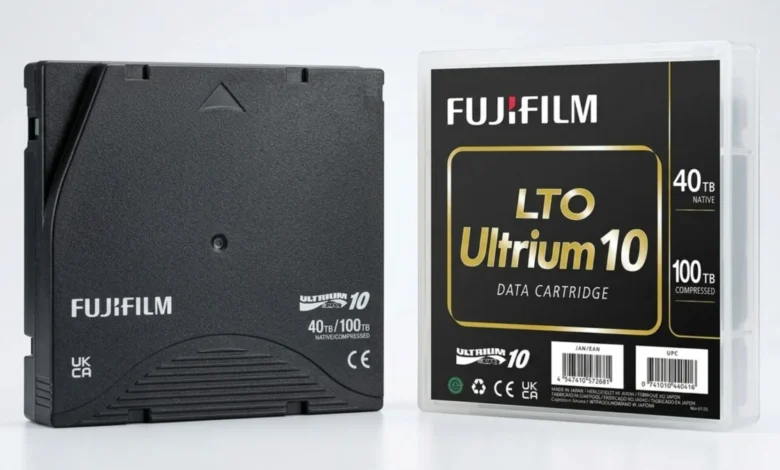
40TB LTO-10 tapes quietly go on sale for $494 — a single tape can hold 13,000,000 songs and up to 100TB of…

The Evolution of LTO Technology
The LTO Program, jointly developed by Hewlett Packard Enterprise, IBM, and Quantum, has served as the gold standard for high-capacity tape storage since its inception in 1997. Over the past three decades, the format has successfully navigated the shift from the dot-com boom to the cloud computing revolution.
The chronology of LTO development is a testament to sustained engineering innovation. When the first LTO-1 generation was introduced, it offered a mere 100GB of storage. With the release of the LTO-10, the format has achieved a thousand-fold increase in native capacity. This trajectory has remained consistent, with each generation roughly doubling the capacity of its predecessor. By prioritizing physical density and magnetic stability, the LTO consortium has ensured that even as solid-state drive (SSD) technology dominated the high-performance computing sector, magnetic tape remained the undisputed champion of the "cold storage" market.
Technical Specifications and Engineering Marvels
The LTO-10 cartridge represents a sophisticated leap in material science. Fujifilm has constructed this iteration utilizing advanced Barium Ferrite (BaFe) particle technology. Unlike traditional metal particle tapes, Barium Ferrite provides superior chemical stability and a significantly longer archival lifespan, with the manufacturer rating the media for up to 30 years under optimal environmental conditions.
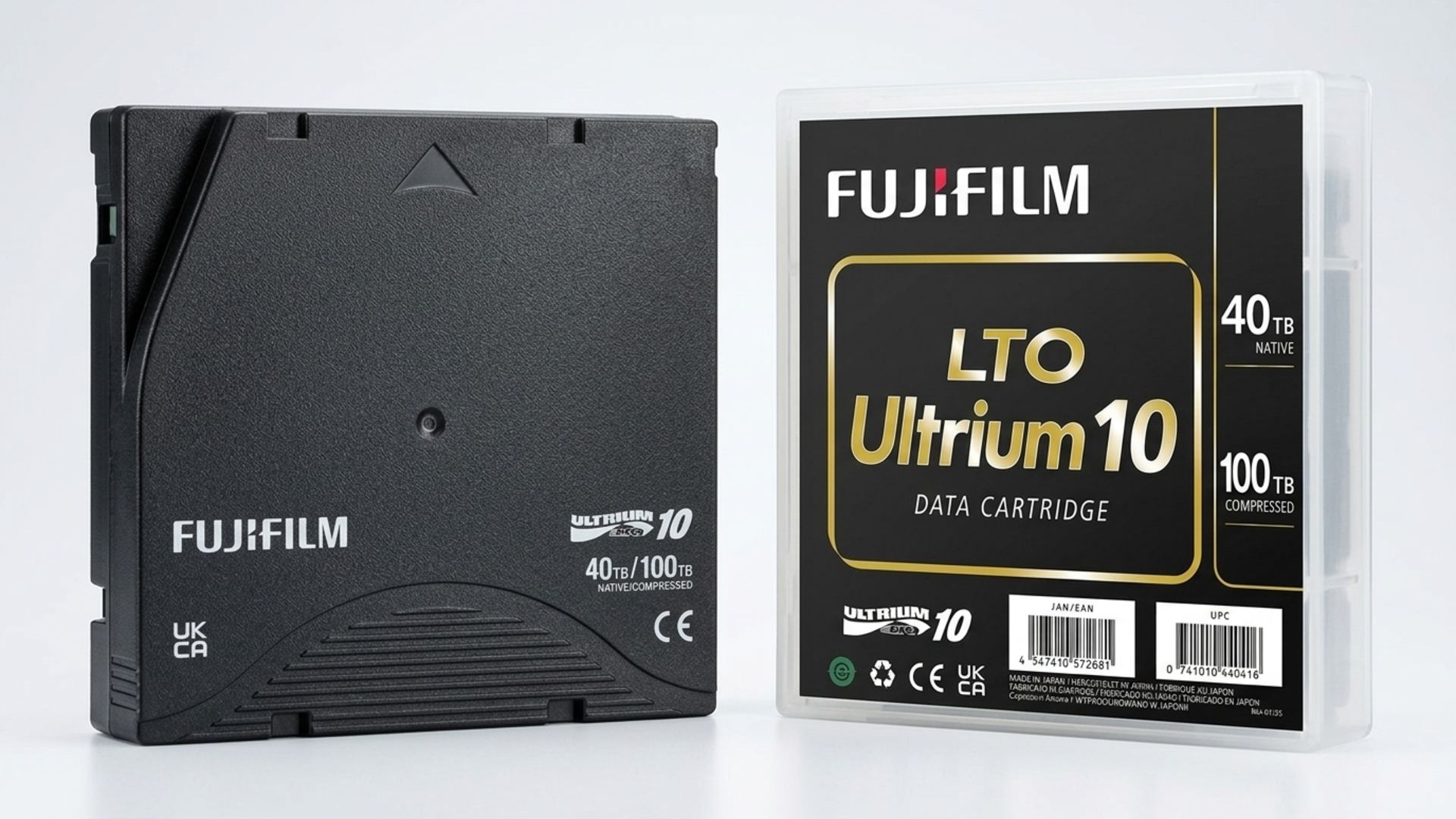
The raw physical specifications of the LTO-10 are designed to handle the massive throughput required by contemporary enterprise environments. The cartridge boasts a native storage capacity of 40TB, which swells to 100TB when utilizing the standard 2.5:1 hardware compression ratio. To put this in perspective, a single tape, which fits easily in the palm of a hand, can store approximately 13 million standard-sized songs or thousands of hours of high-definition video footage.
Data transfer speeds are equally impressive. The LTO-10 supports uncompressed data transfer rates of 440MB per second, which, when compressed, reaches a blistering 1,100MB per second. For comparison, most high-end enterprise SATA hard disk drives (HDDs) typically plateau at 250MB/s to 290MB/s. This performance differential is critical for disaster recovery scenarios where the time taken to restore petabytes of data from a backup can be the difference between operational continuity and catastrophic financial loss.
Reliability and Security in an Uncertain Digital Landscape
In an era where cybersecurity threats and ransomware attacks are ubiquitous, the LTO-10 offers a critical layer of protection through hardware-level security. The cartridge is equipped with AES-256 bit encryption and adheres to FIPS 197 compliance standards. This makes the format a preferred choice for government agencies, financial institutions, and healthcare providers, where the integrity and confidentiality of sensitive data are non-negotiable.
Furthermore, the physical reliability of the tape is unparalleled. Fujifilm reports a bit error rate (BER) of 1 in 10 to the 20th power. Industry analysts suggest this level of reliability is roughly 100,000 times higher than that of standard enterprise-grade hard drives. The technical explanation for this resilience lies in the tape’s architecture, which spreads 15,105 individual tracks across the surface, ensuring a dense yet highly stable layout that is impervious to the mechanical failure modes—such as head crashes or motor degradation—common in spinning hard drives.
Strategic Context: Why Tape Still Matters
Despite the ubiquity of cloud storage services and the dropping prices of NAND flash memory, the demand for LTO tape is currently undergoing a resurgence. The primary driver for this is the "Data Tsunami"—the massive accumulation of unstructured data generated by AI training sets, IoT sensor networks, and high-resolution surveillance systems.
Organizations are increasingly adopting a "tiered" storage strategy. Hot data is kept on high-performance NVMe SSDs for immediate access, while warm data resides on high-capacity HDDs. However, cold data—information that must be retained for regulatory compliance or potential future re-analysis—is increasingly being migrated to LTO tape. The economic logic is undeniable: the cost per terabyte for LTO tape is significantly lower than any other storage medium, including the cheapest high-density HDD arrays.
Moreover, the "air-gap" capability provided by tape remains the final line of defense against ransomware. Because a tape cartridge can be physically removed from the drive and stored offline, it is effectively invisible to digital intruders. This immutable nature of the medium provides a level of protection that no network-attached storage (NAS) device can emulate.
Market Positioning and Implementation Hurdles
While the technical merits of the LTO-10 are evident, its adoption is not universal. The format requires dedicated LTO-10 tape drives and compatible library hardware. This creates a high barrier to entry, as organizations must invest in the underlying infrastructure before they can utilize the media. Consequently, the LTO-10 is primarily targeted at data centers, academic institutions, and media production houses that already possess the necessary, expensive library robotics.
The pricing structure reflects this specialized market. Currently, the LTO-10 cartridge is retailing for approximately $494, a significant discount from its manufacturer-suggested retail price of $888.89. For organizations managing petabytes of information, this price point is highly competitive, especially when factoring in the limited lifetime warranty provided by Fujifilm. This warranty is a notable feature, providing a level of long-term assurance that is rarely offered in the consumer or even the broader enterprise storage hardware markets.
Future Implications for Enterprise Storage
The release of the LTO-10 is more than a mere spec-bump; it is a declaration of intent by the storage industry. As the world moves toward an AI-driven economy, the value of historical data is rising. Data that was once considered "dead" is now being harvested to train large language models and predictive algorithms. The ability to store this data safely, cheaply, and reliably is the foundation upon which these technologies are built.
Looking ahead, the LTO roadmap suggests that future generations will continue to push the boundaries of magnetic recording. While some critics have long predicted the obsolescence of tape, the format has consistently proven that when it comes to the sheer volume of data, the physical tape remains unmatched. For the foreseeable future, as enterprises grapple with the challenge of holding onto every byte of data generated in an increasingly digital world, the LTO-10 will serve as a vital link in the storage hierarchy, ensuring that today’s information remains accessible for the researchers and analysts of tomorrow. The marriage of 30-year archival stability with 100TB capacity density ensures that for the enterprise, the magnetic tape is not merely a legacy technology, but an essential component of a future-proof data strategy.