X Integrates Grok AI Beta into Ads Manager to Drive Full Advertising Automation and Enhanced Campaign Performance

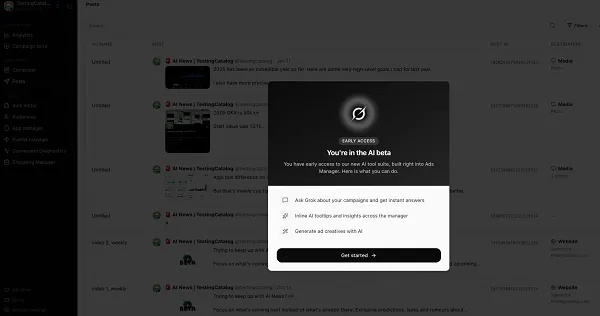
The social media platform X, formerly known as Twitter, has officially commenced beta testing for its Grok artificial intelligence integration within the X Ads Manager, signaling a transformative shift toward a fully automated advertising ecosystem. This latest development, powered by Elon Musk’s xAI venture, aims to provide advertisers with a sophisticated, AI-driven assistant capable of offering real-time strategic guidance, creative inspiration, and campaign optimization. By embedding Grok directly into the advertising workflow, X is positioning itself to compete with the highly automated ad platforms of industry giants like Meta and Google, while leveraging its unique real-time data stream to improve ad relevance and return on investment (ROI).
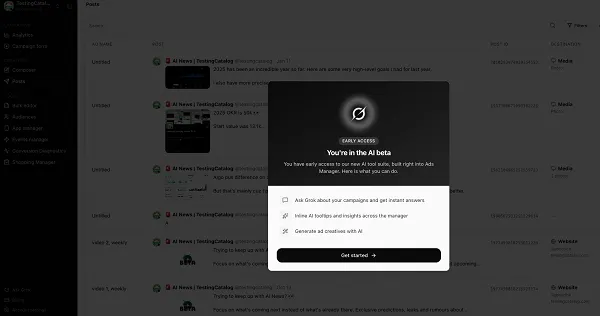
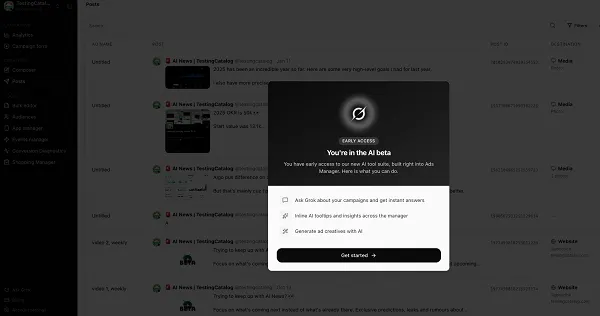
The integration represents the most significant advancement in X’s advertising technology since the platform’s comprehensive rebuild earlier this year. Advertisers participating in the beta test have reported new functionalities that allow them to query the Grok chatbot for specific advice on audience targeting, budget allocation, and creative direction. Furthermore, the update introduces enhanced tooltips and generative AI tools designed to help brands brainstorm and produce ad creatives directly within the stream, reducing the friction between conceptualization and deployment.
The Evolution of X’s AI-Centric Advertising Strategy
The rollout of Grok within the Ads Manager is the culmination of a multi-phase strategy initiated shortly after Elon Musk’s acquisition of the platform in October 2022. Facing a volatile advertising market and the need to diversify revenue streams, Musk has consistently championed AI as the solution to X’s long-standing challenges in ad targeting and brand safety.
In April 2024, X launched a completely overhauled Ad Manager platform, which the company described as the most significant architectural update in its history. This rebuild was focused on replacing legacy systems with modern AI models capable of processing vast amounts of user data in real-time. According to company statements at the time, the new system was designed to better understand user intent and interests, allowing for more precise ad delivery that aligns with the viral trends and breaking news that define the X experience.
The introduction of Grok into this environment is intended to move the platform beyond mere "automated targeting" and into the realm of "agentic" ad generation. In this model, the AI does not just assist the advertiser; it acts as a strategic partner capable of synthesizing complex data sets to make proactive recommendations. Elon Musk has articulated a vision where, by 2025, Grok will facilitate full advertising automation, handling everything from creative production to real-time safety checks and content matching.
Technical Mechanics: How Grok Enhances the Advertiser Experience
Grok’s integration into the Ads Manager is built upon the large language models (LLMs) developed by xAI. Unlike general-purpose AI models, Grok has the unique advantage of real-time access to the global conversation occurring on X. For advertisers, this means the AI can identify emerging cultural moments or shifts in consumer sentiment as they happen, allowing brands to pivot their messaging with unprecedented speed.
The beta features currently being tested include:
- Conversational Campaign Planning: Advertisers can engage in a dialogue with Grok to define their campaign objectives. For example, a brand could ask, "What is the most effective way to reach tech enthusiasts interested in sustainable energy during a major industry conference?" Grok can then suggest specific keywords, follower lookalikes, and demographic filters.
- Generative Creative Assistance: The platform now offers tools to generate ad copy and visual concepts based on successful historical performance data. By analyzing which types of media—such as short-form video or high-resolution imagery—are currently resonating with specific subcultures on X, Grok provides creative prompts that are statistically more likely to drive engagement.
- Real-Time Optimization Tooltips: As advertisers build their campaigns, Grok-powered tooltips appear to provide data-backed suggestions. These might include recommendations to adjust bidding strategies based on current auction density or advice on refining the "call to action" to better align with the mobile-first behavior of X’s user base.
Data-Driven Insights and the 550 Million User Advantage
At the core of this AI push is X’s massive data repository. With more than 550 million monthly active users, the platform generates billions of data points daily, encompassing everything from direct interactions (likes, reposts, and replies) to passive signals like dwell time and scroll depth.
AI tools are uniquely suited to parse this "firehose" of information. By utilizing persona matching, X’s AI can build detailed profiles of high-value consumers. For instance, if a user has previously purchased a high-end consumer electronic product, the system can identify thousands of other users who share similar behavioral patterns, even if they have not explicitly stated an interest in that product category. This capacity for "lookalike" modeling at scale is what X believes will bridge the gap between its current revenue performance and that of its competitors.

Furthermore, the integration of Grok is expected to address the critical issue of brand safety. Historically, advertisers have expressed concerns regarding the proximity of their ads to controversial or "unsafe" content. Musk has stated that Grok’s advanced understanding of context will allow for more nuanced content matching, ensuring that ads appear alongside relevant and appropriate conversations, thereby rebuilding trust with major global brands.
Industry Context and Competitive Landscape
X’s move toward AI-led advertising comes at a time when the entire digital marketing industry is undergoing an AI revolution. Meta’s "Advantage+" and Google’s "Performance Max" have already demonstrated that automation can significantly lower the barrier to entry for small-to-medium businesses (SMBs) while improving efficiency for large agencies.
However, X faces unique challenges. Since the acquisition, the platform has seen a shift in its advertiser base, with many traditional blue-chip brands reducing their spend. The push for full automation via Grok is, in part, an effort to attract a new wave of performance-driven advertisers who prioritize direct-response metrics over traditional brand awareness. If Grok can prove that it can deliver a lower cost-per-acquisition (CPA) through superior AI matching, X may be able to offset the loss of traditional display advertising revenue.
Industry analysts suggest that the success of Grok in Ads Manager will depend on the "hallucination" rate of the AI and the transparency of the data provided to advertisers. While automation is desirable, professional marketers often require granular data to justify their spending. X will need to balance the "black box" nature of AI automation with the reporting requirements of sophisticated marketing departments.
Chronology of X’s Path to AI Integration
- October 2022: Elon Musk completes the acquisition of Twitter, immediately signaling a shift toward engineering-led product development.
- July 2023: Musk announces the formation of xAI, an independent AI research company tasked with building "truth-seeking" artificial intelligence.
- November 2023: Grok is officially launched as a feature for X Premium+ subscribers, showcasing its ability to process real-time data from the platform.
- April 2024: X debuts its rebuilt Ad Manager, laying the technological foundation for deep AI integration and improved targeting algorithms.
- August 2024: During industry discussions, Musk outlines the vision for 2025, emphasizing "agentic" ad generation where Grok manages the end-to-end campaign lifecycle.
- Late 2024 (Current): Beta testing for Grok in Ads Manager begins, with selected advertisers gaining access to conversational guidance and creative tools.
Broader Implications and Future Outlook
The implications of Grok’s integration extend beyond mere advertising. It is a key component of Musk’s broader "Everything App" vision, where X serves as a central hub for social media, financial services, video content, and commerce. In such an ecosystem, advertising is not an external add-on but a seamless part of the user experience, guided by an AI that understands the user’s needs and preferences.
From a labor perspective, the move toward full automation may change the role of social media managers and ad agencies. Rather than spending hours on manual keyword selection and A/B testing, professionals may transition into "AI orchestrators," focusing on high-level strategy and brand voice while leaving the technical execution to Grok.
As the beta testing continues, X is expected to gather feedback and refine the model before a wider rollout. The company has indicated that the goal is to make the platform "the most effective place for a brand to tell its story and drive results." Whether Grok can fulfill this ambitious promise remains to be seen, but the current beta test marks a definitive point of no return in X’s evolution into an AI-first technology company.
The global advertising community will be watching closely to see if X can translate its real-time data advantage into a measurable competitive edge. If successful, the Grok-integrated Ads Manager could set a new standard for how brands interact with social media platforms, moving away from static placements toward a dynamic, intelligent, and fully automated conversational commerce model.
Related posts: