Slack Pioneers Agentic Testing to Revolutionize End-to-End Resilience in Dynamic Software Systems

Slack engineering has unveiled a groundbreaking approach dubbed "agentic testing," integrating artificial intelligence (AI) agents into end-to-end (E2E) testing workflows to bolster resilience within today’s inherently dynamic software systems. This innovative methodology directly confronts a pervasive challenge in continuous delivery (CD) environments: the frequent failure of E2E tests due to superficial changes in user interfaces (UI) or underlying services, rather than genuine functional regressions. Such failures impose a significant maintenance burden, diverting engineering teams from feature development to debugging and updating brittle test suites.
The Evolving Landscape of Software Testing and Its Challenges
Modern software development is characterized by unprecedented speed, complexity, and dynamism. Organizations like Slack operate vast, distributed systems, often built on microservices architectures, with UIs that are constantly evolving through A/B tests, feature flags, and iterative design improvements. Continuous Integration/Continuous Delivery (CI/CD) pipelines, while accelerating deployment, place immense pressure on quality assurance processes to keep pace without compromising reliability.
Traditional E2E tests, designed to simulate complete user journeys across an application, have long been a critical component of quality gates. These tests typically rely on a rigid sequence of actions, stable selectors (like XPath or CSS IDs), and predictable application flows. In a static world, this approach is effective. However, in the context of rapidly changing UIs and APIs, these assumptions frequently break down. A simple UI element relocation, a minor change in a button’s text, or an API response structure tweak, can cause a meticulously crafted E2E test to fail, even if the underlying business logic remains perfectly functional.
Industry reports consistently highlight the substantial cost associated with flaky tests. A 2022 survey by the State of Testing report indicated that over 30% of engineering time is often spent on test maintenance, with a significant portion dedicated to fixing non-deterministic or brittle E2E tests. This "maintenance overhead" not only slows down release cycles but also erodes developer confidence in the test suite, potentially leading to tests being ignored or prematurely disabled. The cumulative effect is a decrease in overall system resilience and an increased risk of user-impacting bugs reaching production.
Introducing Agentic Testing: A Paradigm Shift from Scripts to Intent
Slack’s agentic testing initiative marks a significant departure from these traditional, script-centric models. Instead of defining a strict, step-by-step sequence of actions, engineers now express a test as a high-level objective or "intent." The responsibility for navigating the application to achieve this objective is then delegated to an AI-driven agent.
At its core, agentic testing leverages the adaptive capabilities of AI. An AI agent interprets the specified intent – for example, "add a new channel to a workspace" or "send a direct message to a specific user" – and dynamically interacts with the application. This interaction can occur through both UI surfaces and underlying APIs, allowing the agent a comprehensive view and control over the system under test. At each step of the workflow, the agent evaluates the current application state, drawing upon its understanding of the intent and the system’s behavior, to select the most appropriate next action.
This dynamic decision-making is where agentic testing truly shines. When minor changes are encountered – such as a button moving to a different part of the screen, a form field being renamed, or a new modal appearing – a traditional E2E script would immediately fail. An AI agent, however, attempts alternate paths and strategies to continue execution. It might try clicking a nearby element, searching for text labels, or even inferring the correct interaction based on contextual cues, effectively "healing" the test execution in real-time. Only when the agent is unable to achieve the defined objective after exhausting its adaptive capabilities does the test genuinely fail, signaling a potential functional regression. The successful or failed execution is then validated against expected assertions defined by engineers, ensuring the ultimate outcome aligns with product requirements.
The Agentic Workflow: Planning, Execution, and Observability
The typical workflow for an agentic test begins with the test intent being passed to the dedicated agent layer. This layer initiates a planning phase, where the agent formulates a strategy to achieve the stated goal. Subsequently, it executes actions against the system under test, meticulously observing the results of each interaction. The agent continuously iterates, adapting its plan and actions based on the observed application state, until the objective is successfully completed or a predefined stopping condition is met (e.g., maximum attempts, time limit).
A crucial aspect of this workflow is the comprehensive recording of outcomes. Beyond a simple pass/fail status, agentic testing captures detailed execution traces. These traces document the sequence of decisions made by the agent, the specific interactions performed, and the observed application states at each step. This level of observability is paramount for debugging, allowing engineering teams to replay and inspect failures, understand the agent’s logic, and refine test intents or agent behaviors as needed.
Slack engineers have noted that due to the computational resources and potential non-determinism involved in complex AI decision-making, agent-driven testing is currently better suited for targeted debugging and exploratory testing rather than frequent, high-volume execution within continuous integration (CI) pipelines. Deterministic, fast-running tests remain the cornerstone for rapid feedback in CI.
Illustrative Comparison: Traditional vs. Agentic Flow
To further clarify the conceptual shift, consider the stark contrast in testing flows:
-
Traditional Testing Flow:
click → click → type → assert
This flow is rigid. If any ‘click’ or ‘type’ target moves or changes, the entire sequence breaks. -
Agentic Testing Flow:
goal → agent adapts → verify result
Here, the ‘goal’ is paramount. The agent, with its adaptive intelligence, finds a way to achieve that goal, even if the underlying application structure shifts, and only then is the final outcome verified against expected results.
Strategic Positioning and Complementary Capabilities
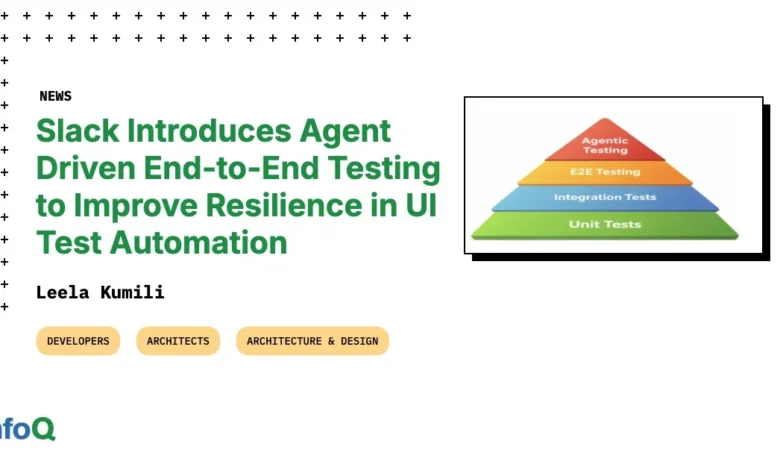
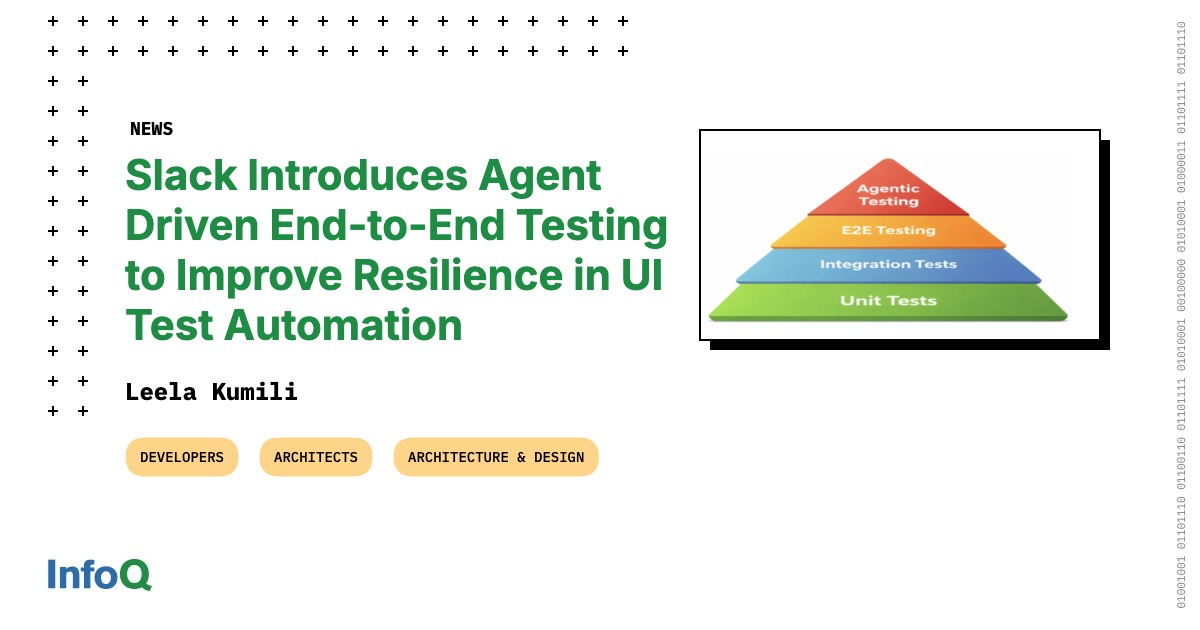
Slack engineering firmly positions agentic testing as a complementary capability within the broader testing ecosystem, not a wholesale replacement for existing methodologies. The widely recognized "testing pyramid" model, which advocates for a large base of fast, inexpensive unit tests, a middle layer of integration tests, and a smaller apex of E2E tests, continues to guide Slack’s overall quality strategy. Agentic testing finds its place specifically within or alongside the E2E layer, where workflows are most susceptible to UI and structural volatility.
Deterministic end-to-end tests will continue to serve as the primary mechanism for validating critical business logic and ensuring contract correctness for APIs, offering fast, repeatable regression validation in CI environments. These scripted or generated tests provide stable verification for predefined, unchanging user journeys.
In contrast, agent-based execution operates from a goal-oriented model, observing the application state and dynamically determining how to reach the desired outcome. This inherent adaptability makes it exceptionally useful for:
- Exploring complex UI behavior: Uncovering edge cases that might be missed by predefined scripts.
- Debugging flaky workflows: Pinpointing the exact point of failure in non-deterministic scenarios.
- Reproducing production issues: Allowing an agent to explore paths that led to a reported bug, even if the exact sequence of user actions is unknown or difficult to replicate manually.
- Reducing failures from superficial changes: Significantly cutting down on the noise generated by E2E test failures that do not reflect actual functional regressions.
Ensuring Control and Observability in an Adaptive System
Introducing AI agents into testing workflows necessitates robust control mechanisms and enhanced observability. Slack’s system includes critical constraints to govern agent behavior during execution. These include:
- Limits on allowed actions: Preventing agents from performing destructive or irrelevant operations.
- Boundaries for exploration: Defining the scope within which an agent can navigate and interact, avoiding infinite loops or unintended system interactions.
- Conditions for stopping execution: Clear criteria under which an agent should cease its attempts, such as reaching a timeout or encountering a critical error.
Observability remains a key requirement for any effective testing strategy, and it is even more critical with adaptive AI agents. As previously mentioned, execution logs are meticulously structured to provide granular visibility into each step taken by the agent, the decisions made, and the observed system state. This comprehensive logging enables engineering teams to understand why an agent succeeded or failed, facilitating effective debugging and continuous improvement of the testing process.
Broader Industry Implications and Future Outlook
Slack’s foray into agentic testing reflects a broader industry trend towards leveraging AI and machine learning (ML) to address long-standing challenges in software development and quality assurance. Companies like Microsoft, Google, and various startups are actively exploring AI agents for tasks ranging from code generation and security analysis to automated bug fixing and intelligent test generation.
The implications of agentic testing, if widely adopted and refined, could be transformative for the software industry:
- Reduced Developer Toil: By automating the adaptation to minor UI changes, engineers can be freed from the tedious and time-consuming task of maintaining brittle E2E tests, allowing them to focus on higher-value activities such as feature development and architectural improvements.
- Enhanced Product Quality and Resilience: More robust and adaptable E2E tests mean that genuine regressions are identified more reliably, leading to fewer critical bugs reaching production and a more stable user experience.
- Shift in QA Skill Sets: The role of quality assurance engineers may evolve from meticulous script writers to strategic intent definers, agent trainers, and sophisticated outcome analysts. Their expertise will shift towards understanding application behavior, designing effective objectives, and interpreting agent traces, rather than fixing flaky selectors.
- Faster Feedback Loops (Indirectly): While not for primary CI, faster debugging and exploratory testing capabilities can accelerate the overall development cycle by quickly identifying and triaging complex issues that would otherwise consume significant manual effort.
- Potential for Self-Healing Systems: In the long term, agentic testing could pave the way for more sophisticated, self-healing testing infrastructures, where agents not only adapt during execution but also learn from past failures to improve their strategies autonomously.
However, challenges remain. The cost-effectiveness of deploying and maintaining such AI systems, the complexity of accurately defining intents, and ensuring sufficient determinism and repeatability for critical validations are areas that will require ongoing research and development. The "black box" nature of some AI decisions also presents a challenge, necessitating robust logging and visualization tools to maintain transparency and trust in the testing process.
Despite these hurdles, Slack’s pioneering work in agentic testing represents a significant leap forward in the quest for more resilient, efficient, and intelligent software quality assurance. It underscores a future where AI agents play an increasingly vital role in ensuring that complex, dynamic software systems can adapt, evolve, and reliably serve their users without succumbing to the inherent brittleness of traditional testing methodologies. This innovation from a leading technology company sets a precedent for how the industry might tackle the ever-growing complexities of modern software delivery.