Rethinking Hammer Tap Testing Protocols: Moving Beyond the Idealized Half-Sine Waveform

The traditional reliance on the idealized half-sine waveform as the gold standard for instrumented hammer testing is undergoing a rigorous technical reassessment within aerospace structural dynamics communities. For decades, engineers have utilized manual hammer taps to excite structures for modal analysis and pyroshock testing, often discarding results that deviated from a perfect, smooth half-sine pulse. However, recent findings from NASA’s Langley Research Center suggest that this practice is not only unnecessary but potentially counterproductive to achieving accurate structural characterization. By prioritizing the precision of the measured force and response history over the visual "perfection" of the input waveform, researchers are moving toward a more robust, data-driven methodology that embraces the complexities of real-world physical contact.
The Evolution of Modal Testing Standards
Structural health monitoring and modal analysis have long relied on hammer excitation—a technique where a load cell-equipped hammer strikes a test article to determine its natural frequencies, mode shapes, and damping characteristics. Historically, the academic and industrial expectation was that a valid test must produce a clean, single half-sine pulse. This expectation was rooted in the convenience of mathematical modeling, where a simple pulse shape is easier to define analytically.
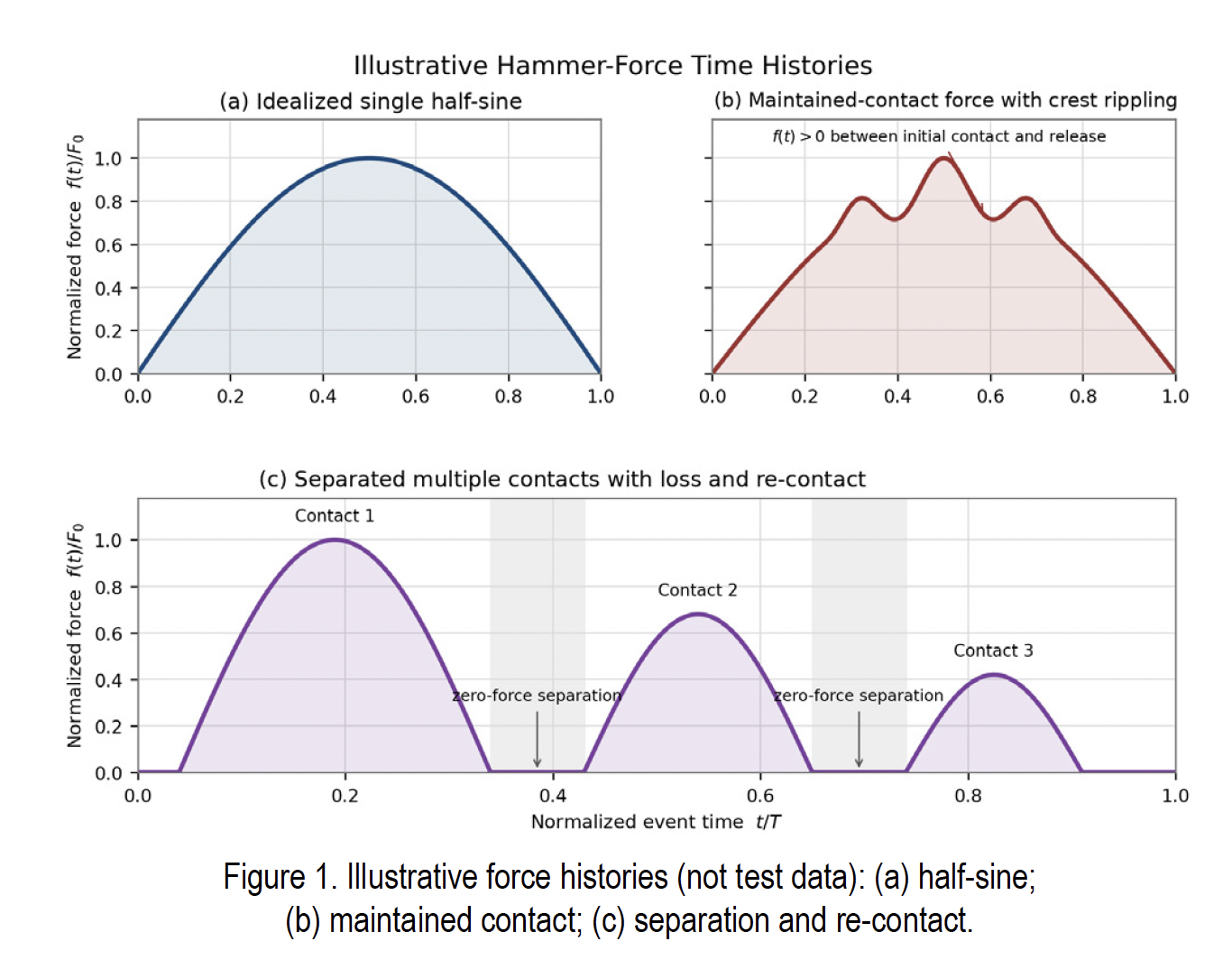
However, the physical reality of a hammer strike is rarely so tidy. Factors such as the material hardness of the hammer tip, the structural stiffness at the point of impact, and the human variability of the technician often introduce "crest ripples" or "separated contacts"—instances where the hammer bounces or oscillates during the brief moment of impact. Previous testing standards often led to the rejection of these non-ideal tests, resulting in repeated efforts that consumed valuable time and resources without necessarily improving the quality of the structural data.
Chronology of Modern Diagnostic Refinement
The shift in perspective stems from a multi-year effort to refine NASA-STD-7003, which governs pyroshock test criteria. Throughout the early 2020s, testing facilities began documenting instances where "imperfect" force inputs yielded highly consistent and reliable modal data.
In late 2025, a collaborative team of researchers, including Joel W. Sills and a multi-disciplinary group of structural engineers, began a systematic study to compare linear and nonlinear structural responses under various excitation histories. By September 2026, the publication of the foundational study, Validity and Predictability of Measured Hammer Tap Inputs: Linear and Nonlinear Structural Systems, formalized the argument that the shape of the excitation does not inherently invalidate a test record, provided the instrumentation captures the complete history of the interaction.
Analyzing the Limitations of the Half-Sine Paradigm
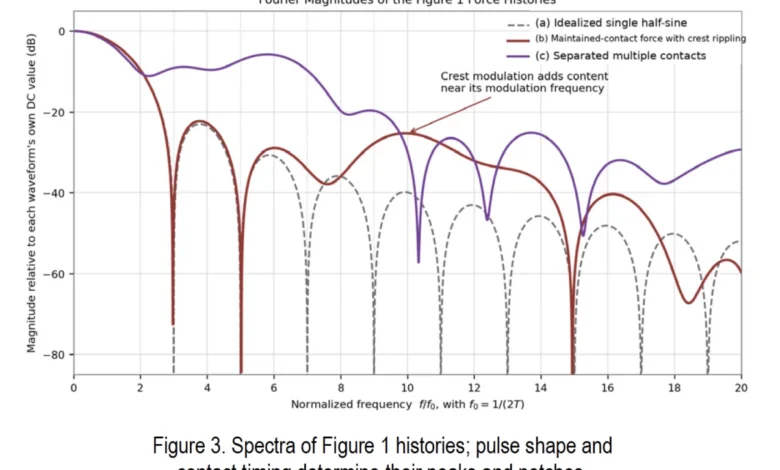
To understand why the half-sine is an insufficient benchmark, one must examine the spectral content of the pulse. A finite half-sine waveform is indeed broadband, but it is not "flat." Spectral analysis reveals that a half-sine pulse contains inherent notches—frequencies where the energy input drops to near zero—at intervals dictated by the pulse duration.
If a test objective requires excitation at these specific notched frequencies, a perfect half-sine pulse will fail to adequately excite the structure, regardless of how clean the waveform looks on an oscilloscope. Conversely, the "imperfect" waveforms characterized by crest ripples actually contain additional spectral content that can fill these notches, providing a more comprehensive excitation of the structure. Furthermore, separated contacts create deterministic interference patterns that, when captured accurately by high-bandwidth data acquisition systems, provide a detailed map of the structural interaction.
The Technical Requirements for Data Validity
The consensus among lead researchers is that validity should be determined by the quality of the measurement chain rather than the aesthetics of the force pulse. To ensure a test meets modern adequacy standards, several technical criteria must be strictly maintained:
- Measurement Fidelity: The entire applied force history must be recorded with high temporal resolution. This requires adequate bandwidth to ensure that high-frequency components of the impact are not filtered out.
- Signal-to-Noise Ratio (SNR): Response measurements must be scrutinized for noise floor interference. If the structural response is indistinguishable from electrical noise, the test must be deemed invalid, regardless of the force pulse shape.
- Dynamic Range and Calibration: Instrumentation must be calibrated to handle the full range of expected impacts, ensuring that the signal is neither clipped by over-range saturation nor buried in the noise of an under-range setting.
- Coverage of Test Objectives: The excitation must demonstrate sufficient amplitude and frequency breadth to cover the nonlinear states of the test article. If the structure exhibits nonlinear behavior—such as joint slipping or material damping shifts—the input must be energetic enough to trigger these states.
Implications for Aerospace and Industrial Testing
The transition away from visual "half-sine verification" has significant implications for aerospace manufacturing and maintenance. By accepting complex force inputs, testing facilities can reduce the number of repeated strikes required to get a "perfect" record. This is particularly critical in the testing of expensive or fragile flight-hardware, where every impact cycle introduces a minute amount of fatigue or risk of surface damage.
Furthermore, this shift encourages a deeper integration of digital signal processing in the field. Engineers are now encouraged to move beyond simple visual inspection and utilize spectral density functions to verify that the energy provided by the hammer is sufficient to excite the required frequency bands. If the measured force history is complete, the numerical model—whether linear or nonlinear—can accurately predict the response, provided the initial conditions are correctly mapped.
Official Guidance and Future Directions
The current recommendation from the Langley Research Center emphasizes that the utility of a hammer test is entirely subordinate to the test objective. If the purpose is to identify a specific modal frequency at 500 Hz, the adequacy of the hammer tap is defined by whether the force input provided sufficient energy at that frequency, not by the symmetry of the pulse.
For practitioners in the field, this represents a move toward "informed validation." Rather than rejecting a test based on the appearance of the waveform, technicians are advised to:
- Verify the synchronization between the force input and the structural response.
- Check for saturation in the response accelerometers or strain gauges.
- Inspect the measured spectrum to ensure that critical frequencies are not lost in the spectral notches of the pulse.
The conclusion drawn by the research community is clear: a half-sine appearance is a poor proxy for validity. As structures become more complex and the demand for high-fidelity modal data increases, the reliance on idealized waveforms must give way to a rigorous evaluation of the complete force and response history. By focusing on the physics of the impact—the bandwidth, the synchronization, and the spectral coverage—engineers can ensure that their structural characterizations are both accurate and defensible under the most stringent safety standards.
For further information regarding these protocols or to consult the latest technical briefings, stakeholders are encouraged to contact Joel W. Sills at the Langley Research Center. The transition toward this evidence-based methodology marks a significant milestone in the maturity of structural testing, ensuring that the tools of the past are utilized with the precision demanded by the engineering challenges of the future.