Meet The Startup Automating The Backbone Of Industrial Infrastructure And Tackling The Labor Shortage

Industrial infrastructure relies heavily on networks of pipes that transport essential resources such as oil, gas, petrochemicals, water, wastewater, food and beverages, mining materials, and nuclear energy. While these systems remain largely invisible to the general public, their assembly, maintenance, and repair demand constant physical labor. At the heart of this physical upkeep are bolted flange joints—the standard mechanical connections used to join sections of pipe together. These joints must be securely fastened and systematically loosened for maintenance, a task that has historically fallen entirely on the shoulders of skilled trade workers like pipefitters.
However, the industries responsible for maintaining these critical networks face mounting operational pressures. A severe, ongoing labor shortage across North America has placed extraordinary demands on the existing workforce. Pipefitters frequently endure grueling schedules, including twelve-hour shifts spanning consecutive months, to keep facilities operational. These demanding physical conditions contribute to high fatigue levels, increased rates of workplace injuries, and notoriously low regional productivity metrics. Recognizing these systemic challenges, a former ExxonMobil engineer and planner named Lindsey Elliott has founded a startup called Nexterity to introduce automation to one of the most physically taxing aspects of industrial maintenance.
The Genesis of Nexterity and the Bolting Symposium
Elliott spent years analyzing the inefficiencies inherent in moving oil, gas, and petrochemicals through large-scale industrial facilities. Her observations consistently pointed to the manual labor required for bolted flange joints as a major bottleneck in infrastructure maintenance. Seeking specialized technical insights, Elliott immersed herself in industry gatherings, notably the annual Bolting Symposium, which recently celebrated its thirteenth installment. There, she engaged with self-proclaimed "torque dorks"—specialized engineers, researchers, and technicians dedicated to the science of industrial fastening and pressure vessel mechanics.
Interactions at the Bolting Symposium and with members of the Pressure Vessels and Piping Division of the American Society of Mechanical Engineers provided Elliott with critical data regarding piping standardization. Industry specialists highlighted that approximately 80 percent of all industrial piping falls between two and eight inches in diameter, designated technically as Nominal Pipe Size 2 through 8 (NPS2 to NPS8). This high degree of dimensional standardization presented an ideal opportunity for targeted robotics and mechanical automation. Armed with this realization, Elliott conceptualized a solution designed to eliminate the physical strain of manual bolt manipulation without requiring a complete redesign of existing piping architecture.
Engineering the Solution: Remote-Controlled Pipe Automation
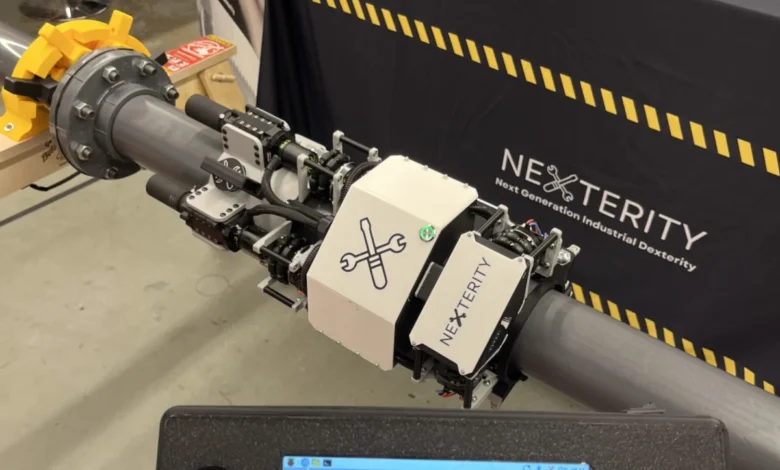
Nexterity has developed a specialized, battery-powered, remote-controlled robotic system designed specifically to handle the loosening and tightening of industrial pipe bolts. The device is engineered in two primary modular components that easily fit around standard cylindrical pipes. Once clamped into position, the robot utilizes an integrated sliding mechanism to traverse the exterior of the pipe, granting it access to multiple fasteners in rapid succession.
Unlike traditional heavy machinery that requires specialized transport and setup, the Nexterity robot is compact and portable. All configurations developed by the startup are designed to fit neatly inside a standard Pelican case, allowing a single worker to transport the equipment easily to and around a job site. This portability aligns directly with the startup’s operational business model, which treats the robotic hardware akin to rental construction equipment. By lowering the barriers to deployment, industrial facilities can integrate the technology into routine maintenance routines without undertaking extensive capital expenditure programs.
The system is engineered to manage four bolts simultaneously, significantly accelerating operations that previously required manual wrenches, pneumatic tools, and sustained physical exertion. By shifting the labor-intensive aspects of flange management from human operators to the remote-controlled unit, the technology aims to drastically reduce the incidence of repetitive strain injuries, muscle fatigue, and acute accidents associated with heavy torque work.
Broader Market Implications and Industrial Applications
While the initial impetus for Nexterity’s technology stemmed from the petrochemical and oil and gas sectors, the potential market applications extend far beyond fossil fuels. Industrial piping infrastructure is universally standardized across multiple critical sectors of the global economy. Water treatment facilities, municipal wastewater systems, commercial food and beverage processing plants, mining operations, nuclear power generation stations, and green manufacturing facilities all utilize similar bolted flange configurations.
The breadth of these potential markets underscores the hidden scale of industrial bolting operations. Although daily consumers rarely consider the complex networks of pipes delivering utilities and goods, the economic footprint of pipefitting and maintenance is immense. By introducing automation into environments characterized by labor shortages and demanding working conditions, startups like Nexterity aim to stabilize maintenance timelines and enhance overall productivity.
Integration into the TechCrunch Disrupt Ecosystem
Nexterity’s innovative approach to an age-old industrial problem has earned the company widespread industry recognition, culminating in its selection as one of the Startup Battlefield 200 participants at TechCrunch Disrupt. This platform places the startup among a select group of emerging companies chosen for their potential to disrupt established industries through novel technological applications.
Participation in high-profile startup showcases provides early-stage companies with vital visibility, connecting founders with potential investors, strategic industrial partners, and prospective enterprise clients. For Nexterity, the exposure offers a strategic pathway to scale manufacturing operations, expand pilot testing programs with major energy and manufacturing firms, and refine its rental-based deployment model.
Outlook for Workforce Dynamics in the Trades
The introduction of robotics into traditional blue-collar trades frequently sparks discussions regarding the future of human labor. However, industry advocates and startup founders emphasize that automation in sectors like pipefitting is primarily designed to augment and relieve human workers rather than completely replace them. Given the acute labor shortages currently plaguing the skilled trades across the United States and Canada, robotic tools like Nexterity’s bolting system offer a necessary relief valve for overextended workforces.
By absorbing the most physically demanding, repetitive, and injury-prone tasks—such as torquing hundreds of industrial bolts during a facility turnaround—automation allows skilled pipefitters to focus on higher-level system diagnostics, safety oversight, and complex problem-solving. This shift not only improves worker retention and safety compliance but also addresses the chronic productivity lag that has challenged North American industrial maintenance for decades. As startups continue to bridge the gap between traditional mechanical engineering and modern robotics, the backbone of industrial infrastructure may finally receive the technological modernization it requires.