HP OmniBook Ultra 14: A Comprehensive Analysis of the New Snapdragon-Powered Lightweight Contender

The HP OmniBook Ultra 14 represents the latest salvo in the increasingly competitive landscape of premium, super-lightweight laptops, positioning itself as a direct rival to the Asus Zenbook A14 and the Apple MacBook Air. Built upon the architecture of Qualcomm’s second-generation Snapdragon X2 chipsets, the device retails for approximately £1,300, placing it firmly in the high-end professional tier. While it shares a foundational philosophy with its competitors—prioritizing portability, efficiency, and integrated AI capabilities—the HP OmniBook Ultra 14 carves out a distinct niche through specific hardware choices, most notably the inclusion of a touchscreen and a unique internal configuration designed to optimize battery endurance over raw processing overhead.
The Evolution of the OmniBook and Market Positioning
HP’s revival of the "OmniBook" moniker signifies a strategic shift in the company’s approach to mobile computing. Historically, the brand was synonymous with high-end, reliable corporate workstations. The 2026 iteration, however, embraces the Copilot+ PC paradigm, a movement driven by Microsoft and its silicon partners to bring neural processing units (NPUs) to the forefront of the user experience.
The market for 14-inch laptops has become the primary battleground for ultrabooks, as professionals demand a balance between screen real estate and carry-weight. The Asus Zenbook A14 has set a high bar for portability, weighing in at an exceptionally light 840g. In contrast, the HP OmniBook Ultra 14 hits the scales at 1.24kg. While this makes it heavier than the Asus model, it remains competitive with the 13.6-inch MacBook Air. HP has utilized a design strategy centered on "sculpted edges," which reduces the physical thickness of the frame to 10.7mm, creating a tactile impression of ultra-portability despite the slight weight premium.
Hardware Architecture and Processing Strategy
At the heart of the HP OmniBook Ultra 14 is the Snapdragon X2P-64-100 processor. This 10-core chip represents the entry-level offering within Qualcomm’s second-generation X2 series. This is a critical point of differentiation from the Asus Zenbook A14, which utilizes the more robust 18-core X2E-88-100 variant.
From an architectural standpoint, the HP configuration features six "Prime" cores clocked at 4.0GHz and four "Performance" cores at 3.4GHz. This decision reflects a calculated design choice: by opting for a less power-hungry processor, HP has achieved a remarkable feat in power efficiency. Benchmarking data confirms this trade-off. In Cinebench R24, the HP recorded 973 in multi-core tests compared to the 1139 of the Asus. Similarly, in the 3DMark Night Raid graphics test, the HP achieved 33,406 versus the Asus’s 40,574.
However, synthetic benchmarks often fail to capture the nuances of daily workflow performance. For the target demographic of office-based professionals, content creators, and mobile executives, the difference in processing overhead is largely negligible. The inclusion of an 80TOPS (Trillion Operations Per Second) NPU ensures that the device is fully capable of running local AI tasks—such as Windows’ Recall feature and generative fill tools in creative applications—without needing to lean heavily on the CPU.
Display Technology: The Touchscreen Advantage
One of the most significant arguments in favor of the HP OmniBook Ultra 14 is the integration of a touchscreen display protected by Corning Gorilla Glass 3. Neither the Apple MacBook Air nor the Asus Zenbook A14 currently offers a touch interface, making the HP the superior choice for users who rely on tactile navigation.
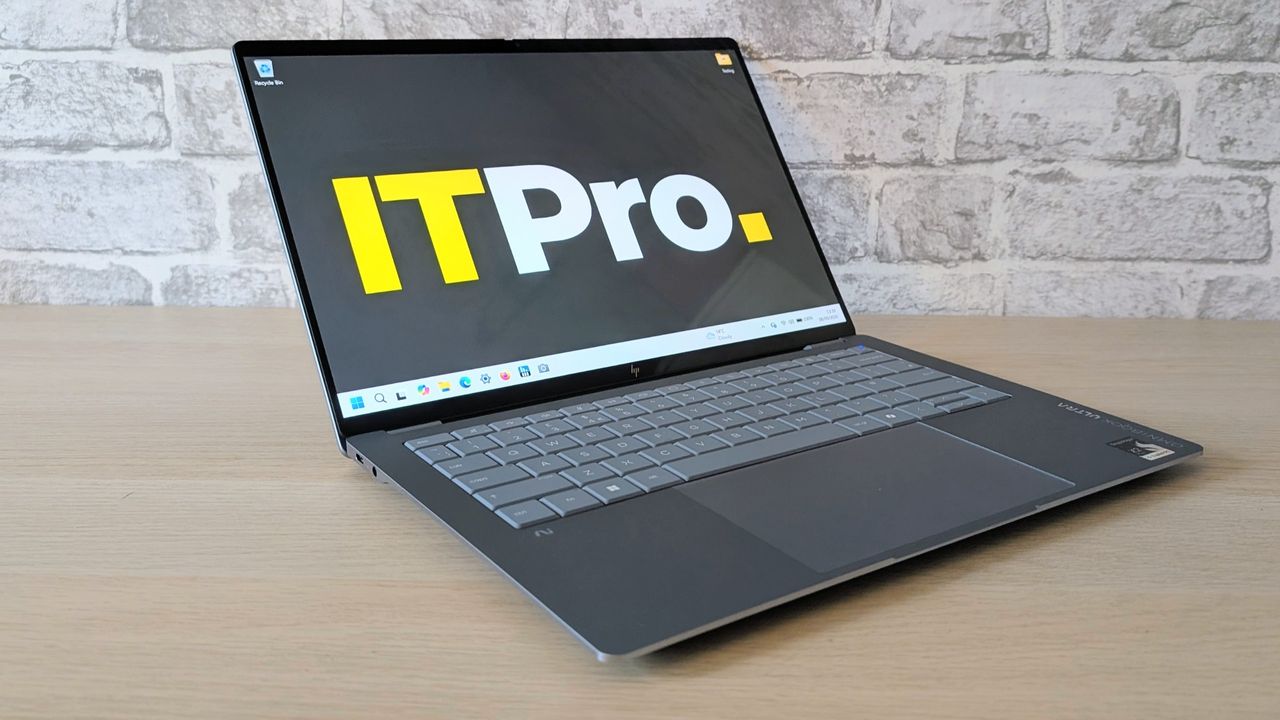
The display is a 60Hz OLED panel with a 1,920 x 1,200 resolution. It offers excellent color accuracy, boasting 162% sRGB and 99.5% DCI-P3 volume, with a Delta E score of 1.1 when configured to the P3-D65 color space. However, there is a technical caveat: the screen’s peak brightness is capped at 285 nits. This falls significantly short of the 390 nits found in the Zenbook A14 and the 500-plus nits on the MacBook Air. Furthermore, the high reflectivity of the glass surface can make outdoor visibility challenging. While the screen is technically impressive for indoor, color-critical work, it is less versatile for those who frequently work in brightly lit environments or direct sunlight.
Battery Life and Operational Efficiency
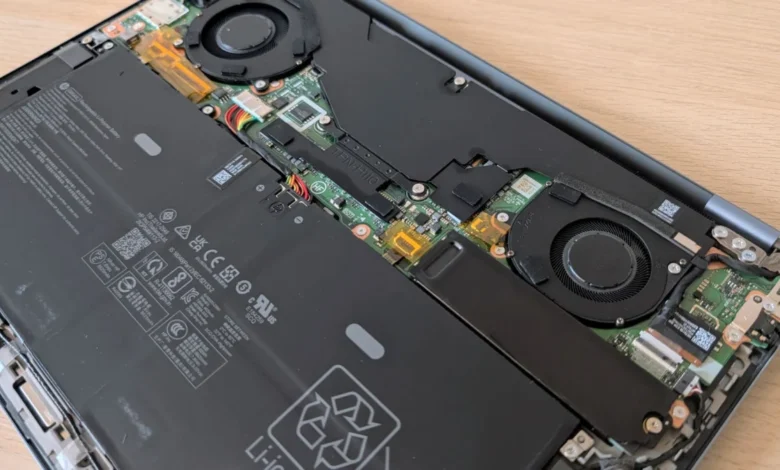
The most compelling aspect of the HP OmniBook Ultra 14 is its extraordinary battery endurance. By utilizing a slightly less power-intensive chipset and balancing the system’s energy consumption, HP has achieved a standout performance in longevity. During internal testing using a standard video-loop (VLC) with brightness locked at 170 nits, the device provided 37 hours and 15 minutes of runtime.
To put this into perspective, this figure is roughly seven hours longer than the Asus Zenbook A14 and nearly two-and-a-half times the duration offered by the M5 MacBook Air. For a business traveler, this capability effectively removes the "battery anxiety" associated with international flights or long days of field work without access to power outlets. It is a tangible, quantifiable benefit that serves as a strong counter-argument to the higher raw processing power of its competitors.
Connectivity and Physical Build
HP has opted for a strictly USB-C ecosystem, equipping the device with three 40Gbps-rated ports that support DisplayPort 2.1. This decision provides users with significant flexibility, allowing for charging from either side of the laptop and dual-monitor setups via a docking station. While the absence of USB-A or HDMI ports may frustrate some users who rely on legacy peripherals, the trade-off is a chassis that feels significantly more modern and streamlined.
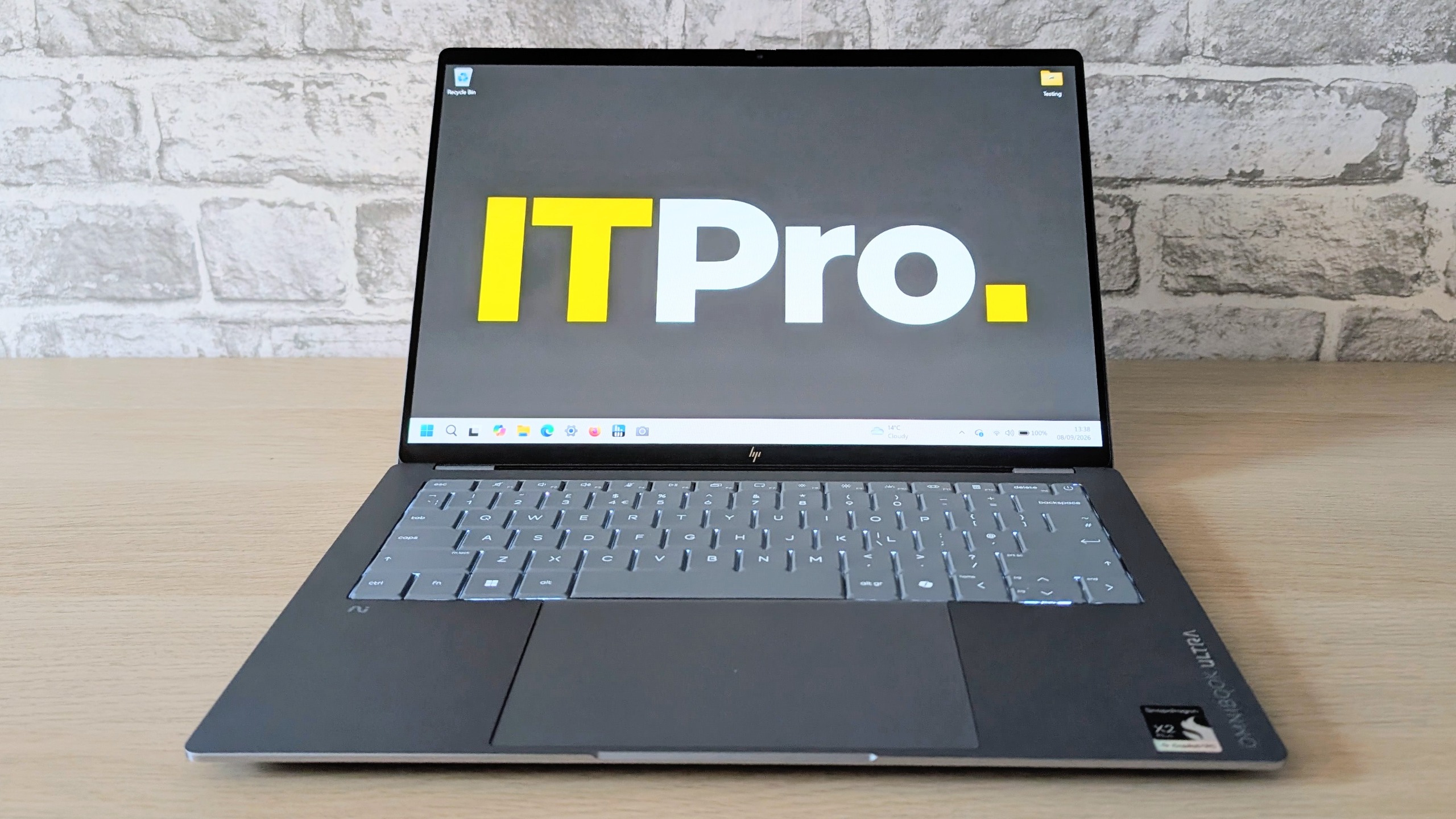
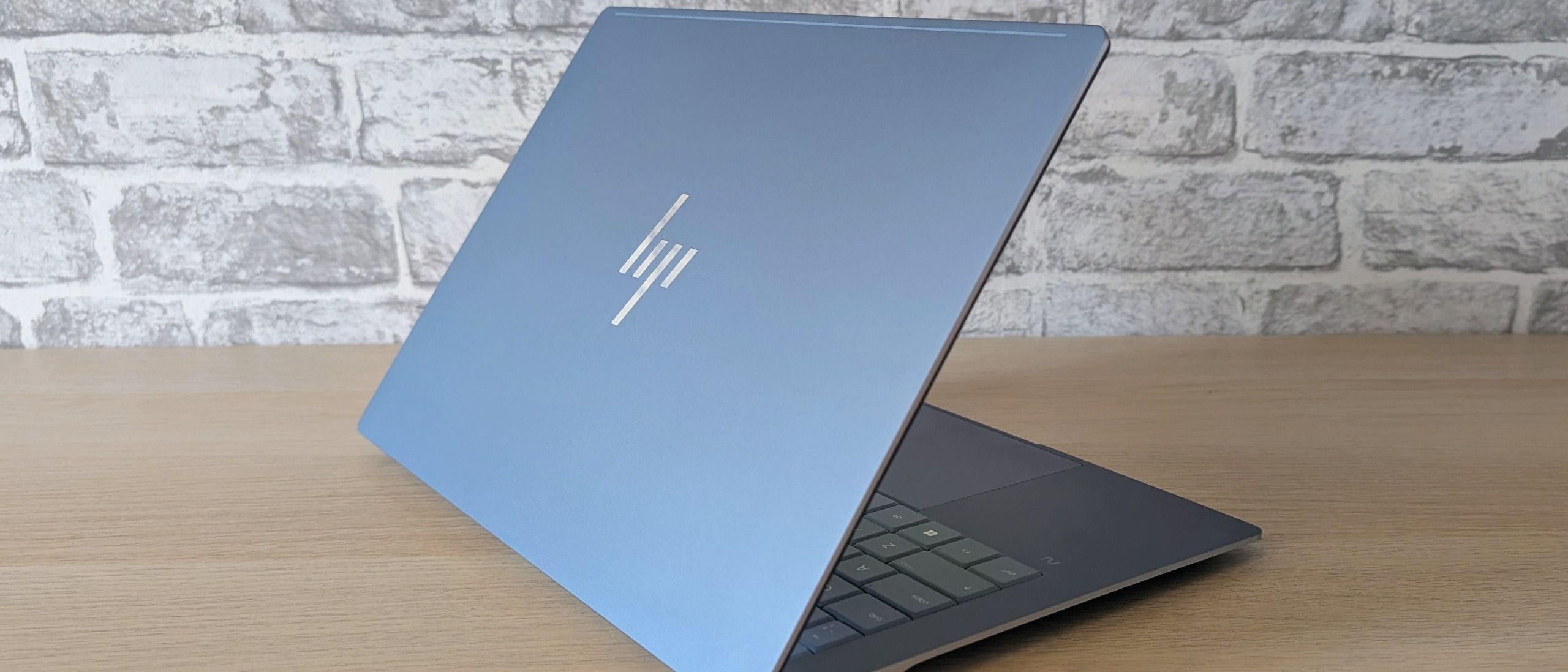
The build quality is characterized by an all-aluminum construction, excluding the base plate, which contributes to a feeling of structural rigidity. The device has passed 20 MIL-STD (Military Standard) tests, ensuring durability against drops, vibrations, and thermal fluctuations. The aesthetic, finished in "Stone Blue" with a sandblasted texture, serves a dual purpose: it provides a sophisticated look and, crucially, resists fingerprints, maintaining a pristine appearance through long-term use.
The Human Interface: Keyboard and Webcam
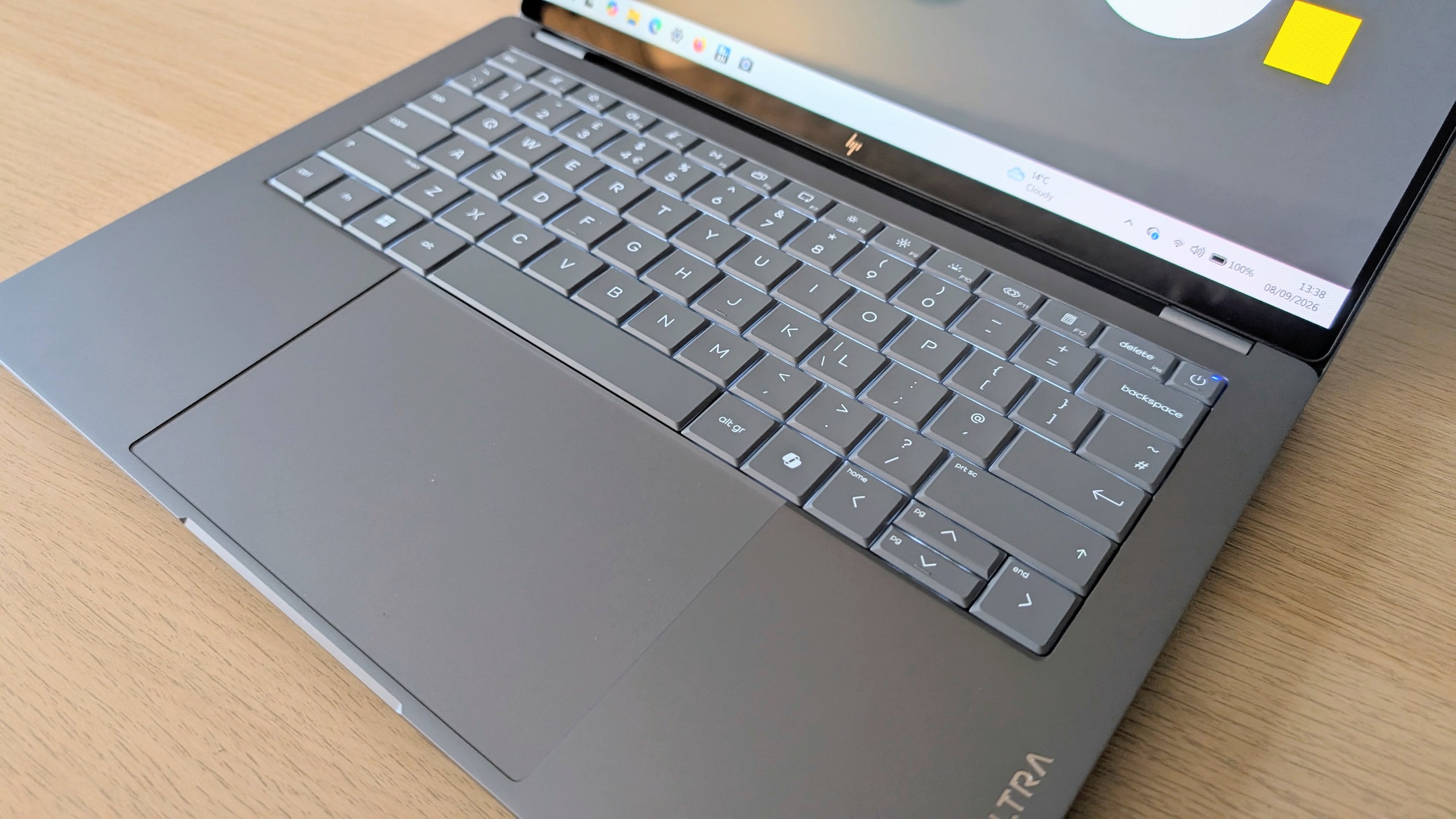
The user interaction experience is bolstered by a high-quality haptic touchpad, which measures 140 x 85mm. The haptic feedback provides a consistent, quiet click, making it ideal for collaborative environments such as boardrooms or libraries. The keyboard offers 1.3mm of key travel with a silent, tactile action, suitable for long-form writing.
Complementing the input devices is a 1440p webcam. In an era where hybrid work is the norm, the quality of video conferencing hardware has become a priority. The HP sensor handles ambient light shifts effectively, providing crisp, color-accurate images. The inclusion of a manual privacy shutter and Windows Hello IR facial recognition provides a necessary layer of security for the enterprise user.
Strategic Implications and Industry Outlook
The release of the HP OmniBook Ultra 14 highlights a broader trend in the PC industry: the move away from raw performance as the sole metric of success, toward a more holistic focus on battery efficiency and specialized feature sets. By choosing a 10-core processor over an 18-core alternative, HP is explicitly betting that the majority of modern users value a device that can last multiple days on a single charge over a marginal increase in rendering or calculation speed.
Furthermore, the integration of an 80TOPS NPU aligns HP with the global shift toward edge-based AI. By moving heavy computation tasks from the cloud to the local processor, these devices are becoming more secure and responsive.
While the screen brightness remains a notable point of contention for potential buyers, the overall package—combining build quality, superior battery life, and a responsive touchscreen—positions the OmniBook Ultra 14 as a serious tool for the modern professional. The laptop does not attempt to outperform the competition in every category; instead, it offers a refined, highly specific experience that prioritizes the needs of the mobile-first worker.
Conclusion
The HP OmniBook Ultra 14 is a testament to the maturation of ARM-based Windows computing. It is a device that succeeds by playing to its strengths, specifically in the areas of endurance and build quality. While it faces stiff competition from the Asus Zenbook A14 and the MacBook Air, its unique combination of a touchscreen, long-lasting battery, and robust, fingerprint-resistant chassis makes it a highly viable option for those who prioritize reliability and mobility. As the market for Copilot+ PCs continues to grow throughout 2026, the OmniBook Ultra 14 will likely serve as a benchmark for how manufacturers can balance performance and power efficiency to satisfy the evolving demands of the global workforce.