DoorDash optimizes AI-powered grocery reordering by shifting to offline batch processing to slash latency and boost conversion rates

In a significant advancement for conversational commerce, DoorDash has successfully overhauled its AI-powered grocery reorder flow, achieving a dramatic reduction in system latency. By transitioning from real-time request-based rebuilding to a precomputed model for recurring purchase needs, the company has improved response times from approximately 16 seconds to a swift 2 seconds. This technical refinement has yielded tangible business results, including a doubling of shopping list views and a 34% increase in the order rate for the grocery reorder flow. This development represents a critical milestone in the evolution of Ask DoorDash, the company’s flagship conversational shopping assistant, and highlights the shifting industry consensus regarding the practical deployment of Large Language Model (LLM) agents.
The Technical Pivot: From Reactive to Proactive Inference
For many AI-integrated platforms, the primary bottleneck in user experience has been the inherent latency of LLM inference during live sessions. In the context of grocery shopping, where users expect near-instantaneous interaction, a 16-second delay is often prohibitive, frequently leading to user abandonment. DoorDash’s engineering team identified that the computational cost of analyzing 90 days of purchase history and consumer profile signals during a live request was the primary driver of this friction.
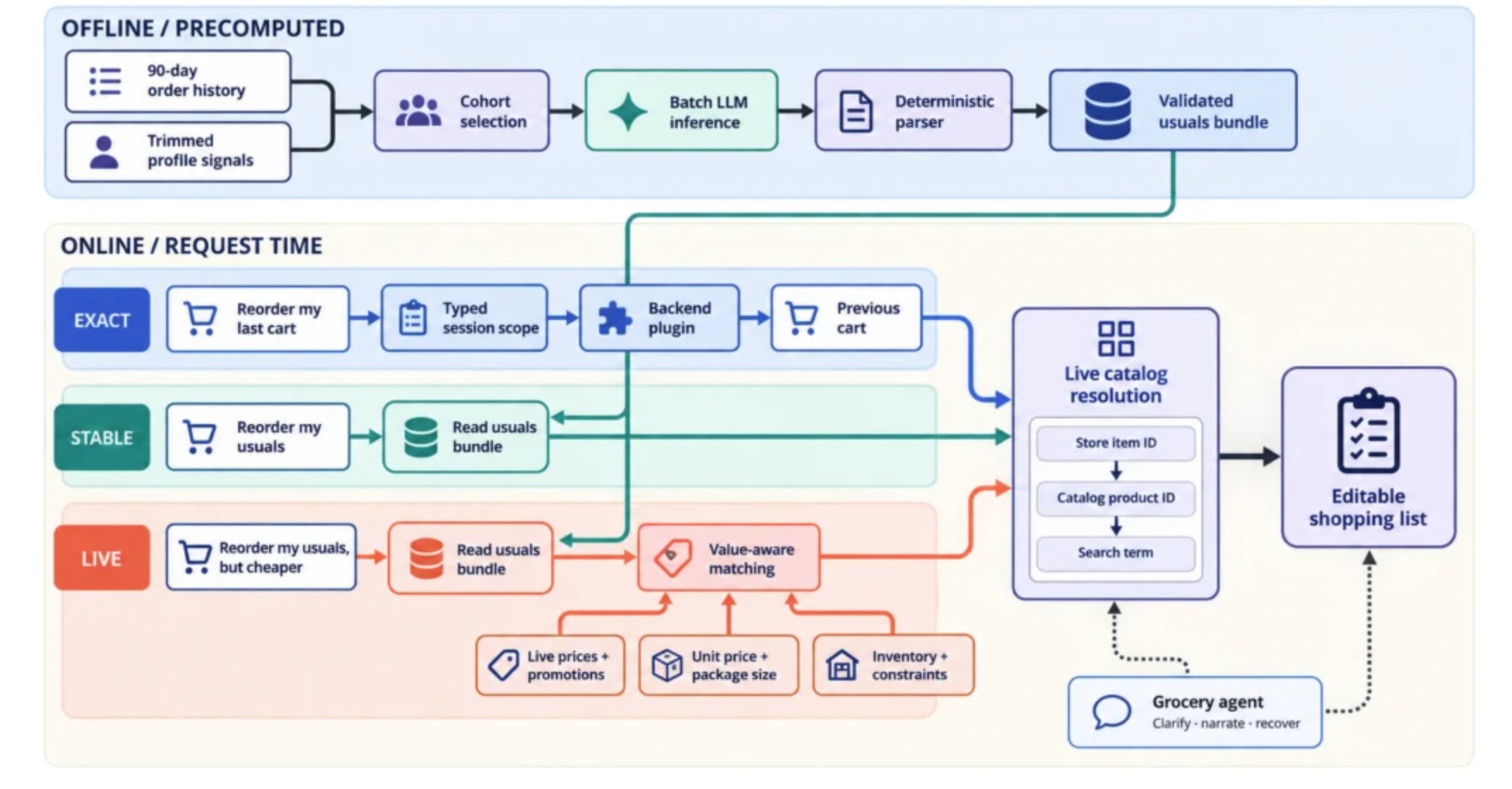
The new architecture decouples historical analysis from the active shopping session. Instead of querying the LLM to interpret past behavior while the user waits, the system now utilizes batch LLM inference to identify likely recurring purchases asynchronously. These results are subjected to a deterministic validation layer, which ensures accuracy and relevance, before being stored as reusable shopping list data. When a user initiates a reorder request, the system retrieves this pre-processed data and performs a live resolution against the current product catalog.
This tiered resolution strategy is robust: it first attempts to match the item to the original store listing; if that fails, it pivots to a catalog product identifier; and if that also proves unsuccessful, it utilizes a search term. This cascading approach allows the system to remain resilient to inventory changes, price fluctuations, and discontinued items without needing to re-run the complex LLM reasoning process.
Chronology of the Ask DoorDash Platform
The success of the grocery reorder feature is not an isolated development but rather the latest iteration of a multi-part infrastructure strategy. Since the inception of Ask DoorDash, the engineering team has been documenting their journey toward building a scalable, agentic platform.
- Foundation Phase: Initial development focused on creating specialized agents capable of conversational discovery. This phase established the core "Ask DoorDash" framework.
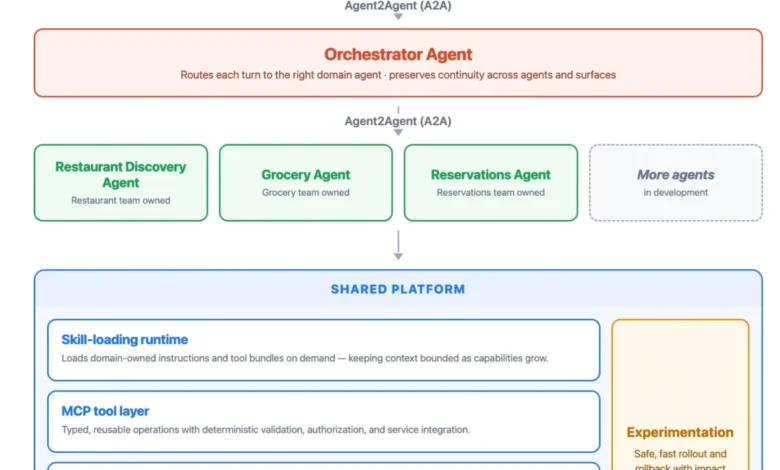
- Infrastructure Scaling: Following the initial deployment, the team shifted toward building a "Shared Agent Platform," which provided reusable infrastructure for memory, model access, tracing, and evaluation. This allowed for the rapid deployment of new agents—most notably, the Reservations agent, which was brought to market in approximately one week, representing a 10x improvement in deployment speed over early domain-specific agents.
- Interface Refinement: Recognizing that conversational history can become cluttered or confusing, DoorDash introduced a "grounded shopping interface." This allows consumers to directly modify shopping lists, with the system treating these manual edits as authoritative.
- Optimization Phase: The most recent development marks the transition to the current offline-first, precomputed reordering flow, which optimizes the user experience by minimizing compute-heavy tasks during the live interaction window.
Implications of Offline Batch Processing
The design rationale behind these changes was articulated by DoorDash engineer Twisha Jain, who emphasized a core principle for the future of agentic AI: "Better agentic systems aren’t always about more reasoning; they’re about deciding what belongs in the agent loop and what can happen ahead of time."
This philosophy signals a broader shift in how tech companies are approaching generative AI. While the industry spent the 2023–2024 period obsessed with raw model performance and "chain-of-thought" reasoning depth, the 2026 landscape is increasingly focused on architectural efficiency. By moving "non-essential" reasoning to the offline phase, DoorDash has freed up the live agent to handle only those tasks that truly require dynamic, real-time intelligence—such as suggesting budget-friendly alternatives based on current promotions or real-time inventory levels.
From a user experience standpoint, the "grounded" nature of the shopping interface is equally vital. By treating the shopping list as a structured artifact that exists independently of the chat log, DoorDash ensures that users maintain agency over their orders. If a user deletes an item from their list, the next agent turn acknowledges that deletion as the "source of truth," rather than attempting to reconcile the user’s intent against a contradictory previous conversational turn.
Competitive Landscape and Industry Context
The competition within the AI-assisted grocery sector remains intense. Instacart, a primary competitor, has similarly leaned into AI to enhance its customer experience, utilizing over 14 years of grocery-specific data to power its own assistant. The Instacart approach focuses heavily on meal planning and complex discovery, utilizing deep integrations with local grocer inventory systems.
DoorDash’s focus on reducing latency for reorders places it in a strong position for the high-frequency user segment. Reordering is, by nature, a utilitarian task; users prioritize speed and accuracy over conversational flair. By separating the "discovery" (which might be handled by a more creative, compute-intensive agent) from the "replenishment" (which is now handled by a high-speed, precomputed system), DoorDash has successfully optimized its service for the specific needs of the grocery consumer.
Economic and Operational Impact
The 34% increase in the order rate within the grocery reorder flow is a significant performance metric that validates the investment in infrastructure. In the e-commerce world, a reduction in friction is almost always correlated with higher conversion. By shortening the path from the intent to reorder to the checkout screen, DoorDash has effectively reduced the "cognitive load" on the consumer.
Furthermore, the modularity of the shared platform offers DoorDash a distinct competitive advantage in terms of agility. The ability to deploy new domain agents in a matter of days—as evidenced by the Reservations agent—means the company can iterate on new product features much faster than competitors who rely on monolithic, harder-to-maintain agent architectures.
Future Outlook and Technical Analysis
The architectural choices made by DoorDash—specifically the use of batch LLM inference followed by deterministic validation—provide a blueprint for other enterprises struggling with the "latency trap" of LLM-based applications. The reliance on deterministic checks acts as a safety buffer, mitigating the risks associated with "hallucinations" or logical errors that can occasionally plague LLMs.
Looking forward, the integration of these agents into a unified platform suggests that DoorDash is moving toward a highly personalized, agent-first ecosystem. As these systems evolve, the role of the human engineer is increasingly focused on defining the boundaries of what these agents can do autonomously and what must remain under the control of the platform’s deterministic rules.
Ultimately, the refinement of the grocery reorder flow demonstrates that the true potential of AI in consumer technology is not necessarily in creating "smarter" models, but in creating better, more responsive systems. By intelligently managing the divide between precomputed insights and real-time user interaction, DoorDash has set a new standard for how transactional AI should function at scale. The industry will likely continue to observe these developments closely as more retail giants look to mirror the success of this "offline-first" approach to agentic commerce.
Related posts: