Dockfin Launches as an Open-Source Self-Hosted PaaS to Challenge Proprietary Cloud Platforms

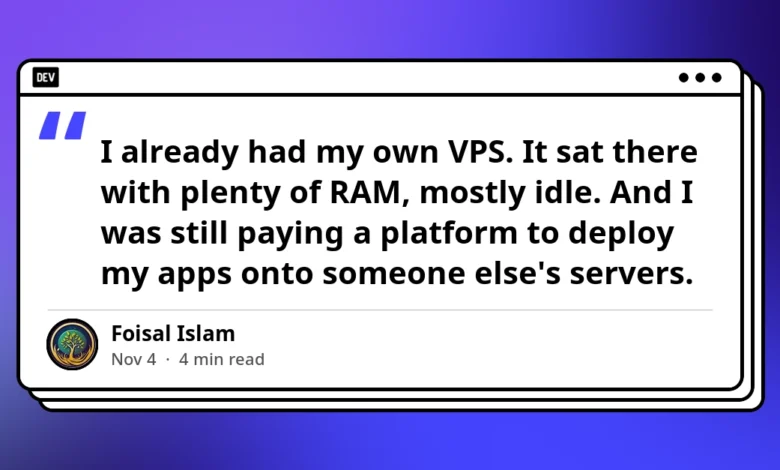
The modern software development lifecycle has long been characterized by a financial paradox: developers frequently maintain idle server capacity on Virtual Private Servers (VPS) while simultaneously paying premium subscription fees to managed Platform-as-a-Service (PaaS) providers. Developer Foisal Islam has confronted this industry standard by releasing Dockfin, an MIT-licensed, open-source self-hosted Platform-as-a-Service designed to bridge the gap between expensive cloud convenience and the operational complexity of raw server management.
The release arrives at a time of growing developer friction regarding escalating cloud infrastructure costs. While industry giants such as Heroku and Vercel have historically dominated the market by offering seamless initial deployments, engineering teams frequently report unexpected budgetary inflation as their architectures scale.
The Hidden Costs of Managed Platforms
The financial trajectory of utilizing managed cloud platforms typically follows a predictable pattern. An initial proof-of-concept deployment feels effortless—engineers push code, receive a production URL instantaneously, and require minimal configuration overhead. However, friction emerges as projects mature.
Modern applications rarely exist in isolation. Scaling a product typically requires provisioning secondary services, including auxiliary application instances, persistent databases, automated staging previews for every pull request, and role-based access control for expanding engineering teams. Individually, these supplementary services incur modest line items; collectively, they culminate in monthly overhead costs that prompt many organizations to reevaluate their infrastructure strategy.
Conversely, the traditional alternative—provisioning raw infrastructure via cloud providers and manually configuring Docker containers, reverse proxies, Transport Layer Security (TLS) certificates, continuous integration webhooks, and automated backup routines—demands significant engineering hours. Maintenance of such custom-built infrastructure often consumes weekends and introduces ongoing operational vulnerabilities.
Consequently, independent developers and small engineering teams have faced a binary choice: pay a premium for cloud convenience or invest extensive technical time in manual server maintenance. Dockfin has been engineered to provide a viable third alternative, utilizing existing server infrastructure under a unified, self-hosted control plane.
Architecture and Technical Implementation
Dockfin is distributed as a single Docker image comprising a backend API written in Go and a frontend dashboard built with React. Designed for deployment on Linux environments utilizing Ubuntu or Debian distributions, the platform relies on a single-line installation script:
curl -fsSL https://raw.githubusercontent.com/foisalislambd/dockfin/main/scripts/install.sh | sudo bash
The installation sequence automates several foundational setup tasks. If Docker is absent from the target host, the script installs the container runtime, generates secure internal system secrets, provisions a dedicated PostgreSQL database container for state persistence, and initializes the Dockfin control plane on port 8000. Crucially, ports 80 and 443 remain unallocated, preserving them for the platform’s native reverse proxy architecture.
Following initial installation, administrators register an administrator account via the web interface. Because Dockfin communicates with managed nodes via Secure Shell (SSH), a single dashboard instance can orchestrate workloads across multiple distinct physical or virtual machines. All application metadata, deployment states, and operational logs reside within the administrator’s localized PostgreSQL instance, ensuring that operational data remains strictly within the boundaries of the organization’s private infrastructure.
Core Architectural Innovations
Rather than attempting to replicate every feature found in enterprise cloud suites, Dockfin focuses its engineering efforts on three core pillars designed to mitigate common operational failure points during production deployments.
First, the platform introduces an administrative feature designated as "Deploy Freeze." During critical business events—such as major product launches or active incident remediation—engineering managers can enforce a system-wide freeze on specific environments paired with mandatory explanatory notes. When active, incoming deployment triggers are halted. Crucially, incoming Git webhooks are skipped rather than failed, preventing version control providers from repeatedly executing failed retry loops that can exhaust system resources and clutter operational logging streams.
Despite an active freeze, foundational server operations such as manual container restarts, service stops, and rapid rollbacks remain fully accessible, ensuring that stability is prioritized without stripping engineers of necessary remediation tools. Authorized owners retain the capacity to override the freeze protocol in the event of an urgent hotfix.
Second, Dockfin emphasizes real-time deployment observability and rapid rollback capabilities. Every deployment action streams execution logs directly to the user interface, detailing the exact progression phase of the build process. If a deployment encounters a failure, diagnostic data is immediately visible. Should a build successfully deploy to production but introduce critical regressions, system operators can revert the environment to a stable prior state with a single interface interaction. For terminal-centric workflows, the platform provides equivalent functionality through its command-line interface via commands such as dfin logs <id> --follow.
Third, the platform features a comprehensive command-line interface (dfin) designed for scriptability and continuous integration pipelines. Unlike secondary command-line tools that offer limited functionality, the Dockfin CLI provides complete parity with the web dashboard, enabling the programmatic creation, modification, and deletion of servers, projects, environments, services, and databases. Every command includes a --json formatting flag, allowing engineering teams to integrate server management directly into custom automation scripts and CI/CD pipelines.
Ecosystem Integration and Scope
Dockfin integrates with standard development tooling. The platform processes native webhooks from major version control platforms, including GitHub, GitLab, Gitea, and Bitbucket. It supports dynamic preview environments for pull requests that automatically provision and decommission resources as code branches are opened and merged. Furthermore, the routing layer accommodates popular reverse proxies and container orchestrators, including Traefik, Caddy, and Docker Swarm, alongside Cloudflare Tunnel configurations for secure ingress without public port exposure.
To manage user expectations, the project maintainer has explicitly outlined the platform’s architectural boundaries. Dockfin is not positioned as a replacement for enterprise-grade Kubernetes control planes, nor does it function as a managed serverless function provider or a multi-tenant cloud provider designed to host third-party applications at scale.
Industry Context and Comparative Landscape
The launch of Dockfin enters a competitive market segment for self-hosted infrastructure orchestration tools. Most notably, Coolify has gained substantial traction within the developer community as an open-source alternative to proprietary PaaS providers.
While architectural comparisons between Dockfin and existing solutions are inevitable, Dockfin differentiates itself through its specific focus on Go-based backend performance, a single-container deployment model, and an emphasis on administrative safeguards such as deployment freezes and comprehensive CLI automation. Industry analysts note that the proliferation of such tools reflects a broader macro trend: engineering organizations are increasingly seeking to reclaim control over their infrastructure spending amidst rising public cloud costs.
Future Roadmap and Community Engagement
Looking ahead, the development roadmap prioritizes the implementation of a decentralized application marketplace. This planned feature will introduce an independent catalog service governed by a dedicated API, allowing Dockfin instances to dynamically query and install complex software packages—such as content management systems and databases—into projects with minimal manual configuration. Crucially, this architecture aims to decouple application package availability from core platform release cycles.
As Dockfin enters its public release phase, the maintainer has invited the broader software engineering community to evaluate the software on spare VPS hardware, stress-test its resilience, and report operational bottlenecks via the official GitHub repository (https://github.com/foisalislambd/dockfin).
The transition toward self-hosted developer tooling underscores a shifting paradigm in software architecture. As proprietary cloud pricing models continue to evolve, tools like Dockfin provide a pragmatic bridge for developers seeking the operational velocity of modern PaaS solutions combined with the financial predictability of raw infrastructure.