University of Alabama in Huntsville Engineers Pioneer Modular Landing Pad Technology to Mitigate Lunar Regolith Hazards

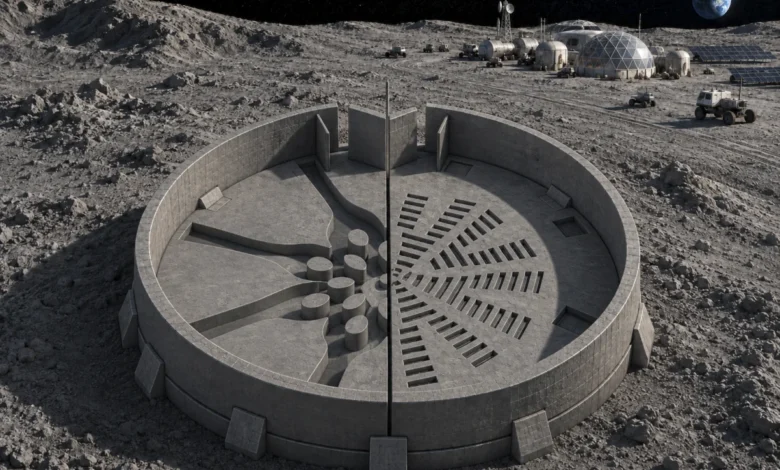
The rapid acceleration of the Artemis program and the global resurgence in lunar exploration have brought a critical engineering challenge to the forefront of aerospace logistics: the mitigation of high-velocity lunar dust, or regolith, during vertical takeoff and landing (VTOL) maneuvers. When spacecraft descend onto the Moon’s airless surface, the intense heat and force of rocket plumes interact with the fine, abrasive particulate matter covering the lunar landscape, creating potentially catastrophic debris clouds. To address this, a research team from the University of Alabama in Huntsville (UAH), in partnership with Linc Research Inc., has successfully tested a novel, modular, vented landing pad design aimed at securing the future of sustained lunar surface operations.
The Engineering Challenge: Understanding the "Moondust" Threat
Lunar regolith is not merely dirt; it is a complex, sharp, and electrostatically charged material formed over billions of years by meteoritic impacts. Because the Moon lacks an atmosphere, there is no air resistance to slow the dispersion of this material during a rocket ignition. On Earth, the atmosphere acts as a buffer, but in the vacuum of the lunar environment, rocket exhaust plumes expand rapidly and unchecked, picking up regolith particles and accelerating them to thousands of miles per hour.
This phenomenon creates a "sandblasting" effect that poses an existential threat to nearby lunar habitats, solar arrays, communication equipment, and even orbiting assets. Past Apollo-era missions demonstrated that even small-scale landings could scatter dust across vast distances, occasionally coating instruments and optical surfaces. As space agencies plan for larger, heavier cargo and crewed landers, the kinetic energy contained in these dust plumes scales exponentially, necessitating infrastructure capable of containment and redirection.
UAH and Linc Research: A Collaborative Approach
The UAH research initiative is supported by NASA’s Small Business Technology Transfer (STTR) program, a vehicle designed to facilitate the transition of academic research into commercial aerospace applications. By pairing the theoretical and experimental capabilities of the university with the industry expertise of Linc Research Inc., the project aims to create a scalable solution that can eventually be manufactured using local materials.
Led by Dr. Judy Schneider, a professor in the UAH Department of Mechanical and Aerospace Engineering, the team has moved beyond the traditional concept of a solid, "dead-weight" landing pad. Traditional pads, while effective at providing a level surface, often suffer from severe structural degradation when subjected to the concentrated thermal and pressure loads of a modern rocket engine. The recent failure of launch infrastructure during early SpaceX Starship testing serves as a prime example of how even massive, solid structures can be compromised by the sheer force of modern methane-oxygen engines.
Chronology of the Testing Phase
The development cycle reached a significant milestone this past summer at the UAH Propulsion Research Center. The team executed a series of three high-intensity hot-fire rocket motor tests on a 3.65-meter (12-foot) prototype. The objectives were threefold: to evaluate the structural integrity of the interlocking components, to measure the heat distribution across the modular surface, and to verify the efficacy of the internal venting system.
- Phase I (Conceptualization): Development of the interlocking hexagonal geometry designed to distribute pressure loads and accommodate thermal expansion.
- Phase II (Material Selection): Utilization of specialized concrete analogs, representing the potential for "lunacrete"—a construction material composed of lunar regolith mixed with a binding agent.
- Phase III (Hot-Fire Testing): Three consecutive firings at the UAH Propulsion Research Center to validate the vent system’s ability to capture and redirect exhaust energy away from the spacecraft and the pad structure itself.
The data gathered from these tests, facilitated by integrated sensors within the modular blocks, provided clear evidence that the vented design successfully dissipated thermal energy, preventing the "cratering" effects that typically plague non-vented landing zones.
In-Situ Resource Utilization and Future Scaling
A core tenet of this research is the principle of In-Situ Resource Utilization (ISRU). Transporting massive amounts of steel or concrete from Earth to the Moon is cost-prohibitive, with current launch costs estimated in the thousands of dollars per kilogram. Therefore, the UAH team’s modular design is intentionally optimized for production using lunar materials.
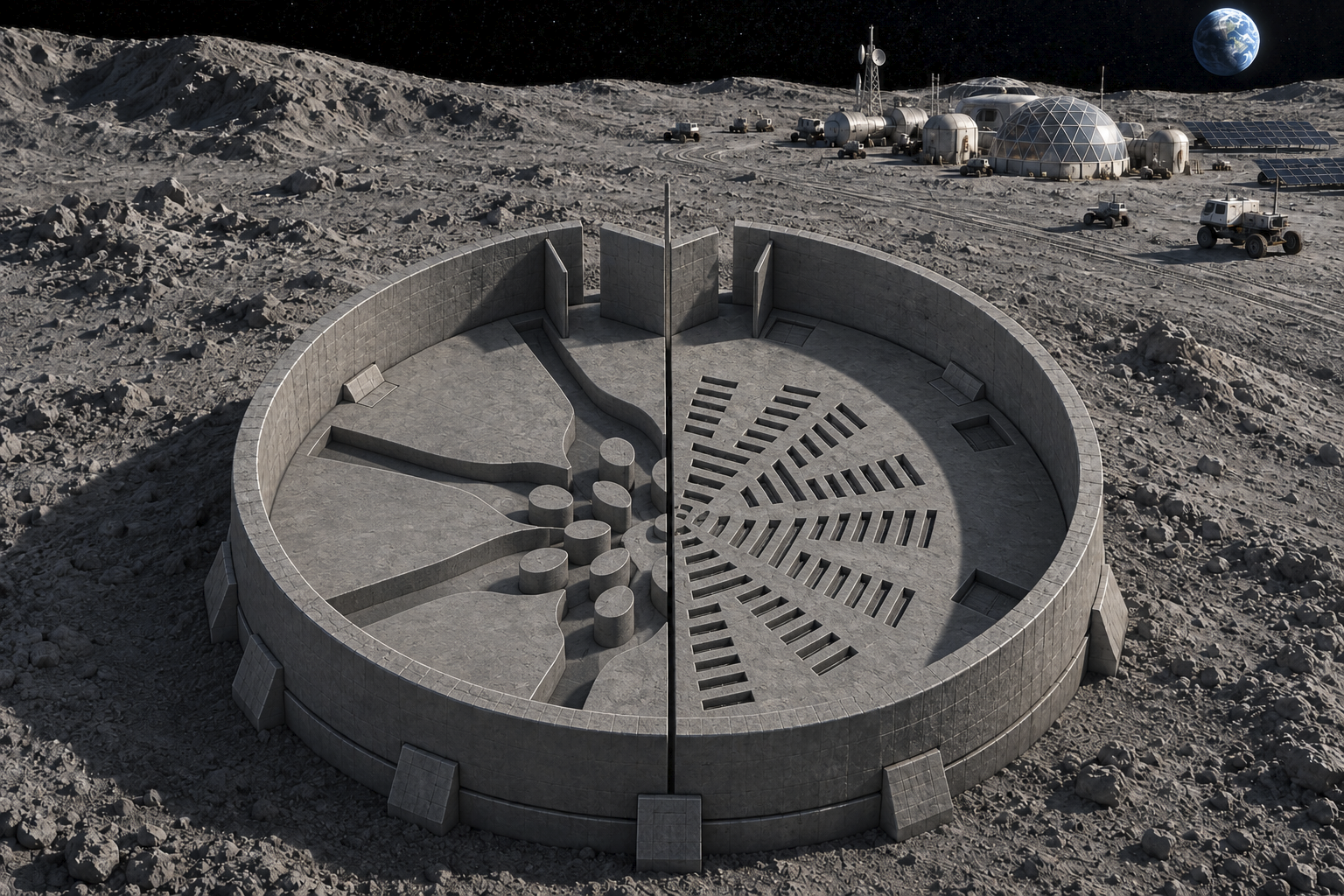
Whether through the sintering of regolith into ceramic-like tiles or the mixing of regolith with imported binders to create concrete, the modular approach allows for "incremental expansion." A small, initial landing pad could be assembled by autonomous rovers or early human crews and later expanded into a larger, more robust landing complex as the base matures. This modularity also offers a distinct maintenance advantage: if one segment of the pad is damaged, it can be replaced individually without the need to reconstruct the entire facility.
Implications for Artemis and Beyond
The implications of this research extend far beyond mere debris management. NASA’s Artemis program seeks to establish a permanent presence at the lunar south pole, an area of high interest due to the presence of water ice. Establishing a base there requires reliable transportation cycles, which in turn require hardened landing infrastructure.
"On Earth, we use water-cooled flame buckets to redirect rocket exhaust," Dr. Schneider noted in a statement following the tests. "But we won’t have those resources on the lunar surface, where water will be in limited supply. Our goal is to redirect the rocket plume so it doesn’t damage the landing vehicle or any surrounding structures."
By solving the problem of plume-surface interaction, the UAH team is effectively clearing a major hurdle for the logistical sustainability of lunar exploration. If successful, the vented pad technology could become a standard requirement for all future lunar landing sites, including those slated for the Lunar Gateway or private commercial lunar landers.
Strategic Path Forward: Toward NASA Marshall
Following the success of the 3.65-meter prototype, the UAH team is currently transitioning to the next phase of development. A larger, 6-meter (20-foot) prototype is under construction. This unit is slated for delivery to NASA’s Marshall Space Flight Center in Huntsville, where it will undergo more rigorous stress testing and long-term evaluation.
At the Marshall facility, the pad will face simulated environments designed to push the limits of its thermal management and pressure-relief capabilities. These tests will be crucial in determining the "technological readiness level" (TRL) of the design. If the 6-meter prototype performs as expected, it will provide NASA with a validated, scalable solution that can be transitioned from the laboratory to the lunar surface.
Analysis of Economic and Operational Impact
The move toward modular, regolith-based landing pads represents a shift in aerospace philosophy: from "carrying everything from Earth" to "building with what is found." This approach significantly lowers the total mission mass, thereby increasing the payload capacity for scientific instruments or life-support systems.
Furthermore, the integration of STTR-funded research into NASA’s long-term strategy underscores the agency’s commitment to fostering a private sector economy around lunar infrastructure. By relying on academic and commercial partners like UAH and Linc Research, NASA is not only developing technology but also cultivating a workforce trained in the specific, harsh requirements of extraterrestrial civil engineering.
As the industry looks toward the late 2020s and early 2030s, the development of these landing pads will serve as the foundation for the "lunar highway." Without a stable, dust-free environment, the risks of repeated landings—including engine damage, sensor interference, and the degradation of external mission-critical hardware—would render a permanent base unviable. The UAH research team’s successful hot-fire tests represent a critical step toward ensuring that when humanity returns to the Moon to stay, the landing process is as safe and routine as possible.