The life cycle of a star is a narrative of inevitable transformation, dictated primarily by its initial mass. While the most massive stars exit the cosmic stage in cataclysmic supernovae—spectacular, high-energy explosions that seed the universe with heavy elements—the vast majority of stars, including our own Sun, follow a more protracted and less explosive path. Upon exhausting their nuclear fuel, these moderate-sized stars shed their outer layers in a graceful, albeit destructive, expansion, eventually cooling into dense, Earth-sized remnants known as white dwarfs. This process, while seemingly terminal, is increasingly revealed by astronomers to be a complex, ongoing evolution that can involve the persistent, haunting presence of planetary debris.
New research published in Nature Astronomy by lead author Nicola Gentile Fusillo of the Università degli Studi di Trieste provides a rare and detailed observation of this phenomenon. By analyzing the white dwarf WD J132800.85–145019.95, a team of international researchers has identified a complex, dual-component debris disc surrounding the stellar remnant. This discovery challenges existing models of post-stellar evolution and offers a compelling, if sobering, glimpse into the potential long-term fate of our own solar system.
The Anatomy of a Stellar Graveyard
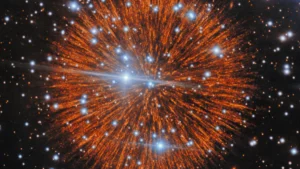
To understand the significance of the WD J1328–1450 system, one must first consider the standard progression of a sun-like star. As the hydrogen in its core is depleted, the star leaves the main sequence, expanding into a red giant. In this phase, the star’s gravitational influence shifts, and its outer atmosphere is cast off into the surrounding interstellar medium, forming a planetary nebula—an ethereal, glowing shell of ionized gas. What remains is a white dwarf, a degenerate stellar core held up against gravity by electron degeneracy pressure.
For decades, astronomers have known that these white dwarfs can be accompanied by dusty, circumstellar discs. These discs are believed to be the remnants of planetary systems that were unable to survive the star’s expansion. The intense tidal forces of the white dwarf often shred any remaining asteroids or moons that wander too close, turning them into a ring of dust and debris. However, gas-rich discs are significantly rarer. To date, only 21 such systems have been identified, and their existence has been a subject of intense scientific debate. The discovery of WD J1328–1450, with its uniquely complex architecture, serves as a critical data point for understanding how these systems maintain stability over geological timescales.
Chronology of the Discovery and Spectral Analysis
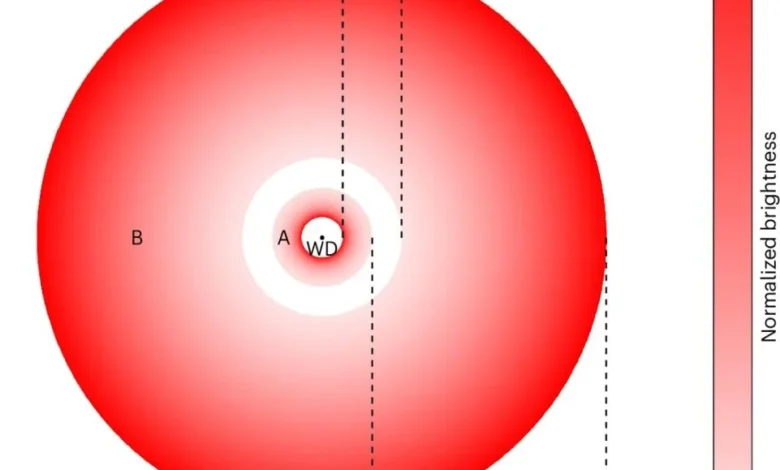
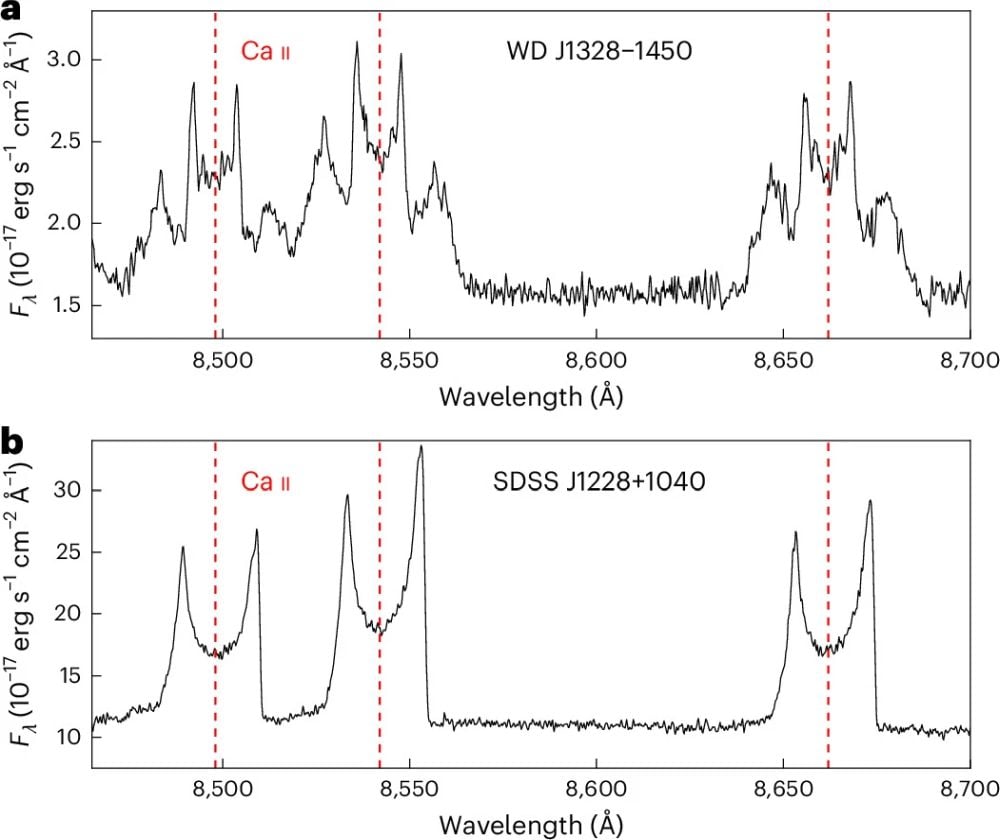
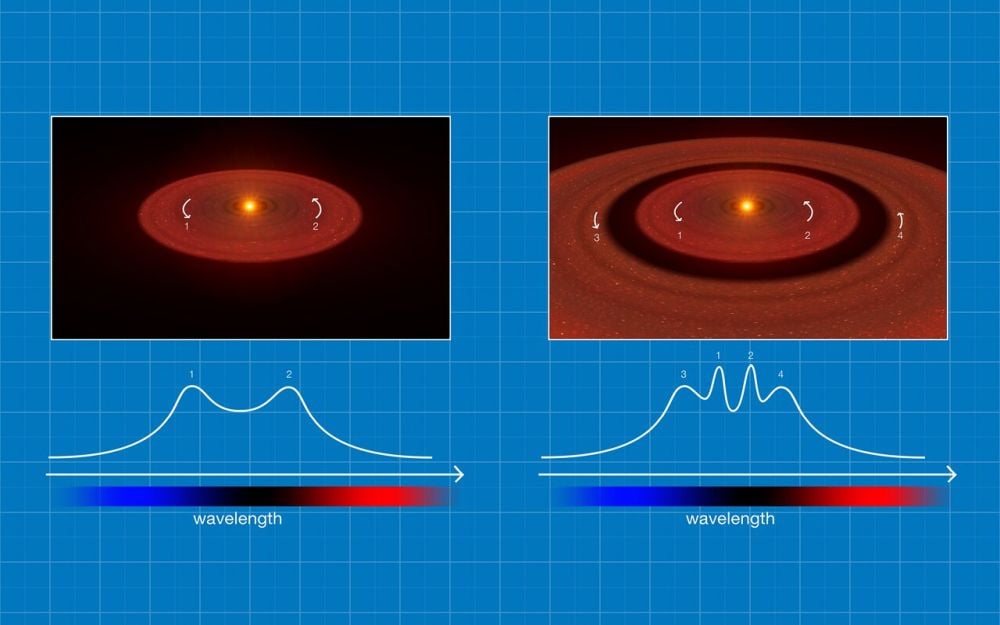
The research team utilized high-resolution spectrographic data to map the environment around WD J1328–1450. The detection of gas in these environments typically relies on the interpretation of "line profiles"—the specific patterns of light emitted by the rotating gas. In a standard rotating flat disc, the movement of gas toward and away from the observer causes a characteristic "double-peaked" Doppler shift, where the light is split into red-shifted and blue-shifted components.
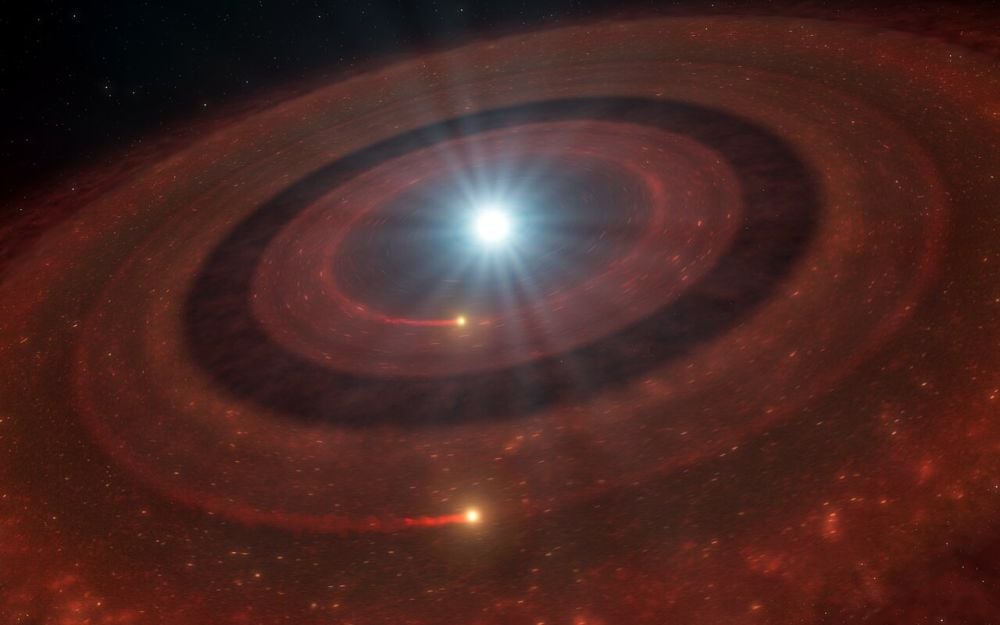
In the case of WD J1328–1450, the researchers observed something entirely unprecedented: a quadruple-peaked emission line profile. This anomaly indicated that the gaseous material was not confined to a single, uniform ring, but was instead organized into two distinct, concentric gaseous discs. According to the study, the inner ring extends from approximately 0.14 to 0.34 stellar radii, while the outer ring spans from 0.54 to 1.93 stellar radii. This distinct gap between the two structures suggests that the disc is not merely a collection of random dust, but a system actively sculpted by orbiting bodies.
The Role of Surviving Planetesimals
The presence of gas within these discs is a mechanical puzzle. At the extreme temperatures and conditions near a white dwarf, dust should theoretically be the dominant state of matter. Astronomers hypothesize that the gas is generated through high-velocity collisions between dust grains and larger, surviving planetesimals. As these bodies orbit within the disc, they collide with debris at speeds sufficient to vaporize the material, creating a localized gas cloud.
The research team posits that at least two planetary bodies are responsible for maintaining the structure of the WD J1328–1450 discs. The inner body is estimated to be on the scale of a large asteroid, mere kilometers in diameter, while the outer body is significantly larger—potentially the size of the Moon or Pluto.
The physical requirements for these bodies to survive at such close proximity to the white dwarf are extreme. To remain intact and not be torn apart by the white dwarf’s immense tidal forces, these planetesimals must possess significant internal strength or exceptionally high density. The study notes that the required density for these survivors exceeds that of any known exoplanet, suggesting that these are not merely loose collections of rock, but dense, cohesive objects.
Broader Implications for Planetary Systems
The stability of the double-disc structure around WD J1328–1450 is a significant finding. For these two rings to remain separated by a stable gap, the orbiting bodies must exert enough gravitational influence to clear their orbital paths, similar to how moons shape the rings of Saturn. This interaction provides a dynamic "laboratory" for astronomers to observe the end-stages of planetary systems in real-time.
"The system is a rare glimpse of the violent, chaotic process by which a planetary system meets its end, and it hints that dead stars can have disc structures far more complex than previously realised," stated Nicola Gentile Fusillo. This complexity implies that our current models for how debris discs form and evolve are incomplete. The existence of these rings suggests that planetary systems are far more resilient than previously thought, with remnants persisting for vast periods even after the host star has essentially died.
Future Scenarios for the Solar System
The parallels between WD J1328–1450 and our own solar system are unavoidable. In approximately five billion years, the Sun will exhaust its nuclear fuel, expand to engulf the inner planets, and eventually collapse into a white dwarf. Current projections indicate that Mercury, Venus, and almost certainly Earth will be consumed during the Sun’s red giant phase.
What remains of the solar system after this transition depends on the gravitational dynamics of the surviving outer planets, such as Jupiter and Saturn. If the system follows the pattern seen in WD J1328–1450, the outer reaches of our solar system could potentially form similar debris discs. While the possibility of life "re-spawning" on these resurrected planets is considered highly unlikely due to the harsh radiation and lack of a traditional star, the discovery of such complex structures proves that the "corpse" of a planetary system can still be a place of significant activity.
Scientific Consensus and Next Steps
The findings presented by Fusillo and his colleagues, including co-author Felipe Lagos-Vilches of the University of Warwick, provide a new set of observational constraints for theorists. By identifying the chemical composition of the rings—specifically the enrichment of magnesium in the inner ring and its relative absence in the outer—the team has opened the door to "geological" analysis of dead planetary systems. This variation in composition could point to the destruction of a differentiated planet, where the inner ring represents the metallic core and the outer ring represents the rocky crust.
The scientific community is now tasked with refining models to account for these stable, multi-ring structures. Future observations with next-generation telescopes will likely focus on identifying similar "quadruple-peaked" systems to determine if WD J1328–1450 is an outlier or a common, yet previously undetected, configuration of stellar remnants.
As astronomers continue to map the heavens, the study of white dwarfs and their debris discs serves as a reminder that the universe does not simply cease to exist when a star dies. Instead, the process of stellar and planetary evolution continues in a different, more subdued form. The discovery of the WD J1328–1450 system provides a profound, albeit distant, mirror held up to our own future, illustrating that the story of a star—and its planets—extends far beyond its final flicker of fusion.