Rosetta Mission Self-Portrait Captures the Historic Close-Up Encounter with Comet 67P

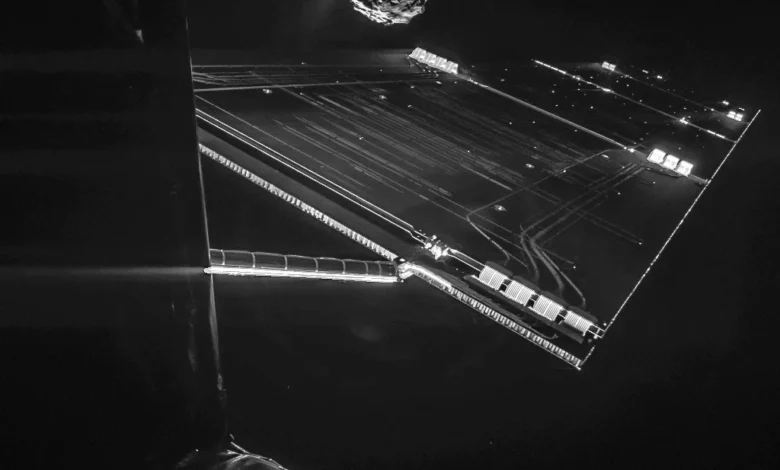
On October 7, 2014, the European Space Agency’s Rosetta spacecraft achieved a milestone in deep-space photography by capturing a high-contrast self-portrait while orbiting just 16 kilometers above the jagged, primordial surface of Comet 67P/Churyumov-Gerasimenko. This image, taken by the CIVA camera system mounted on the Philae lander—which was still securely attached to the orbiter at the time—serves as a testament to the technical precision required for interplanetary exploration. The photograph depicts a stark, industrial contrast between the metallic solar arrays of the Rosetta probe and the ancient, dust-shrouded nucleus of a celestial body that had been hurtling through the solar system for eons.
The Anatomy of an Interplanetary Selfie
The image captured by the CIVA (Comet Infrared and Visible Analyzer) instrument is a composite of two separate exposures. Engineers opted for this technique to manage the extreme dynamic range of the scene: one short exposure to capture the brilliant sunlight glinting off the 14-meter-long solar panels, and one long exposure to resolve the subtle textures and outgassing features of the comet’s double-lobed nucleus.
At the time the shutter clicked, the Rosetta mission was operating approximately 472 million kilometers from Earth. The proximity to the comet—a mere 16 kilometers—offered an unprecedented view of the active processes occurring on 67P. In the frame, the comet’s unique "rubber duck" shape, characterized by its two distinct lobes connected by a narrow neck, is visible. Thin wisps of dust and gas, the telltale signatures of cometary activity as the body approached the warmth of the inner solar system, can be seen emanating from the surface. This specific angle provided mission planners with critical visual data for finalizing the landing site for the Philae module.
A Chronology of the Rosetta-Philae Rendezvous
The journey to this moment was the culmination of a decade-long pursuit. Launched in March 2004, Rosetta spent ten years traveling through the inner solar system, utilizing gravity-assist maneuvers around Earth and Mars to gain the necessary velocity to intercept its target.
- March 2, 2004: Rosetta launches from the Guiana Space Centre in Kourou, French Guiana.
- August 6, 2014: After a long-duration cruise and several deep-space maneuvers, Rosetta successfully achieves orbit around Comet 67P/Churyumov-Gerasimenko.
- October 7, 2014: The CIVA instrument on the Philae lander captures the now-famous "selfie," providing a final visual survey of the target before separation.
- November 12, 2014: Philae separates from the Rosetta orbiter to begin its historic descent to the comet’s surface.
- November 12, 2014 (Later): Philae touches down on the nucleus. Despite issues with the harpoon anchoring system, the lander successfully secures itself and begins transmitting data, providing the first-ever in-situ analysis of a comet’s surface chemistry.
Supporting Data and Mission Specifications
The Rosetta mission was defined by its sheer engineering ambition. The spacecraft weighed approximately 2,900 kilograms at launch, including the 100-kilogram Philae lander. The solar arrays, which appear so prominently in the October 7 image, were massive, spanning 32 meters from tip to tip. These panels were essential for providing power to the orbiter’s eleven science instruments as it moved further from the Sun, where traditional solar energy collection became increasingly inefficient.
Comet 67P itself, the subject of the background in the photograph, measures approximately 4.1 by 3.3 kilometers. It is a Jupiter-family comet with an orbital period of about 6.45 years. The data gathered during the mission suggested that 67P is highly porous, with a density lower than that of water ice, leading scientists to conclude that it is essentially a "fluffy" aggregate of dust and frozen volatiles held together by weak gravitational forces.

Official Statements and Engineering Challenges
The European Space Agency (ESA) characterized the mission as a "risky but necessary" endeavor. Project scientists emphasized that the proximity of 16 kilometers was necessary to map the surface features with enough resolution to identify a landing site that would be safe for Philae. The primary landing site, designated "Agilkia," was located on the smaller of the two lobes visible in the CIVA image.
"The decision to take these photos was not merely for public outreach," noted a lead systems engineer during the post-mission briefing. "The CIVA images provided the final validation that our target site was free of large-scale obstructions that could jeopardize the landing. The high-contrast lighting presented a significant challenge for the onboard processing, but it allowed us to see the topography in a way that ground-based telescopes could never achieve."
The Philae lander, while it experienced a "bouncing" landing due to the failure of its thrusters and harpoons, managed to perform its core scientific mission. It detected organic molecules on the comet’s surface—the building blocks of life—which significantly advanced the scientific understanding of the role comets may have played in delivering water and complex chemistry to the early Earth.
Broader Impact and Scientific Implications
The legacy of the Rosetta mission extends far beyond the iconic imagery. By conducting long-term monitoring of a comet’s activity as it approached the Sun, Rosetta provided the most detailed "life cycle" analysis of a comet in history.
The data derived from the mission has transformed planetary science in several key areas:
- Chemical Composition: Analysis of the water vapor emitted by 67P showed a significantly different deuterium-to-hydrogen ratio compared to Earth’s oceans. This finding forced scientists to rethink the theory that Earth’s water was primarily delivered by comets, suggesting instead that asteroids might have played a larger role.
- Surface Morphology: The images revealed a landscape defined by dramatic cliffs, deep pits, and smooth, dust-covered plains. These features suggest that 67P is a dynamic object undergoing continuous erosion and reconfiguration as it releases gas.
- Formation History: The "double-lobed" structure is widely interpreted as the result of a low-velocity collision between two separate cometesimals early in the solar system’s history. This provides a window into the accretion processes that formed larger planets.
Conclusion
The selfie taken on October 7, 2014, remains a poignant symbol of human curiosity and technological reach. It represents the point at which our species transitioned from merely observing the heavens from afar to actively engaging with the primitive relics of the solar system’s formation. As Rosetta continued its mission—eventually concluding with a controlled crash-landing onto the comet’s surface in 2016—the images it captured, including that first intimate portrait, solidified its place in the annals of space exploration.
The mission proved that the harsh environment of a comet, while volatile and unpredictable, contains the keys to unlocking the mysteries of the early solar system. Each pixel of the CIVA image, from the sun-drenched solar panels to the shadowed, ancient dust of 67P, serves as a record of an era when humanity successfully bridged the gap between our home planet and the wandering messengers of the deep solar system. The data gathered by Rosetta continues to be analyzed today, fueling new hypotheses and providing a benchmark for future missions to small bodies like asteroids and comets.