AWS Announces Major Upgrade to Amazon EventBridge With Enhanced Custom Event Buses Designed for Multi-Account Serverless Scale

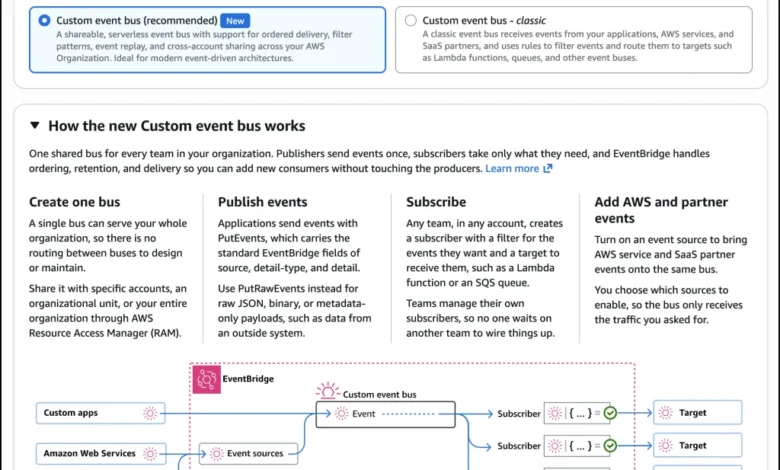
Amazon Web Services (AWS) has officially announced the rollout of a significantly upgraded infrastructure model for Amazon EventBridge, introducing the enhanced custom event bus. Designed specifically to alleviate operational friction in large-scale cloud environments, the new architectural offering aims to streamline event-driven applications that span multiple teams, business units, and distinct AWS accounts. By establishing a single, centralized event backbone across an entire organization, the new iteration seeks to eliminate the intricate matrix of cross-account permissions and bus-to-bus routing rules that have historically complicated serverless engineering.
The evolution of Amazon EventBridge reflects broader shifts in enterprise cloud architecture. When Amazon EventBridge was first popularized under its foundational design principles, organizations typically launched their event-driven applications within isolated, single-account environments managed by a unified engineering team. In these early paradigms, a solitary custom event bus handled all message routing efficiently. However, as cloud adoption matured and corporate governance frameworks demanded strict workload segregation for security and billing purposes, organizations widely transitioned to multi-account structures.
Under the multi-account paradigm, individual engineering teams operate within dedicated AWS accounts. While this successfully establishes security boundaries and clear resource ownership, it inadvertently creates severe networking hurdles for event-driven workflows. To pass event notifications from a publisher in Account A to a consumer in Account B, platform engineers had to construct intricate webs of cross-account resource-based policies, IAM roles, and interconnected event buses.
This operational workaround gradually reintroduced the very complexities that serverless architectures were engineered to eliminate. Centralized platform teams routinely lost holistic visibility into who was subscribing to specific event streams. Furthermore, the financial overhead of cross-account and bus-to-bus routing charges escalated rapidly, creating budgetary friction for scaling enterprises. Perhaps most critically, teams requiring strict sequencing guarantees—such as those handling financial transactions, real-time logistics, or inventory management—were frequently forced to construct fragile internal workarounds or abandon serverless event routing entirely in favor of dedicated messaging queues.
Answering these long-standing architectural pain points, the newly released enhanced custom event bus introduces native organization-wide sharing, sequential ordering capabilities, and an overhauled subscription and pricing architecture.
Simplifying Administration Through Native Resource Sharing
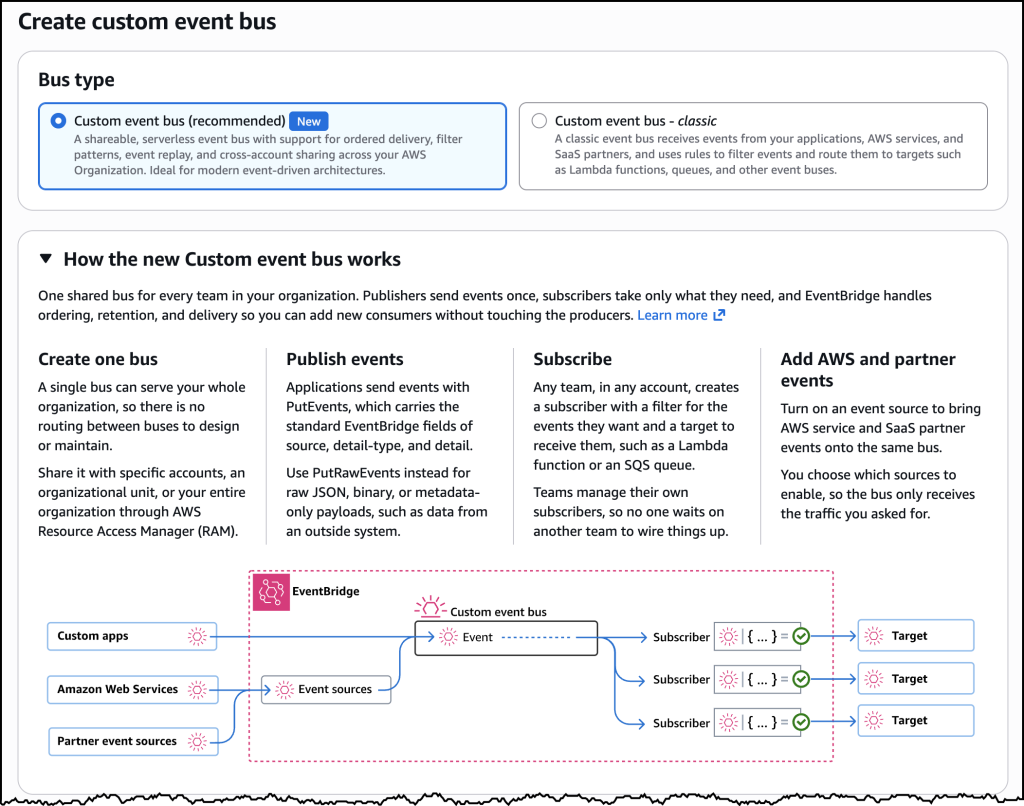
At the core of the new offering is seamless organization-wide resource sharing, powered by AWS Resource Access Manager (AWS RAM). Rather than manually configuring cross-account permissions for every individual route, platform administrators can now provision a single, centralized event bus and instantly share it across every AWS account within an enterprise’s AWS Organization.

Through the AWS Management Console, CLI, or APIs, administrators can scope resource sharing precisely—restricting access to specific organizational units, individual accounts, or designated IAM principals. Once shared, application teams can independently publish and subscribe to events on the central backbone without requiring constant intervention or infrastructure provisioning from central platform engineers.
To ensure stability at enterprise scale, AWS has engineered the enhanced bus to support a default quota of 10,000 active subscribers per event bus, with higher limits available upon request. This high ceiling prevents the artificial fragmentation that previously forced organizations to split workloads across dozens of separate, unmanaged buses simply to circumvent subscriber thresholds.
Addressing the Sequencing Challenge in Event-Driven Systems
For years, a foundational tenet of asynchronous event-driven design has been the decoupling of events from time-dependent sequencing. In ideal serverless environments, consumers process notifications independently, and the chronological arrival of messages bears no impact on system integrity.
However, real-world business logic frequently defies theoretical purity. In enterprise logistics, for instance, coordinate updates from a delivery fleet must be ingested and processed in strict chronological sequence. If an out-of-sequence location event is processed ahead of its predecessor, routing and mapping algorithms inevitably make navigational decisions based on stale data, leading to operational failures.
The enhanced custom event bus resolves this tension by natively supporting both ordered and unordered consumption models on the exact same infrastructure. Publishers can attach an optional EventGroupId parameter to outgoing message payloads. EventBridge intelligently routes all messages sharing a specific EventGroupId in strict sequence to subscribers configured for ordered delivery. Concurrently, other subscribers on the same bus can consume those identical event streams asynchronously without ordering constraints.
To complement sequential processing, AWS has introduced native synchronous invocation targets for services like AWS Lambda. By allowing synchronous confirmation before a message is formally acknowledged, the architecture eliminates the legacy requirement of deploying intermediate Amazon SQS queues merely to guarantee reliable, ordered execution chains.
Granular Control via the New Subscriber Resource

To replace the cumbersome combination of disparate rules, targets, and individual retry policies, the enhanced event bus introduces a unified administrative entity known as the Subscriber resource.
The Subscriber resource consolidates event filtering, target endpoint definitions, custom retry policies, and dead-letter queue (DLQ) destinations into a single, manageable configuration unit. This abstraction drastically reduces the cognitive load on application developers, granting them clear ownership over how their downstream systems ingest, process, and recover from failed messages.
Additionally, the resource incorporates variable start time options. This capability streamlines the onboarding of newly deployed microservices and simplifies event replay workflows—a critical utility when engineering teams need to recover from application anomalies, backfill data stores, or hydrate new testing environments from historical logs.
Advanced Event Evaluation, Deduplication, and Transformation
Data fidelity and payload optimization represent another major focus of the updated architecture. The enhanced custom event bus features built-in, content-based deduplication designed to safeguard applications against accidental retry floods.
When network timeouts, downstream hiccups, or upstream publisher retries dispatch identical event payloads twice within a tight window, EventBridge can automatically analyze and collapse the matching content hashes. Operating on a five-minute evaluation window, this mechanism grants transient retries true exactly-once delivery semantics, replacing the traditional at-least-once model without requiring developers to manually generate and track custom idempotency tokens.
For data transformation, consumers can leverage native JSONata expressions to dynamically reshape incoming events before they reach target endpoints. Downstream services that expect specific payloads no longer require dedicated parsing middleware; EventBridge can extract fields, rename attributes, and compute new structural values on the fly.
Furthermore, for organizations utilizing structured data serialization standards such as Apache Avro or Protocol Buffers, the enhanced bus provides native deserialization capabilities. EventBridge can unpack these binary payloads into standard JSON formats, enabling fine-grained filtering and routing across the entire event payload without forcing developers to write custom deserialization code.
A Scalable Ingress-Egress Pricing Model
Financial predictability has also been restructured to align with multi-account topologies. The legacy Amazon EventBridge pricing structure relied primarily on a per-event ingestion and routing fee that frequently compounded exponentially in complex, multi-bus, cross-account environments.
The enhanced custom event bus transitions to an explicit ingress and egress throughput pricing model. Under this updated framework, publishers absorb the ingestion cost for publishing events, while subscribers pay exclusively for the volume of data delivered to their specific endpoints. This decoupling removes the financial penalties associated with cross-account distribution, making large-scale hub-and-spoke event topologies economically viable for growing enterprises.
Industry Context and Deployment Roadmap
Cloud architects and enterprise IT leaders have largely welcomed the announcement, viewing the enhanced event bus as a mature maturation of AWS’s serverless portfolio. As enterprise migration to the cloud reaches deeper into core operational tiers, the demand for robust governance, strict auditability, and simplified cross-account communication has intensified. By addressing the operational overhead of distributed event-driven systems at the infrastructure layer, AWS is positioning EventBridge as a foundational enterprise service capable of orchestrating mission-critical workflows across complex corporate hierarchies.
Crucially, AWS has emphasized that existing infrastructure will remain entirely undisturbed. Legacy custom event buses will continue to operate without modification, seamlessly designated in the management console as Custom event bus — classic. The newly released enhanced bus operates as a distinct, modern resource, allowing organizations to migrate and adopt the updated features incrementally and at their own operational pace.
The enhanced custom event bus is globally available immediately across a broad footprint of AWS Regions, spanning US East (N. Virginia, Ohio), US West (Oregon), multiple European hubs (Ireland, Frankfurt, Stockholm, Spain), and key Asia-Pacific markets including Hong Kong, Malaysia, Mumbai, Singapore, Sydney, Thailand, and Tokyo.
Engineering teams can provision and configure the new architecture immediately via the AWS Management Console, the AWS Command Line Interface (AWS CLI), or programmatic calls to the EventBridge API. Comprehensive documentation and architectural deployment guides are currently accessible through the official Amazon EventBridge developer portal.