How Anthropic’s 80% AI Code Generation Shattered Traditional CI Pipelines and Shifted Software Engineering Bottlenecks

Recent data released by artificial intelligence research firm Anthropic has ignited a profound industry-wide debate regarding the operational realities of AI-assisted software development. While the headline figure that Claude, Anthropic’s proprietary AI assistant, now writes approximately 80% of the company’s codebase captured widespread attention across technology forums, secondary metrics within the report reveal a more demanding engineering narrative. Over a six-month observation period, Anthropic’s internal test suites expanded tenfold, while continuous integration (CI) job executions surged by a staggering 25 times. This exponential scaling highlights a critical paradigm shift: as artificial intelligence dramatically accelerates code production, the primary bottleneck in software delivery has migrated from authoring code to verifying its safety, reliability, and functional integrity.
For decades, the software engineering discipline focused heavily on optimizing developer throughput—streamlining Integrated Development Environments (IDEs), reducing build times, and adopting agile methodologies to help human engineers write code faster. AI has effectively removed this historic constraint, allowing developers and autonomous agents to generate unprecedented volumes of code, pull requests, and file modifications. However, downstream verification infrastructure—encompassing code reviews, test execution engines, staging environments, and deployment pipelines—has traditionally operated on linear scaling models. When an autonomous coding agent enables a developer to scale their output from a handful of meaningful changes per sprint to dozens, every downstream process experiences a proportional surge in demand. Anthropic’s 25x increase in CI jobs serves as a real-world case study of this systemic pressure, proving that accelerated generation without corresponding improvements in verification leads directly to operational gridlock.

To manage this unprecedented verification load, engineering teams are being forced to rethink fundamental assumptions regarding automated testing. Historically, standard industry practice dictated a "run all tests" approach to pull request validation, ensuring that every code change undergoes a complete regression battery. In an AI-native development environment where agents continuously write, test, and self-correct, running a massive, universal regression suite for every incremental two-line change quickly becomes unsustainable. It not only overwhelms compute budgets and spikes cloud infrastructure expenditures, but it also introduces unacceptable latency into the agent’s feedback loop. Autonomous coding agents rely heavily on rapid, targeted execution results to evaluate their own output, correct syntax or logic errors, and iterate toward a functional solution. When test suites take too long to run, the autonomous loop stalls, neutralizing the productivity gains conferred by AI generation.
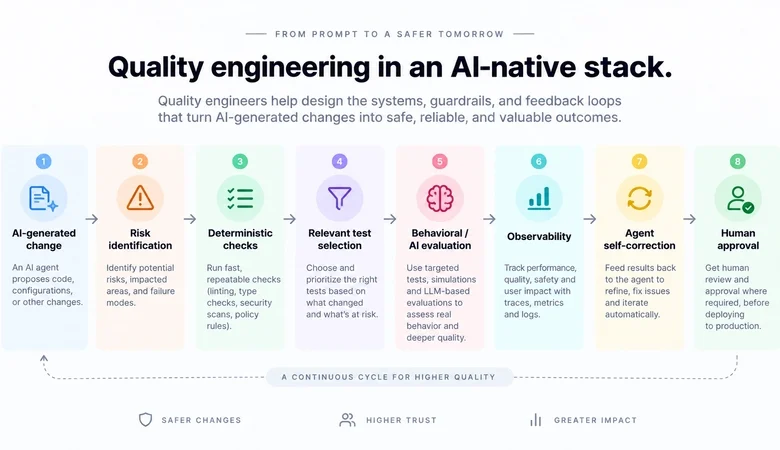
Addressing this challenge requires sophisticated, deterministic test selection mechanisms rather than stochastic or purely heuristic approaches. Anthropic’s internal engineering post outlines the deployment of a deterministic test impact analysis service. Instead of executing every test indiscriminately, this system intelligently selects relevant test cases based on package dependencies, architectural relevance, and historical performance data. Industry analysts emphasize the distinction between deterministic filtering and relying on large language models to guess which tests should run. While AI excels at code generation and linguistic tasks, relying on an LLM to determine test selection introduces unacceptable risks of omission. By anchoring test selection in deterministic, rules-based logic while utilizing AI for code generation and self-correction, organizations can maintain rigorous safety standards without sacrificing execution velocity.
Furthermore, the proliferation of AI-generated code introduces complex quality assurance challenges, particularly concerning the volume versus the quality of automated tests. Autonomous coding agents are fully capable of generating thousands of supplementary test cases in minutes. However, volume does not equate to coverage. An agent may produce numerous redundant tests verifying trivial variations of a single behavior while entirely overlooking critical, high-risk failure modes that could cause production outages. Quality engineering leadership must therefore shift away from vanity metrics, such as total test counts or lines of code generated, and focus instead on risk-based coverage metrics. Evaluating whether generated assertions capture genuine business logic, guard against complex edge cases, and resist brittleness during routine refactoring has become a central competency for modern software quality teams.

The evolution of these engineering workflows fundamentally redefines the role of Quality Engineering (QE) within technology enterprises. Historically, QE functions operated downstream, receiving finished features from developers and executing manual or automated test cases prior to release. In an AI-native stack, quality engineering moves upstream, embedding itself directly into the operational environment where autonomous agents execute. Quality professionals are no longer defined solely by their ability to script end-to-end tests; rather, they design the overarching governance frameworks that dictate risk assessment, deterministic validation rules, observability pipelines, and the boundaries between autonomous self-correction and mandatory human sign-off.
The broader implications for the software industry point toward a necessary recalibration of engineering metrics and infrastructure investments. Executive leadership teams witnessing massive spikes in code generation throughput must recognize that speed without proportional verification investments results in negative operational outcomes—namely, a sprawling codebase with decreasing confidence per deployment. Organizations that fail to scale their verification pipelines alongside their code generation capabilities risk cultivating an environment of automation theater, characterized by bloated CI bills, congested merge queues, and degraded software reliability. As the technology sector navigates this transition, the defining competitive advantage will no longer be how fast an organization can generate software, but how rapidly and reliably it can prove that software deserves to ship.
Related posts: