Independent AI Researcher Shatters Silicon Valley’s Infrastructure Monopoly by Training Foundational Model on Consumer Hardware

For years, the artificial intelligence landscape has been dominated by a singular, capital-intensive narrative: that the development of foundational large language models is an exclusive domain reserved for entities with thousands of specialized H100 clusters and multi-million-dollar venture capital backing. According to this prevailing dogma, independent researchers and smaller institutions lacking hyper-scale cloud infrastructure are effectively locked out of foundational research, relegated instead to fine-tuning existing models or building superficial application programming interface wrappers. This synthetic barrier to entry, carefully cultivated by major technology conglomerates, has recently been fundamentally challenged from a single-room independent laboratory.
Independent researcher Mert Çetin, operating under Me Force Technology, has advanced the development of CetinLM Base-v1, a 1.18-billion-parameter foundational language model, past the 3.80-billion-token training milestone. Crucially, this entire pre-training process has been executed from scratch utilizing a single consumer-grade desktop graphics processing unit—specifically, an NVIDIA RTX 4070 Ti SUPER equipped with 16GB of video random access memory. The achievement undercuts the long-standing financial and infrastructural assumptions governing modern artificial intelligence research, demonstrating that high-density foundational model development can be achieved at a fraction of traditionally accepted computational costs.

Chronology of the Development and Training Trajectory
The development of CetinLM Base-v1 represents the culmination of a deliberate, highly focused engineering pipeline rather than a random computational experiment. Over a concentrated preparation phase spanning approximately one week, the project bypassed the conventional approach of ingesting massive, uncurated web dumps—a strategy that typically requires immense computing power to filter and process. Instead, the team constructed a proprietary, highly structured core dataset designed to act as an architectural guide for the neural network.
The pre-training phase commenced with an emphasis on memory efficiency, custom tokenization frameworks, and robust recovery mechanics to prevent hardware crashes during continuous operation. As the model progressed through its training cycles, performance metrics were closely monitored via held-out validation loss curves.
Tracking the quantitative progress reveals a distinct downward trajectory that defies standard expectations of scaling law decay:

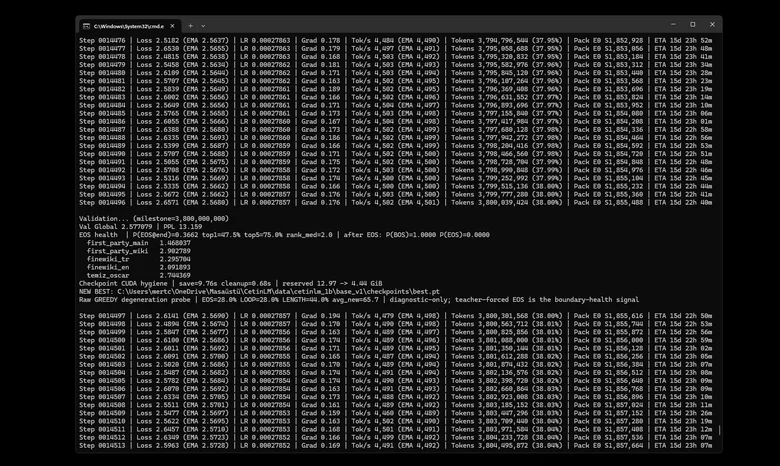
- At the 3.60-billion-token mark, the recorded validation loss stood at 2.592976.
- Just 200 million tokens later, at the 3.80-billion-token milestone, the validation loss declined further to 2.577079.
This continuous descent, occurring without plateaus or training instability at approximately 36% of the planned overall training run, indicates that the model’s underlying architecture is effectively capturing semantic patterns and logic structures without the brute-force data obesity characteristic of larger corporate projects.
Challenging Benchmark Theatre and Corporate Metrics
The announcement arrives amidst growing industry skepticism regarding "Benchmark Theatre," a practice wherein major corporate laboratories optimize static evaluation datasets—such as the Massive Multitask Language Understanding (MMLU) or Grade School Math (GSM8K) exams—by inadvertently or intentionally incorporating evaluation questions into their trillion-token training corpuses. Consequently, commercially published performance metrics are occasionally viewed by independent engineers as marketing artifacts rather than pure reflections of model capability.
Rather than relying on static, easily gamed benchmark scores, the Me Force Technology project demonstrated CetinLM’s capabilities through live, unedited functional deployments. Running locally via a zero-latency web interface on localhost at a throughput of approximately 48 tokens per second, the raw, non-instruction-tuned, non-aligned base model exhibited sophisticated structural and semantic responses during multi-turn interactions.

When subjected to a basic mathematical probe ("2+2=?"), the 1.18-billion-parameter engine avoided the token loops or internet noise typical of unaligned models of similar scale. Instead, it generated a mathematically equivalent, asymmetric rhetorical counter-question ("3+1=?"), indicating an underlying grasp of logical equivalence rather than mere pattern regurgitation. Similarly, when tested with colloquial conversational inputs in Turkish, the model bypassed rigid corporate guardrails, demonstrating organic contextual compression and conversational awareness directly from next-token optimization.
Technical and Financial Implications for the AI Industry
The successful training of a billion-parameter foundational model on a mid-tier consumer GPU carries significant implications for the economics of artificial intelligence research. Historically, the cost of training state-of-the-art models has scaled exponentially, pricing out academic institutions, independent developers, and smaller national economies.
By proving that a bulletproof, fail-closed training pipeline can achieve stable loss reduction on hardware accessible to individual consumers, the project challenges the financial necessity of hyper-scale clusters for early-stage foundational research. While CetinLM does not currently rival mature, post-trained industry flagships in downstream application performance, its existence mathematically invalidates the absolute claim that consumer hardware is entirely incapable of foundational model training.

Furthermore, the project highlights a broader geopolitical shift toward sovereign artificial intelligence. For years, the consensus dictated that advanced foundational research must originate from major tech hubs in Northern California or Beijing. By establishing an autonomous pre-training infrastructure from an independent laboratory in Türkiye, the initiative illustrates that localized, high-density AI development is increasingly achievable through engineering discipline and architectural focus rather than sheer financial supremacy.
Broader Industry Impact and Future Outlook
As the artificial intelligence sector matures, the methods pioneered by independent researchers like Mert Çetin may influence how smaller organizations approach model architecture. By prioritizing curated, high-density core datasets over massive data volumes, developers can potentially lower the computational overhead required to establish baseline intelligence in smaller parameter models.
Industry analysts note that while hyper-scale clusters will remain essential for frontier models pushing the absolute limits of capability, the democratization of billion-parameter training on desktop hardware expands the participant pool for foundational research. As the training run for CetinLM Base-v1 continues toward its completion, the broader developer community will monitor whether these efficiency gains can be scaled further, potentially signaling a permanent shift in how artificial intelligence systems are conceptualized, funded, and built.