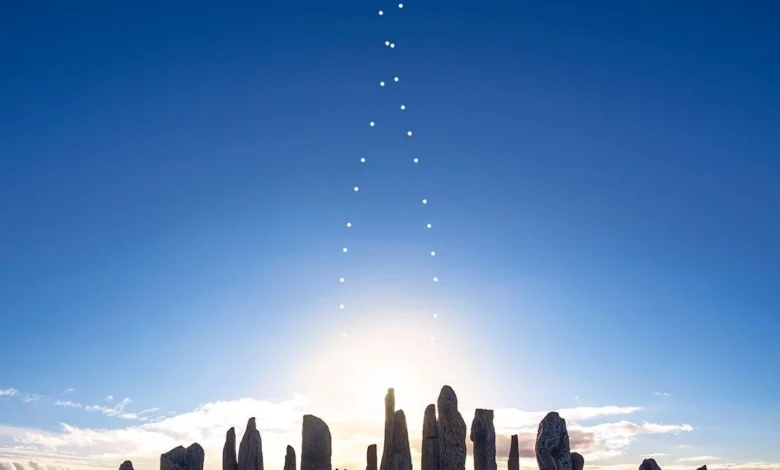
The phenomenon known as an analemma represents one of the most elegant intersections of orbital mechanics and human observation. When an observer records the position of the Sun at the exact same time of day over the course of a full year, the resulting composite image reveals a distinct, elongated figure-eight pattern. This visual trace is not merely a quirk of photography but a profound testament to the complex geometry of our planet’s journey around the Sun. A recent high-profile study of this phenomenon, captured by astronomer Giuseppe Petricca, features the ancient Callanish Stones in Scotland, bridging the gap between modern scientific visualization and the mysterious astronomical practices of the Bronze Age.
The Mechanics of the Analemma
The figure-eight shape of an analemma is dictated by two primary factors: the axial tilt of the Earth and the eccentricity of its orbital path. Because Earth’s axis is tilted at approximately 23.5 degrees relative to its orbital plane, the Sun’s position in the sky appears to migrate north and south throughout the year. Simultaneously, because Earth’s orbit around the Sun is elliptical rather than a perfect circle, the planet’s orbital speed varies according to Kepler’s Second Law. As Earth approaches perihelion—its closest point to the Sun—it travels faster, and as it reaches aphelion, it slows down.
This combination of variable orbital velocity and constant axial tilt results in the "equation of time," which describes the discrepancy between "apparent solar time" (as shown by a sundial) and "mean solar time" (as kept by a clock). The analemma is the visual manifestation of this equation of time, plotting the declination of the Sun against the variation in its solar time. The top and bottom loops of the figure-eight correspond to the solstices, where the Sun reaches its maximum northern and southern declinations, while the intersection point represents the equinoxes, where the Sun crosses the celestial equator.
A Chronology of the Callanish Stones
The setting for this particular photographic documentation, the Callanish Stones, provides a poignant historical backdrop. Located on the Isle of Lewis in the Outer Hebrides of Scotland, the site consists of a cruciform arrangement of megaliths erected approximately 4,700 years ago, during the Neolithic to Bronze Age transition. While Stonehenge in southern England is widely recognized for its solar alignments, the Callanish Stones have long been the subject of intensive academic debate regarding their potential function as a prehistoric observatory.
Archaeological surveys indicate that the site’s layout is complex, with a central monolith flanked by rows of stones that align with various lunar and solar events. Researchers have noted that the stones appear to track the "lunar standstill," an 18.6-year cycle where the Moon reaches its most northerly and southerly points. By positioning the modern analemma capture against the backdrop of these ancient monoliths, the work of Giuseppe Petricca serves to bridge the gap between ancient sky-watchers, who lacked modern clocks but possessed sophisticated observational knowledge, and contemporary astronomers who map these movements with digital precision.
Supporting Data and Methodology
Creating a solar analemma is a process that requires extreme patience and meticulous logistical planning. Unlike a single-exposure photograph, the analemma is a composite of dozens of individual images taken over a twelve-month period. To achieve the results seen in the Callanish project, the photographer must return to the exact same geographical coordinates at the same mean solar time for each interval.
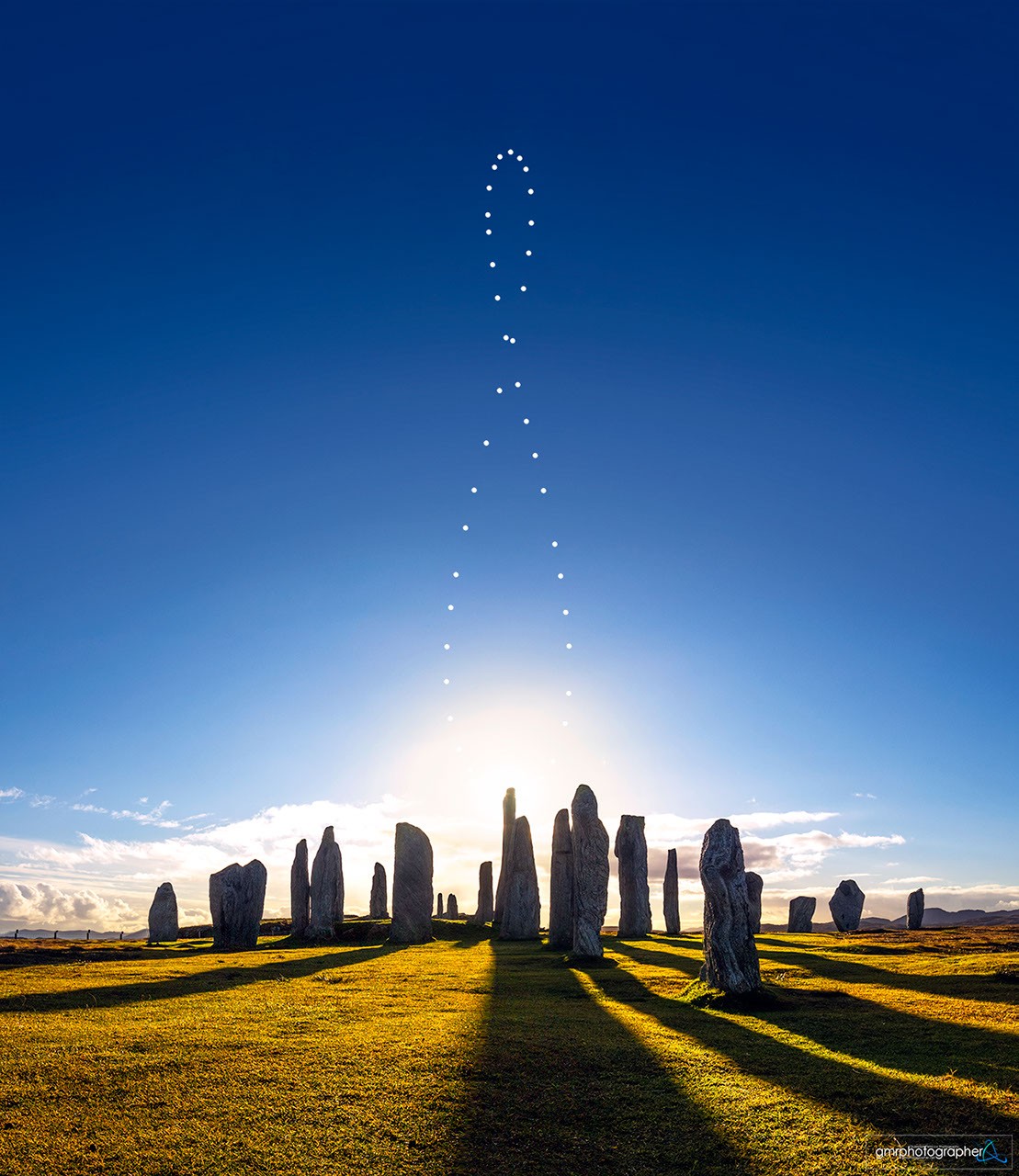
In the case of the Petricca study, images were captured every few days near the village of Callanish. The methodology requires a camera mounted on a stable tripod, often left in a fixed location or precisely repositioned using GPS coordinates to ensure consistency. The exposure settings must be carefully calibrated to account for varying weather conditions throughout the seasons, ensuring that the Sun’s position is captured with high contrast against the sky. The resulting data points are then layered through specialized post-processing software to produce the final composite curve.
Implications of Solar Cycles
The study of analemmas remains a vital tool for understanding Earth’s climate and orbital stability. Scientists analyze these solar patterns to verify orbital mechanics and calibrate precision timekeeping systems. Furthermore, the upcoming equinox—occurring just two days after this observation date—serves as a reminder of the global nature of these solar markers. During an equinox, the Sun stands vertically over the equator, leading to roughly equal periods of day and night across the globe.
For cultural historians, the recurrence of these events highlights why ancient societies, such as those that constructed the Callanish Stones, placed such high value on tracking the heavens. The transition of seasons was not merely a matter of curiosity but a survival imperative, dictating the planting and harvesting cycles necessary for sustaining prehistoric populations. The analemma, therefore, represents a universal language of time that has been read by humans for millennia, even if the tools used to record it have evolved from stone monoliths to digital sensors.
Official Perspective and Scientific Context
NASA, through its Astronomy Picture of the Day (APOD) program, continues to utilize such imagery to foster public engagement with space science. By providing expert explanations for these images, institutions like NASA and Michigan Technological University aim to translate complex celestial mechanics into accessible formats.
According to Dr. Robert Nemiroff, a lead editor at APOD, the transition of the project’s main portal to the official NASA Science website marks a renewed commitment to disseminating astronomical data to a broader audience. This shift reflects the growing importance of "Science Activation"—a NASA initiative designed to connect the scientific community with the public through education and outreach. As the digital archive of APOD grows, the collection of analemmas from various latitudes provides a unique, crowd-sourced dataset that documents how the sky looks from different parts of the world, offering a comparative view of the same fundamental celestial mechanics.
Broader Impact and Future Observation
The significance of the Callanish Stones analemma extends beyond its aesthetic appeal. It serves as a stark reminder of the persistent, rhythmic nature of our solar system. While modern technology allows us to calculate these positions with near-infinite precision, the visual evidence provided by an analemma remains the most intuitive way for the layperson to comprehend the Earth’s movement through space.
As we move toward the next equinox, observers worldwide are encouraged to take note of the changing position of the Sun at noon. Whether viewed from the perspective of an ancient stone circle in the Hebrides or from a modern city center, the Sun’s path remains constant, tied to the physical laws of gravity and motion. The continued documentation of such phenomena ensures that, even as our civilization advances, we remain tethered to the fundamental cycles that have dictated the flow of time since the dawn of human history. Through the integration of historical sites like Callanish with modern scientific methodology, researchers ensure that the legacy of astronomical inquiry remains as enduring as the stones themselves.