Launching Bill Payments in India, Enabling People to Pay Everyday Household Bills Directly on WhatsApp

The Evolution of WhatsApp in the Indian Digital Economy
The integration of bill payments is not an isolated development but rather the latest chapter in a broader digital transformation strategy. Over the past five years, WhatsApp has systematically integrated itself into the fabric of Indian daily life. Initially recognized as a peer-to-peer messaging service, the platform has successfully pivoted to cater to the complex requirements of a burgeoning digital economy.
The progression began with the introduction of WhatsApp Pay, built upon the Unified Payments Interface (UPI) infrastructure, which allowed for seamless money transfers. Following this, the platform expanded its utility by partnering with various state governments and municipal corporations to provide chatbot-based access to citizen services, such as downloading vaccination certificates, booking metro tickets, and accessing land records. The addition of bill payments represents the consolidation of these financial utilities, effectively reducing the friction associated with managing household expenditures.
Technical Infrastructure and Scope
The new feature is powered by the Bharat Connect (formerly known as the Bharat Bill Payment System or BBPS), a centralized, interoperable ecosystem operated by the National Payments Corporation of India (NPCI). By integrating with this network, WhatsApp gains access to a vast repository of service providers.
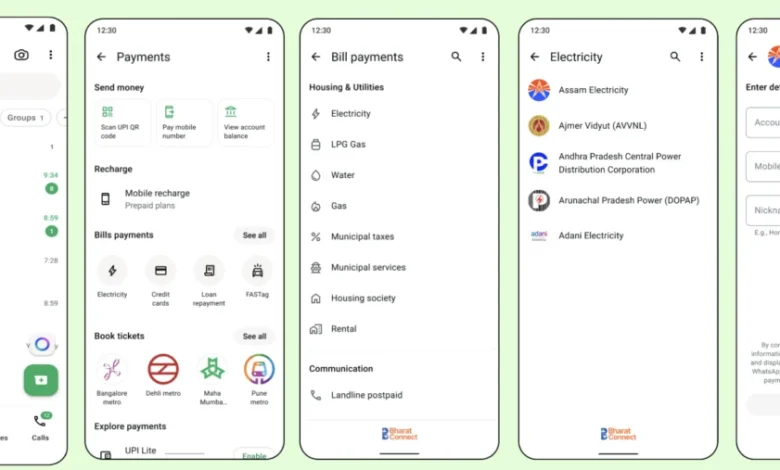
According to the official announcement, the feature supports 22,722 billers spanning 30 distinct categories. This scope covers essential services that are ubiquitous across both urban and rural India. Users can now manage their electricity bills, municipal water charges, piped natural gas (PNG) connections, FASTag toll recharges, life and general insurance premiums, and even recurring credit card and loan repayments.
The user interface for this feature has been designed to prioritize simplicity, mirroring the intuitive nature of sending a standard text message. Users can locate the bill payment function by tapping the payment icon—typically identified by the currency symbol—at the top of the home screen. This portal acts as a centralized dashboard where users can view pending dues, track payment history, manage multiple accounts under a single utility provider, and select their preferred digital payment method.
Chronology of Digital Payment Adoption in India
To understand the impact of this rollout, it is essential to look at the timeline of India’s digital payment revolution:
- 2016: The National Payments Corporation of India (NPCI) launches the Unified Payments Interface (UPI), which fundamentally changes the landscape of mobile-based retail payments.
- 2020: WhatsApp receives regulatory approval from the NPCI to launch its UPI-based payment services in a phased manner, marking its entry into the competitive Indian fintech space.
- 2022: WhatsApp expands its partnership with the Delhi Metro Rail Corporation (DMRC) and other transport authorities to enable QR-based ticket booking directly within the chat interface.
- 2023: The government of India mandates the integration of various citizen services into messaging platforms to increase accessibility, leading to the proliferation of "Gov-Tech" chatbots on WhatsApp.
- 2024: WhatsApp formalizes its entry into the utility bill payment sector via the BBPS network, aiming to capture the high-frequency transaction market.
Economic Context and Market Data
India currently boasts one of the world’s most robust digital payment ecosystems. According to recent data from the NPCI, UPI transactions have consistently hit record highs, often exceeding 10 billion transactions per month. The integration of bill payments into a platform with over 500 million active users in India provides a massive tailwind for the formalization of these payments.
Industry analysts observe that while many Indians have adopted UPI for retail payments, utility bill payments have historically been fragmented. Users often had to toggle between various service-specific apps or rely on third-party aggregators. By centralizing these functions, WhatsApp is positioning itself as a "one-stop-shop." This is particularly impactful for the semi-urban and rural demographics, where high-frequency, low-latency financial services were previously limited by the technical complexity of disparate applications.
Perspectives from Meta Leadership
Arun Srinivas, Managing Director and Country Head of Meta (India), emphasized that the primary objective of this launch is to enhance the user experience by reducing administrative friction. "For millions of Indians, WhatsApp is already the simplest way to stay close to family and friends, talk to businesses, access citizen services, and buy everything from metro tickets to insurance—all without leaving the app," Srinivas stated.
He further noted, "With Bill payments, we’re bringing that same simplicity to one of the most routine tasks in every household. No more juggling apps or tracking multiple due dates. We want to make paying a bill on WhatsApp as effortless as sending a message, and help bring the convenience of digital payments to people across the remotest parts of the country."
Strategic Implications and Industry Competition
The entry of WhatsApp into the bill payment domain introduces a new layer of competition for existing fintech incumbents, such as Paytm, PhonePe, and Google Pay. While these platforms have traditionally held a dominant share of the bill payment market, WhatsApp’s unique advantage lies in its ubiquity. It is already the primary communication channel for most Indian households, meaning that the barrier to adoption for the new bill payment feature is significantly lower than for a standalone financial application.
Furthermore, the integration serves to deepen Meta’s engagement metrics. By increasing the "time spent" within the app for productive, rather than just social, purposes, the platform reinforces its role as an indispensable utility. This also creates a data-rich environment that, while strictly governed by data privacy regulations, allows for more personalized service delivery.
Security and Regulatory Compliance
A critical aspect of the rollout is security. Because the feature is built on the BBPS framework and utilizes UPI, it adheres to the stringent security protocols mandated by the Reserve Bank of India (RBI). Every transaction requires the user’s UPI PIN, ensuring that payments are authorized and secure. Additionally, the platform provides a clear audit trail of all transactions, allowing users to dispute or track payments directly through the app’s support channels.
The rollout is being conducted in a phased manner to ensure system stability. Over the coming weeks, the feature will be pushed to all Android and iOS users across the country. This gradual approach is standard for major updates in the Indian market, allowing the company to monitor performance and resolve technical bottlenecks before a full-scale deployment.
Broader Societal Impact
The transition of essential services to the WhatsApp ecosystem carries significant implications for financial inclusion. By providing a familiar, text-based interface, the platform lowers the technical literacy requirement for digital payments. Elderly users or those in rural areas who may find complex banking apps intimidating are more likely to engage with a service embedded within a platform they use daily for communication.
Moreover, the automation of bill payments—such as reminders for upcoming due dates—can help mitigate the risk of late payment penalties, thereby providing a tangible financial benefit to the average household. As India continues to digitize its economy, the role of "conversational commerce" and "conversational finance" is expected to grow. WhatsApp’s latest initiative is a clear signal that the future of digital interaction in India will be defined by seamless, multi-purpose platforms that eliminate the need to exit a familiar digital environment to complete a task.
Conclusion
The introduction of bill payments on WhatsApp is a landmark event that signals the maturation of India’s digital payment sector. By bridging the gap between social communication and essential financial administration, Meta is setting a new standard for user convenience. As the service reaches its full user base in the coming weeks, the success of this integration will likely be measured by the reduction in time spent on manual bill management and the continued growth of digital payment volume across the nation. For the Indian consumer, the message is clear: the digital utility of the future is no longer about navigating an array of disparate applications, but about consolidating life’s necessities into the singular space where they already communicate.
Related posts: