Danish Startup Triton Depth Secures €1 Million Pre-Seed Funding to Pioneer Underwater Acoustic Defense Systems


A nascent Danish company, Triton Depth, founded by a trio of ambitious students, is charting a course into the critical, yet often overlooked, domain of underwater defense. The company has successfully secured €1 million in pre-seed funding, a significant endorsement from investors including the London-based venture capital firm The Creator Fund and Denmark’s state-owned Export and Investment Fund (EIFO). This substantial backing is earmarked to fuel Triton Depth’s innovative approach to a pressing European security challenge: the escalating threat of drone-based naval warfare and subsea sabotage.
The investment by EIFO, in particular, signals a growing awareness within Danish governmental circles of the imperative to bolster domestic defense capabilities. This strategic move comes at a time when the broader European security landscape is marked by increased geopolitical tensions and a perceived volatility in traditional alliances. The vulnerability of the European Union, and by extension Denmark, to a spectrum of maritime threats necessitates a proactive and self-reliant approach to defense. Triton Depth’s focus on leveraging affordable, dual-use acoustic technology is seen as a potentially pivotal element in this evolving security architecture.
The Strategic Imperative: Securing Europe’s Subsea Domain
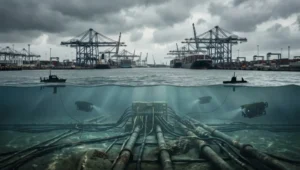
The strategic importance of the underwater domain has been underscored by a series of recent incidents and a general increase in global maritime activity. Critical infrastructure, including undersea communication cables, energy pipelines, and offshore renewable energy installations, lies vulnerable beneath the waves. The sabotage of the Nord Stream 1 and 2 pipelines in the Baltic Sea in September 2022 served as a stark reminder of this vulnerability, causing significant economic disruption and highlighting the potential for covert hostile actions. This event, in particular, has likely galvanized investment in companies like Triton Depth, which propose solutions to detect and deter such threats.
The geopolitical context further amplifies the need for robust subsea defense. With evolving global power dynamics and an increased focus on strategic chokepoints and critical infrastructure, the underwater battlefield is becoming increasingly significant. Nations worldwide are recognizing the need for advanced surveillance and response capabilities to protect their maritime interests and economic lifelines. Triton Depth’s ambition to provide an "intelligence layer for the ocean" addresses this burgeoning demand for comprehensive subsea awareness.
Triton Depth’s Innovative Approach: Acoustic Intelligence for the Seas
Triton Depth’s core innovation lies in its ‘Triton Nodes,’ a scalable network of low-maintenance passive acoustic sensors. These sensors are designed to meticulously measure and analyze sound signatures in the underwater environment. The data collected is then fed into an artificial intelligence (AI) model that is capable of real-time assessment and classification of detected sounds. This allows for the identification of anomalies, potential threats, and the classification of various underwater activities, from commercial shipping to the distinct acoustic profiles of unmanned underwater vehicles (UUVs) or autonomous underwater vehicles (AUVs).

The company’s strategy of marketing its technology as "dual-use" is particularly shrewd. This approach allows for broader market penetration, serving both civilian and defense applications. For civilian use, the Triton Nodes can monitor maritime traffic, environmental conditions, and the structural integrity of underwater installations. In the defense sector, the technology offers a cost-effective solution for maritime domain awareness, early warning systems, and the detection of potential sabotage or espionage activities. This versatility is crucial for a startup operating in a sector often characterized by high entry barriers and lengthy procurement cycles.
Carl Borg, CEO and Co-Founder of Triton Depth, articulated the company’s vision: "We aim to build ‘the intelligence layer for the ocean’ for both civilian and defense use cases." This statement encapsulates the ambitious scope of their project, which seeks to provide a holistic understanding of the underwater environment. The reliance on passive acoustics is a key differentiator, offering a covert and energy-efficient method of surveillance that is difficult to detect and jam.
Financial Backing and Strategic Significance
The €1 million in pre-seed funding is a critical injection of capital that will enable Triton Depth to accelerate product development, refine its AI algorithms, and conduct further testing and validation. The involvement of EIFO, Denmark’s state-backed investment fund, is particularly noteworthy. EIFO’s mandate includes supporting Danish companies in their export efforts and fostering innovation in strategic sectors. Their investment in Triton Depth suggests a strategic alignment with national security interests and a commitment to supporting emerging defense technologies.
This investment can be viewed as a proactive measure by the Danish government to address perceived security gaps. In an era where international partnerships can be unpredictable, fostering domestic expertise and technological capabilities in critical defense areas becomes paramount. The Baltic Sea, a vital waterway for trade and regional security, is of particular concern to Denmark, given its geographical position and its critical undersea infrastructure.
The broader European defense market is experiencing a renaissance, driven by a renewed appreciation for national security and a desire for greater strategic autonomy. Nordic defense budgets, in particular, have seen a steady increase in recent years, reflecting this trend. Companies like Triton Depth are well-positioned to capitalize on this growing demand for scalable, affordable, and technologically advanced defense solutions.
The Broader Implications for Maritime Security
The implications of Triton Depth’s success extend beyond the company itself. It signifies a potential shift in how maritime security is approached, moving towards more distributed, intelligent, and cost-effective surveillance systems. The reliance on AI for data analysis is a testament to the transformative impact of artificial intelligence across various industries, including defense.

The success of this Danish startup could inspire similar ventures across Europe, fostering a more competitive and innovative European defense technology sector. The focus on dual-use technology also encourages a more integrated approach to security, where civilian infrastructure and defense capabilities can mutually benefit from technological advancements.
Moreover, the emphasis on acoustic sensing aligns with a growing understanding of the importance of the underwater acoustic environment. Sound travels efficiently underwater, making it a reliable medium for detection and communication. As other technologies, such as fiber optic cables, are being explored for their potential to detect subsea disturbances through subtle light pulses, acoustic monitoring remains a foundational and robust method for understanding underwater activity. The ability to differentiate between natural underwater sounds, commercial activities, and potential hostile actions is a complex challenge that Triton Depth’s AI-driven approach aims to solve.
Future Outlook and Challenges
While the pre-seed funding provides a strong foundation, Triton Depth faces the inherent challenges of the defense industry. These include navigating complex regulatory environments, securing further investment for scaling production, and winning contracts with national defense agencies. The company’s ability to demonstrate the reliability, accuracy, and cost-effectiveness of its Triton Nodes will be crucial for its long-term success.
The evolving nature of underwater threats, particularly the increasing sophistication of autonomous systems, will also require continuous innovation and adaptation. Triton Depth’s commitment to developing an "intelligence layer" suggests a long-term vision of an adaptive and evolving system, capable of learning and responding to new threats as they emerge.
The investment in Triton Depth is more than just a financial transaction; it is a strategic investment in Europe’s future maritime security. By focusing on affordable, dual-use acoustic technology, the company is poised to play a significant role in safeguarding critical infrastructure and enhancing the defense capabilities of nations in a rapidly changing geopolitical landscape. The success of this young Danish company underscores the growing importance of innovation and self-reliance in ensuring the security of the underwater domain, a vital frontier in the 21st century. The ongoing geopolitical climate, marked by heightened tensions and a renewed focus on strategic vulnerabilities, places companies like Triton Depth at the forefront of a critical national and international security endeavor. Their work in developing advanced acoustic intelligence systems could prove instrumental in deterring aggression and protecting the vital undersea arteries that power modern economies and communication networks.