AWS Lambda Now Supports GPU-Accelerated Workloads on Managed Instances With Serverless Simplicity

Amazon Web Services (AWS) has officially announced native Graphics Processing Unit (GPU) support for EC2 G-series GPU instances within AWS Lambda Managed Instances (LMI), marking a significant milestone in serverless computing. This capability allows developers and enterprises to execute heavy GPU-accelerated workloads—such as machine learning inference, real-time media processing, 3D rendering, and complex scientific simulations—directly within a serverless architecture. By bridging the gap between high-performance specialized hardware and serverless orchestration, AWS aims to eliminate the traditional overhead associated with managing infrastructure clusters, configuring CUDA drivers, and maintaining low-level machine learning pipelines.
The official rollout addresses long-standing challenges in cloud architecture, specifically the friction of deploying high-performance compute resources and the financial inefficiency of underutilized hardware. Historically, running workloads on GPUs required provisioning self-managed EC2 instances or configuring cumbersome third-party clusters. These traditional setups demanded extensive manual intervention, from selecting the correct AMI and managing driver versions to building custom scaling logic and writing bespoke event integrations. Furthermore, because GPUs are inherently expensive and individual workloads rarely saturate a full device, organizations frequently found themselves paying for idle capacity. The integration into Lambda Managed Instances resolves these operational bottlenecks by automating provisioning, scaling, and event integration, while simultaneously maximizing hardware utilization through intelligent request concurrency.
Main Facts and Technical Capabilities
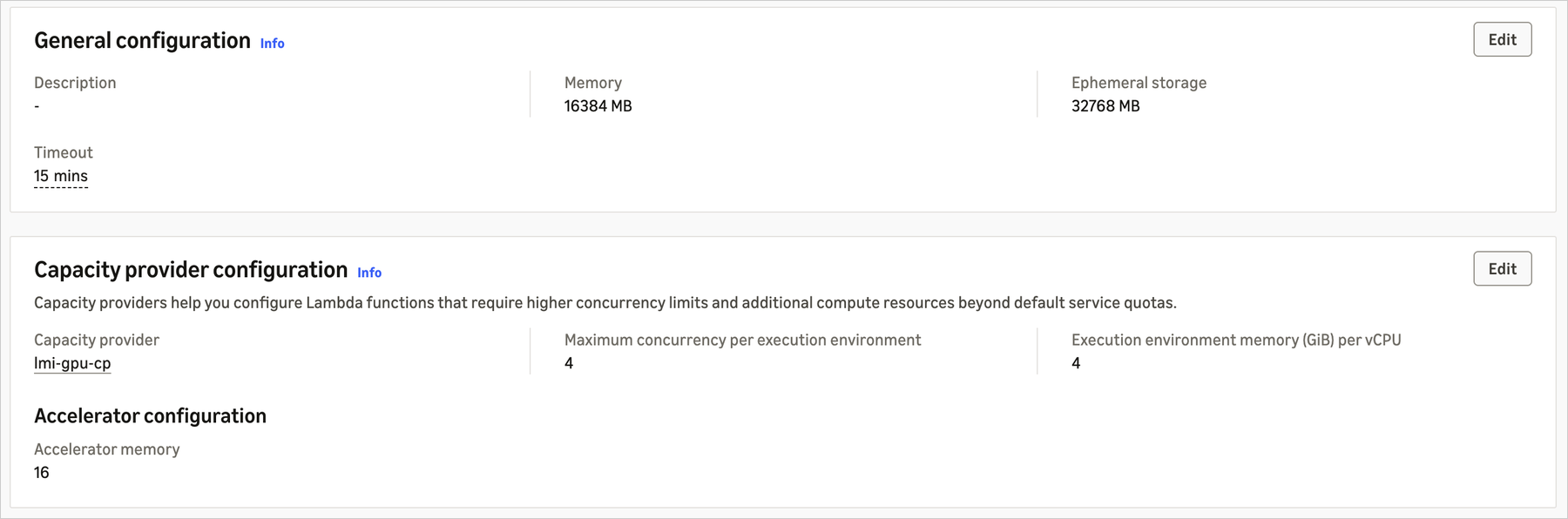
The newly introduced feature operates on the foundation of Lambda Managed Instances, integrating seamlessly into the existing AWS Lambda programming model. Developers package their GPU-accelerated functions as Open Container Initiative (OCI) container images up to 32 GB in size, leveraging Seekable OCI (SOCI) lazy loading to reduce startup latencies by up to 70 percent. These functions can handle up to 32 GB of NVMe ephemeral storage in the /tmp directory, memory allocations ranging from 2,048 to 32,768 MB, and accelerator memory between 3 and 48 GB.
A critical technical innovation of this release is the support for per-environment concurrency. Each execution environment can process up to 48 concurrent requests simultaneously on a single GPU. For instance, when deploying large language models using optimized serving engines like vLLM or SGLang, concurrent invocations share a single copy of the model weights residing in GPU memory. This capability dramatically increases throughput and ensures that organizations derive maximum value from the underlying hardware they finance.
Furthermore, GPU-accelerated functions benefit from extended function timeouts of up to 90 minutes for asynchronous and event source mapping invocations. This allows data engineers and scientists to execute long-running batch operations, multi-step inference chains, and heavy media transcoding tasks without redesigning their system architecture. Native integration with over 200 AWS event sources—including Amazon S3, Amazon SQS, Amazon API Gateway, and Amazon EventBridge—ensures that triggering a GPU-backed function is as straightforward as invoking any standard serverless function.
Background Context and Evolution of Serverless Compute

The journey toward serverless GPU computing has been shaped by the explosive growth of generative artificial intelligence and deep learning over the past several years. As organizations increasingly adopt custom models, fine-tuned large language models, and specialized computer vision pipelines, the demand for agile, scalable compute infrastructure has surged.
Initially, serverless platforms were strictly bound to CPU architectures, optimized for lightweight, stateless web applications, event-driven data transformations, and microservices coordination. While services like Amazon Bedrock provided fully managed access to foundational models, developers who wished to deploy custom, domain-specific models or execute non-ML workloads requiring massive parallel processing were forced back into the realm of infrastructure management. They had to orchestrate Auto Scaling groups, construct complex Kubernetes clusters, or manage EC2 instance lifecycles manually.
AWS introduced Lambda Managed Instances to offer a middle ground: the predictable pricing and specialized compute capabilities of Amazon EC2 combined with the operational simplicity of serverless administration. By extending LMI to encompass G-series GPU instances, AWS has effectively completed the evolution, enabling enterprise customers to deploy specialized hardware workloads with the same operational model used for standard business logic.
Chronology of Deployment and Implementation Workflow
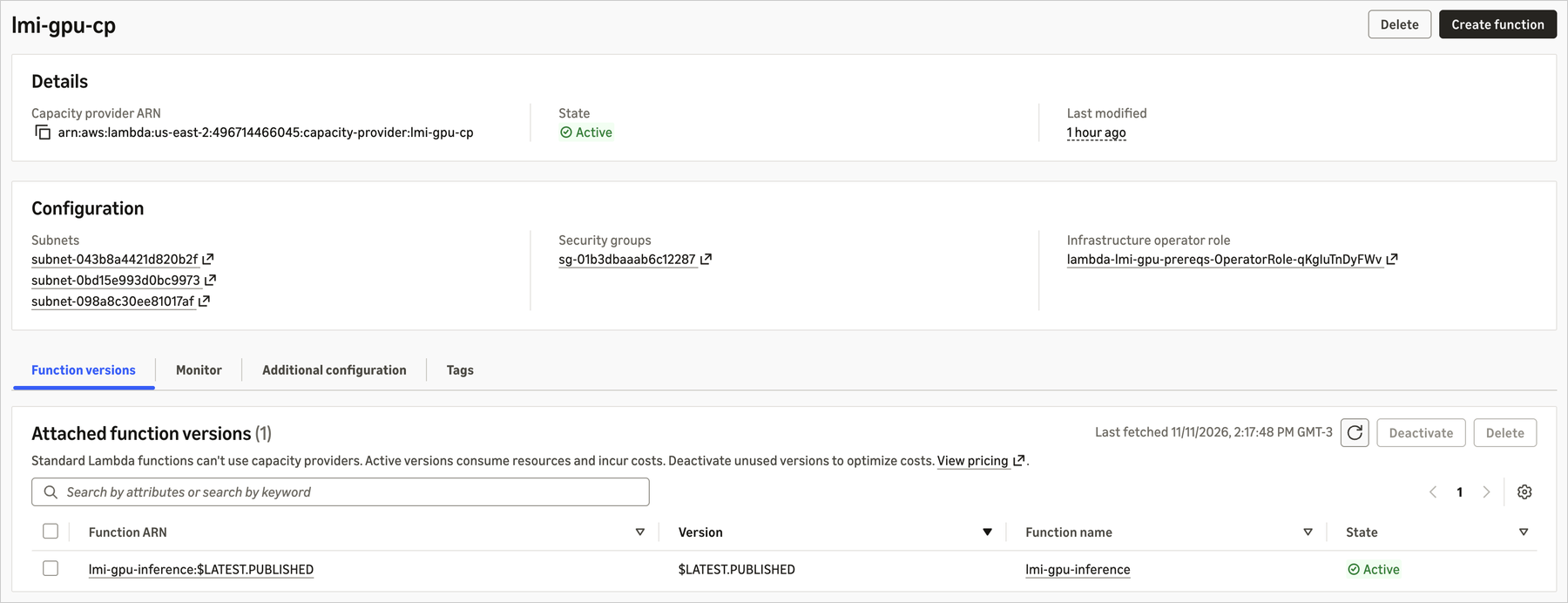
Implementing a GPU-accelerated Lambda function follows a structured, repeatable DevOps workflow designed to minimize friction. While initial testing with models such as Qwen/Qwen2.5-1.5B-Instruct demonstrates that a live, OpenAI-compatible endpoint can be established in approximately ten minutes, production environments adhere to a rigorous provisioning sequence:
- Capacity Provider Configuration: Developers define a capacity provider by specifying allowed GPU instance types—such as g5.2xlarge, g6.2xlarge, and g6e.2xlarge—alongside VPC subnets, security groups, and scaling parameters. Listing multiple instance generations allows Lambda to intelligently select the most cost-effective and available hardware, automatically falling back during capacity constraints.
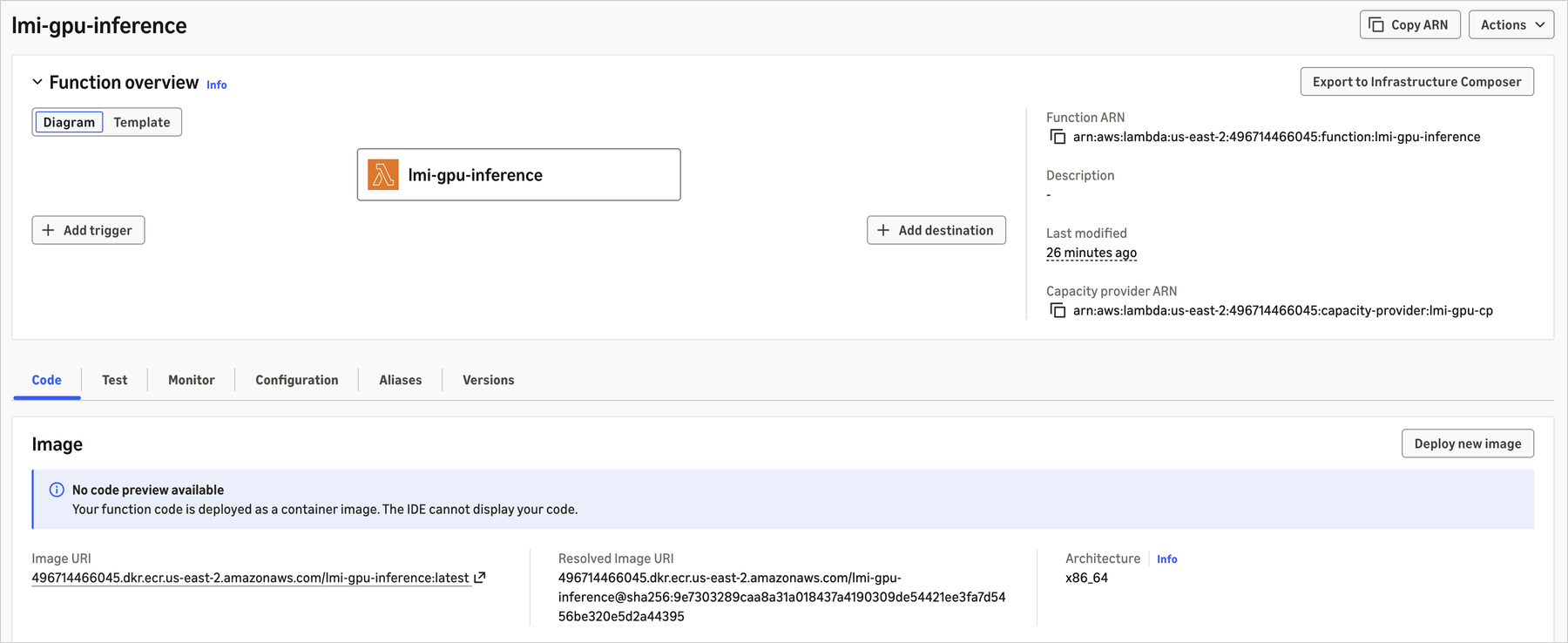
- Container Image Construction: Using curated vLLM or SGLang base images provided by AWS, developers build and push OCI images to Amazon Elastic Container Registry (ECR). These curated images come pre-packaged with PyTorch, the CUDA toolkit, and serving frameworks, requiring minimal configuration beyond defining environment variables like
MODEL_ID. - Function Creation and Versioning: The function is created with specific
AcceleratorConfigparameters to define minimum GPU memory requirements. Prior to invocation, a version is published, triggering the execution environments to download model weights and complete engine warm-ups during the publishing phase rather than at the moment of the first client request. - Invocation and Orchestration: Once active, the function can be invoked via standard API payloads, integrated into Amazon SQS event streams, or orchestrated through Lambda durable functions for complex, multi-step workflows.
Supporting Data, Metrics, and Observability
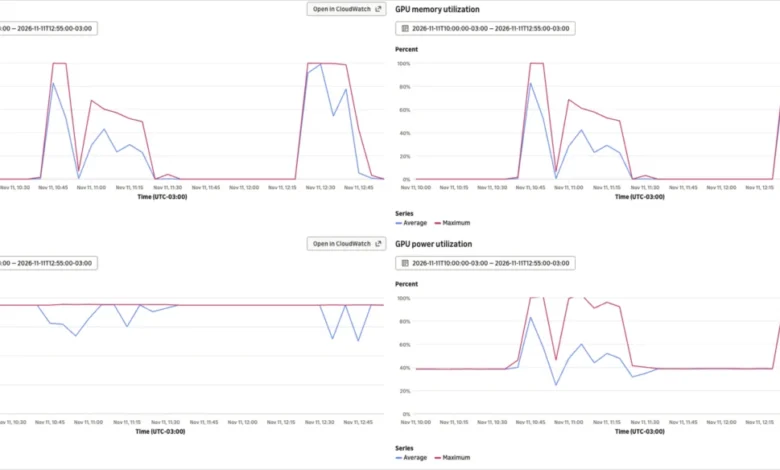
Monitoring complex GPU workloads has traditionally required third-party telemetry tools and custom monitoring daemons. AWS has integrated GPU observability directly into the native management ecosystem. Post-invocation, administrators can access granular metrics via Amazon CloudWatch and the AWS Lambda console, tracking key performance indicators such as GPU utilization, GPU memory utilization, absolute memory usage, and GPU power consumption.
These real-time metrics provide the empirical data required to fine-tune execution environment concurrency, optimize memory-to-vCPU ratios, and drive effective cost-management strategies. Additionally, organizations can leverage Amazon EC2 On-Demand Capacity Reservations (ODCR) to guarantee hardware availability for critical production pipelines, while standard Compute Savings Plans and Reserved Instances seamlessly apply to the underlying G-series instance fees.
Industry Implications and Economic Analysis
From an economic perspective, this release alters the cost-benefit calculus of deploying machine learning and high-performance computing in the cloud. By decoupling GPU hardware management from application code, enterprises can significantly reduce the operational overhead traditionally absorbed by specialized machine learning engineering teams. Engineers can redirect their focus toward model tuning and business logic rather than driver compatibility and cluster maintenance.
Furthermore, the ability to consolidate multiple concurrent requests onto a single GPU execution environment addresses the notorious problem of low hardware utilization. In traditional architectures, provisioning a dedicated GPU instance for sporadic or low-volume inference tasks often results in capital waste, with hardware sitting idle for extended periods. Lambda’s scaling model ensures that users pay strictly for compute time consumed during active execution, while high-density request packing maximizes throughput per instance.
Official Availability and Future Outlook
GPU support for EC2 G-series instances (including G4dn, G5, G6, G6f, Gr6, Gr6f, and G6e) on AWS Lambda Managed Instances is generally available today across supported AWS Regions. Pricing consists of the standard underlying EC2 instance fee—eligible for existing Savings Plans and Reserved Instances—alongside a transparent 9.75 percent management fee for GPU instances and standard Lambda request fees.
As AWS continues to expand instance family support and refine its serverless orchestration capabilities, industry analysts predict accelerated adoption of custom AI inference and media processing workloads among small- and medium-sized enterprises previously priced out of dedicated GPU infrastructure management. Documentation, sample templates, and deployment guides are currently available through the official AWS Lambda console and developer documentation portals.