OpenRouter Data Reveals AI Token Consumption Soars While Developer Spending Stagnates, Testing Jevons Paradox


The artificial intelligence industry has long relied on a foundational economic hypothesis to justify its trillion-dollar infrastructure buildout: as AI becomes cheaper, usage will skyrocket to such a degree that overall spending and revenues will actually rise. However, comprehensive new empirical data published by AI model aggregator OpenRouter suggests this foundational principle—known as Jevons Paradox—may be losing its grip on the modern software development landscape.
According to proprietary research released Thursday by OpenRouter, a platform that grants developers unified API access to hundreds of foundational models from various providers, users are consuming AI tokens at unprecedented rates. Yet, remarkably, their actual financial outlays have remained virtually flat since early October. This disconnect between surging digital consumption and stagnant monetary expenditure introduces a complex new variable into ongoing debates regarding the financial sustainability of the global artificial intelligence boom.
The Mechanics of Consumption and the Collapse of Token Pricing
To understand the weight of OpenRouter’s findings, one must examine the fundamental unit of economic exchange in the generative AI era: the token. Tokens represent the discrete chunks of text, code, or data that AI models ingest and produce. When developers build applications, they access these foundational models via application programming interfaces (APIs), paying fractions of a cent per token processed.
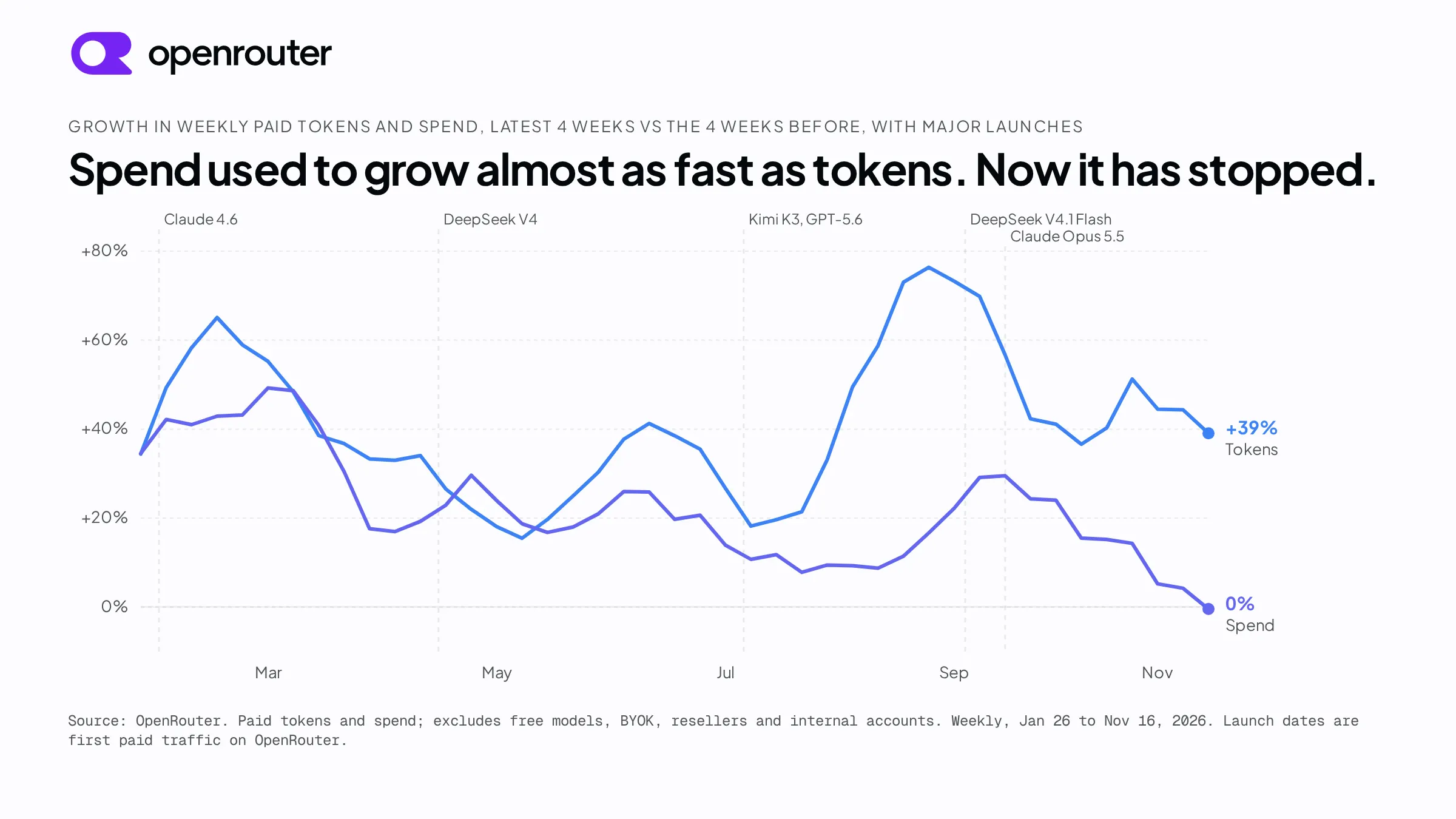
Historically, fierce competition among model providers—intensified by open-source breakthroughs and aggressive price-cutting wars—has driven down the cost of intelligence at a staggering pace. OpenRouter’s data illustrates this hyper-deflationary trend with stark clarity. Between the week of January 5 and the week of November 16, weekly paid token consumption on the platform expanded by a staggering 44-fold. Over that exact same timeframe, overall financial spending by users grew by a comparatively modest 7.6-fold.
The mathematical consequence of this disparity is an 83% collapse in the average price per token. In practical terms, this dramatic reduction in cost has empowered businesses and developers to execute exponentially more complex AI tasks, automate larger workflows, and process vast quantities of unstructured data without expanding their operating budgets.
However, looking at the most recent four-week window compared to the preceding four weeks, OpenRouter identified a pivotal shift. Token consumption grew by a healthy 39%, but spending growth essentially flatlined, rounding to zero percent. Earlier in the year, consumption and spending tracked closely together; today, they are thoroughly decoupled.

Tracing the Timeline: The Rise, Peak, and Cooling of Price Elasticity
To quantify how efficiency gains translate into market demand, OpenRouter utilized the economic concept of price elasticity. In this context, elasticity measures the percentage increase in token consumption generated by a 1% decrease in the average token price. If the elasticity coefficient is greater than 1, a drop in price drives enough new demand to increase total revenue. If elasticity equals 1, total revenue remains unchanged as prices fall. If it drops below 1, total revenue shrinks even as volume increases.
The trajectory of price elasticity throughout the year maps out a distinct chronology of the AI market:
- Early 2026 (The Agentic Surge): OpenRouter attributes an initial massive surge in early 2026 usage to the maturation and proliferation of autonomous AI agents capable of executing complex software engineering and coding tasks with minimal human intervention.
- Second Quarter 2026 (Peak Jevons Paradox): Price elasticity peaked at a remarkable 5.5, meaning that for every 1% drop in the cost of tokens, consumption surged by 5.5%. During this period, the Jevons Paradox held supreme authority, validating massive capital expenditures in silicon and data centers.
- Third Quarter 2026 (Moderation): As the market began to saturate and basic automation use cases stabilized, price elasticity sharply decelerated, falling to 1.6.
- Fourth Quarter 2026 (The Plateau): Through November 16, elasticity dropped further to 1.2, hovering dangerously close to the inflection point where further price reductions yield zero incremental revenue growth for providers.
Furthermore, OpenRouter’s research uncovered a behavioral divergence between distinct customer segments. Large enterprise corporations appear increasingly inclined to pocket the savings generated by cheaper model iterations, keeping their AI software budgets flat while enjoying greater operational efficiency. Conversely, native AI startups—whose entire business models are structurally dependent on generative intelligence—continue to scale up their usage, though not enough to offset the broader macroeconomic cooling trend.
The Macroeconomic Context: Jevons Paradox and the Trillion-Dollar Infrastructure Bet
The timing of OpenRouter’s data release coincides with heightened market anxiety regarding the return on investment (ROI) for artificial intelligence infrastructure. For nearly two years, technology executives and venture capitalists have leaned heavily on Jevons Paradox to defend historic levels of capital expenditure (capex).
The concept derives from 1865, when British economist William Stanley Jevons observed that technological improvements that increased the efficiency of steam engines actually led to a massive increase in Great Britain’s total coal consumption. The argument was simple: making a resource cheaper and more efficient does not conserve it; instead, it democratizes access and stimulates exponential demand.
In the wake of Chinese AI developer DeepSeek’s shock market entry in January 2025—which proved that highly capable models could be trained and operated at a fraction of traditional costs—technology leaders quickly adopted Jevons’ historical observation. Microsoft CEO Satya Nadella and other industry figureheads frequently cited the paradox to reassure Wall Street that efficiency gains would accelerate, rather than cannibalize, AI adoption.
Yet, current market indicators suggest cracks in that thesis. High-profile hardware stocks have experienced extreme volatility. Notably, shares of Nvidia—the primary chipmaker powering the AI revolution—suffered a severe correction, plunging nearly 48% from their October record highs by late November amid mounting Wall Street skepticism over monetization timelines.
Concurrently, financial institutions are tallying the staggering capital required to sustain the ecosystem. Global research from JPMorgan Chase estimates that worldwide AI capital expenditures will hit an astonishing $900 billion in 2026 alone, with cumulative spending projected to reach $5.5 trillion through 2030. JPMorgan analysts have repeatedly highlighted the growing reliance on external debt and complex financing vehicles to fund the continuous expansion of hyperscale data centers.
Implications for Model Providers and Data Center Financiers
The decoupling of token consumption from financial expenditure carries profound implications for every layer of the AI stack.
For foundational model providers—such as OpenAI, Anthropic, Google, and a myriad of open-source contributors—falling prices combined with stagnant spending growth mean that simply shipping more volume is no longer a guaranteed path to revenue expansion. If the cost of generating intelligence falls faster than enterprise demand can expand, the top-line revenue of API providers could stall.
For the institutional investors, private equity firms, and real estate developers financing the construction of massive data centers, the stakes are even higher. These multi-billion-dollar infrastructure projects require predictable, long-term revenue streams to service debt and deliver projected yields. If corporate AI budgets remain fixed while computing efficiency drives token prices down to pennies, recovering the immense capital cost of these facilities becomes significantly more challenging.
Methodological Nuances and Market Limitations
Industry analysts emphasize that OpenRouter’s dataset, while robust, paints a specific picture of the developer economy and does not tell the entire story of the global AI market.

To maintain analytical accuracy, OpenRouter excluded free-tier models, internal company accounts, third-party resellers, and developers utilizing their own custom API keys directly with primary providers. Consequently, the findings do not capture consumer-facing subscription revenues (such as individual ChatGPT Plus accounts) or direct, enterprise-level tier-one cloud agreements.
Additionally, raw token counts are not a direct proxy for computational intensity. Different model architectures—ranging from dense transformer models to complex Mixture-of-Experts (MoE) systems—require varying levels of hardware resources to process identical token volumes. Furthermore, a deflationary pricing environment driven by lower operating costs and algorithmic efficiencies means that flat financial spending by customers does not automatically equate to flat profit margins for underlying providers.
Looking Forward: A Maturing Software Ecosystem
Ultimately, OpenRouter’s findings do not signal the death of artificial intelligence, nor do they imply that the broader market is shrinking. Instead, the data suggests that the AI industry is transitioning from a period of explosive, speculative land-grab growth into a more mature, cost-conscious operational phase.
As enterprises shift focus from proof-of-concept experimentation to bottom-line efficiency and return on investment, the wild ride of exponential price-elasticity may be leveling off. Whether the infrastructure boom can sustainably adjust to a world where intelligence is increasingly cheap and ubiquitous remains the defining question for the technology sector heading into the final stretch of the decade.