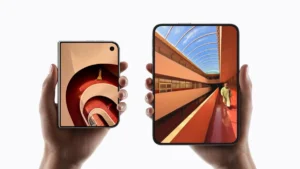
The unveiling of the Apple iPhone Duo at the Cupertino “Surprise and Shine” keynote on September 9, 2026, marked a watershed moment in mobile technology, signaling Apple’s official entry into the competitive foldable smartphone market. With a retail price point of $1,999, the device represents the most significant departure from the traditional slab smartphone form factor in the company’s history. As early testers and industry analysts gain hands-on access to the device at Apple Park, a clearer picture is emerging regarding the hardware’s real-world performance, the fluidity of its software transitions, and the physical reality of its folding mechanism.
A New Chapter for Apple Hardware
The iPhone Duo, which features a 7.6-inch internal display, arrives at a time when the foldable market is maturing. Competitors have occupied this space for several years, yet Apple’s late entry suggests a strategic focus on refinement rather than early-adopter experimentation. During the keynote, Apple emphasized the "seamlessness" of the hinge and the software’s ability to adapt instantaneously to the change in screen real estate.
Early physical impressions from those on the ground at Apple Park, including Mashable’s senior editorial team, confirm that the device maintains the signature industrial design language associated with the brand. Despite the mechanical complexity required for a folding display, the device maintains an impressively thin profile, suggesting that Apple has successfully integrated its latest thin-film transistor technology with a robust, yet compact, hinge mechanism.

The Real-World Experience: Crease and Continuity
One of the primary concerns surrounding foldable technology has always been the visibility and tactile feel of the center crease. In controlled, studio-lit presentations, such blemishes are often obscured. However, in the hands of early testers, the reality is more nuanced. While the internal display appears nearly continuous under standard indoor lighting, shifting the device toward a direct overhead light source reveals a faint, vertical indentation along the hinge line.
This observation has prompted a broad debate among tech enthusiasts and reviewers. Some have lauded the achievement, noting that the crease is the least obtrusive they have encountered in the current generation of foldables. Others remain skeptical, suggesting that the "magic" of the screen is contingent upon viewing angles. Despite these critiques, the consensus among those who have spent time with the device is that the internal display’s brightness and color accuracy largely mitigate the visual impact of the seam during daily tasks such as web browsing or video playback.
Software Integration and User Interface
A critical element of the iPhone Duo’s value proposition is its software, which must handle the transition between the outer screen and the full 7.6-inch internal display without latency. Initial reports from creators like Max Weinbach and iJustine indicate that the system response is remarkably rapid. The interface automatically repositions apps and multitasking windows as the user transitions from a single-handed orientation to a tablet-like, two-handed experience.
One of the most notable features highlighted during initial testing is the under-display camera technology. Industry analysts had long questioned how Apple would handle the front-facing camera on a foldable device, fearing that a punch-hole would mar the immersive experience of the inner display. The implementation of an invisible under-display sensor has been described by early reviewers as "wild" and unexpectedly refined, providing a clean, uninterrupted canvas for media consumption.

Chronology of the Development Cycle
The road to the iPhone Duo was paved with years of speculation and supply chain rumors.
- 2023: Initial patents regarding multi-axis hinge mechanisms were filed by Apple, sparking early rumors of a "foldable iPhone."
- 2024: Reports surfaced regarding Apple’s partnership with display manufacturers to develop high-durability, flexible OLED panels capable of withstanding hundreds of thousands of folds.
- 2025: Beta testing of specialized versions of iOS—often dubbed "foldable-ready" iterations—began internally, focusing on UI continuity and multi-app window management.
- September 9, 2026: The official launch event confirms the existence of the device, with a scheduled consumer release date of October 23, 2026.
Market Implications and Competitive Analysis
The $1,999 price tag places the iPhone Duo firmly in the "ultra-premium" category. While this may limit initial market penetration, it positions the device as a productivity tool aimed at professionals and power users who require the portability of a phone with the utility of a tablet.
Industry analysts observe that Apple’s entry into this segment is likely to accelerate the adoption of foldable displays across the broader smartphone ecosystem. By validating the form factor, Apple is effectively signaling to app developers that they must optimize their software for variable screen ratios. This shift is expected to have a ripple effect, potentially driving down costs for components as manufacturers ramp up production to meet the anticipated demand for foldable technology.
Community and Expert Reaction
The discourse surrounding the iPhone Duo has been polarized. On one side, tech creators have praised the build quality, with many noting that the device feels more like a piece of jewelry than a traditional handheld computer. The ability to use the outer display for camera previews while the phone is partially folded—a "tent mode" equivalent—has been hailed as a game-changer for content creators.

Conversely, some observers have noted that the form factor invites comparisons to legacy devices like the Nintendo DS or the Microsoft Surface Duo, suggesting that the dual-screen experience requires a significant shift in user behavior. There are also lingering questions regarding the long-term durability of the folding display and the performance of games that rely on precise touch input across the center crease. As the October 23 release date approaches, these questions remain the primary focus of the tech community.
Technical Specifications and Future Outlook
While full technical specifications were not exhaustive at the launch, the hardware is expected to utilize the latest iteration of Apple’s silicon, optimized for the thermal demands of a dual-screen device. The battery configuration, which must account for the limited space in the folding chassis, will likely be a point of scrutiny during long-term reviews.
The launch of the iPhone Duo is not merely the introduction of a new product; it is the opening of a new front in the mobile computing war. By successfully executing a design that many thought would be too fragile or technically inconsistent for the Apple standard, the company has set a new benchmark. Whether the consumer market is ready to embrace this transition—and pay the premium for it—will be the defining story of the Q4 2026 fiscal cycle.
As the device reaches public hands in late October, the focus will inevitably shift from "first looks" to "daily driver" performance. The success of the iPhone Duo will be measured by its ability to remain reliable, performant, and intuitive over months of use, rather than minutes of demonstration. For now, however, the early reports from Apple Park suggest that the gamble on the foldable form factor is one that the company is prepared to support with the full weight of its ecosystem.