Amazon S3 Tables Now Support Managed Migration of Apache Hive Tables to Apache Iceberg for Streamlined Data Lake Modernization

Modern enterprises are swimming in petabytes of data, yet organizing, optimizing, and modernizing that vast ocean of information has historically demanded an immense amount of engineering heavy lifting. For years, organizations relying on Apache Hive tables registered within the AWS Glue Data Catalog faced a daunting operational hurdle whenever they sought to upgrade their architecture to Apache Iceberg, the rapidly emerging open standard for large-scale analytics datasets. Migrating these legacy systems typically required weeks, if not months, of custom pipeline development, specialized infrastructure provisioning, meticulous data type conversions, and complex rollback management.
To alleviate these friction points, Amazon Web Services (AWS) has officially announced a streamlined, cost-effective solution for data lake modernization. Amazon S3 Tables now natively support fully managed migrations from Apache Hive to Apache Iceberg. This new API-driven capability allows data engineering teams to seamlessly upgrade their storage architectures with zero custom pipelines to build, no dedicated compute resources to provision, and minimal disruption to ongoing production workloads.
The Evolution of Open Table Formats
To understand the significance of this development, one must examine the architectural trajectory of modern data lakes. Apache Hive has served as a foundational data warehousing and querying software for Hadoop-based systems for well over a decade. However, as data volumes scaled into the petabyte range, traditional table formats began to show their age, struggling with high concurrency, schema evolution, and fine-grained data manipulation.
Enter Apache Iceberg, an open-source, high-performance table format designed specifically for massive analytic datasets. Iceberg introduced revolutionary features to the data lake ecosystem, including advanced schema evolution (allowing columns to be renamed, dropped, or reordered safely without breaking downstream queries), hidden partitioning (preventing users from needing to know physical partition layouts to write efficient queries), and time travel capabilities (enabling analysts to query historical snapshots of data as they existed at specific points in time). Furthermore, Iceberg keeps data entirely open and accessible via any compatible query engine, preventing vendor lock-in and democratizing data access.

Recognizing the industry-wide shift toward Iceberg, AWS introduced Amazon S3 Tables to offer purpose-built, fully managed storage designed to keep Iceberg tables performant and cost-effective as they scale. S3 Tables feature built-in automated maintenance, file compaction, data optimization, replication, and seamless integration with S3 Intelligent-Tiering. Until now, however, bridging the gap between legacy Hive tables and modern S3 Tables required a significant upfront investment in engineering hours and infrastructure management.
A Fully Managed, API-Driven Workflow
The newly introduced managed migration feature fundamentally transforms how organizations approach this architectural transition. Rather than forcing data teams to write bespoke migration scripts, validate individual data types, and manually handle file compression and error handling, S3 Tables now automate the entire lifecycle of the migration process.
When a migration is initiated, S3 Tables systematically examine the scope of the source data, executing comprehensive compatibility checks and generating detailed compatibility reports before a single byte of data is copied. The platform handles complex backend tasks such as data validation, type conversions, file recompression, and compaction directly within the managed service layer.
Crucially, production pipelines do not need to grind to a halt during this process. Organizations can continuously synchronize their destination tables with ongoing changes in the source Hive tables using repeated sync operations. Source tables remain fully writable throughout the vast majority of the migration window, ensuring zero downtime for critical business operations. A brief cutover period is required only at the final stage of promotion, during which the destination table transitions from read-only to read-write status.
Economic Efficiencies and Cost Structures

In enterprise technology deployments, cost is frequently as critical a metric as technical capability. Self-managed migration strategies often incur hidden costs, including the compute resources required to run translation jobs, the engineering salaries dedicated to monitoring pipelines, and potential downtime penalties.
AWS has designed S3 Tables managed migrations with a transparent and economical pricing model. Organizations pay strictly for the data actually copied during the migration process. Notably, there are no additional service charges levied for the underlying Hive-to-Iceberg format conversion. Furthermore, source objects residing within S3 Intelligent-Tiering remain securely in their current access tiers throughout the operation, eliminating unnecessary data retrieval or tier-change fees.
Execution Options: From Console to CLI and AI Toolkits
Flexibility is a core tenet of the modern cloud ecosystem, and AWS has ensured that the migration feature can be invoked through a wide variety of administrative interfaces.
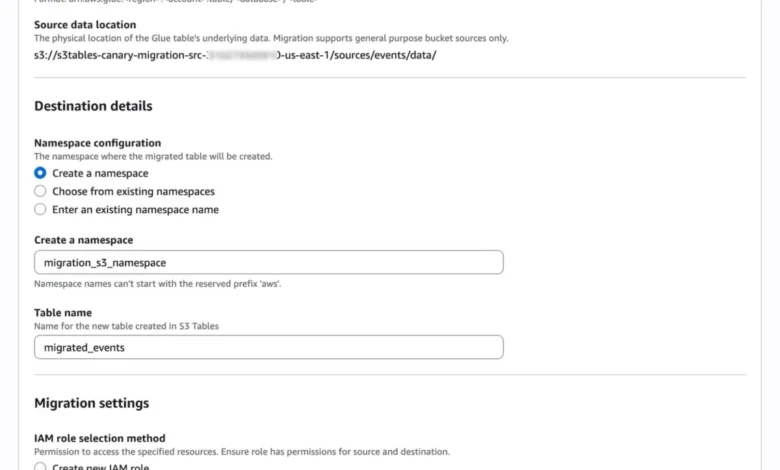
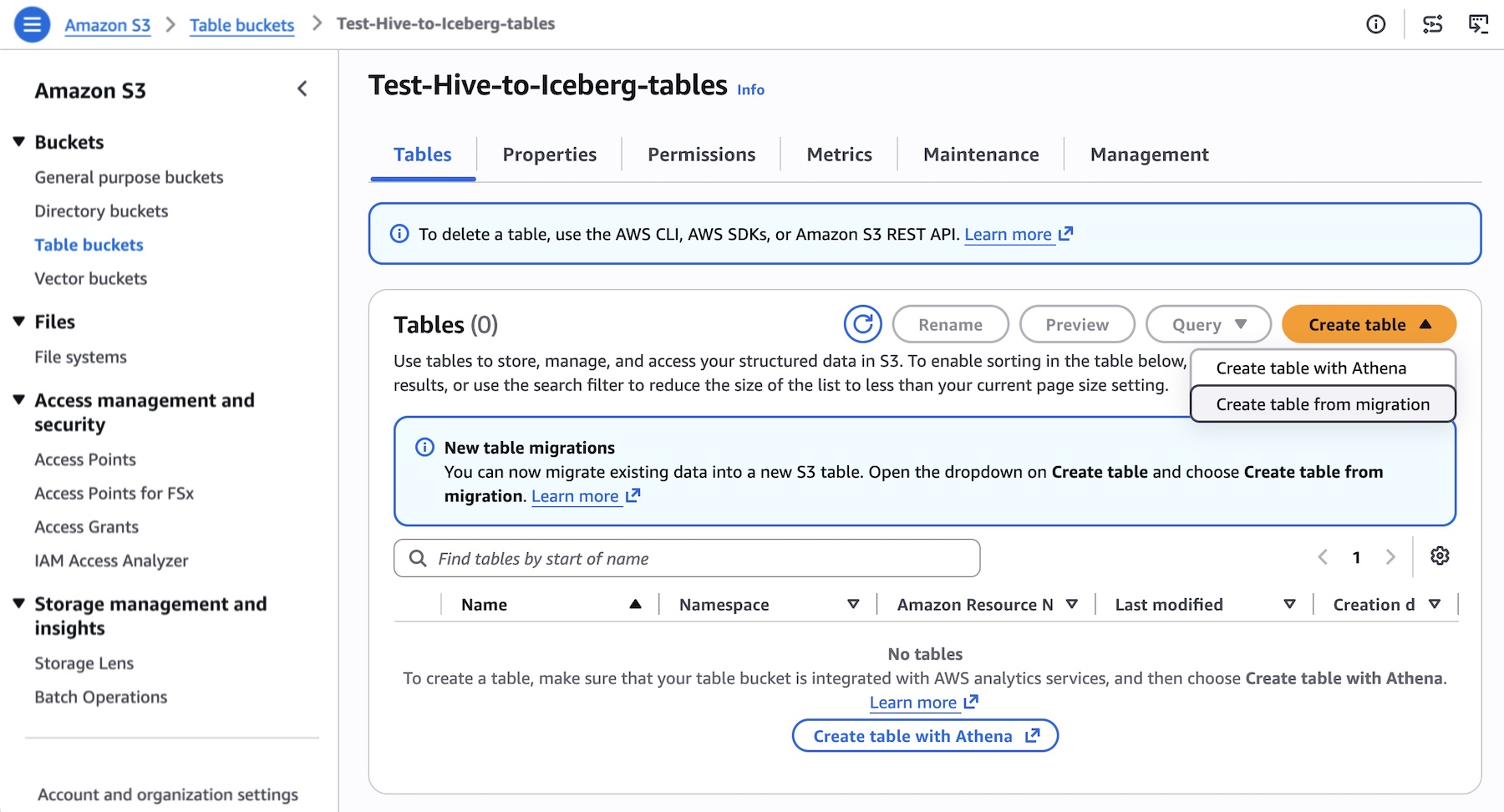
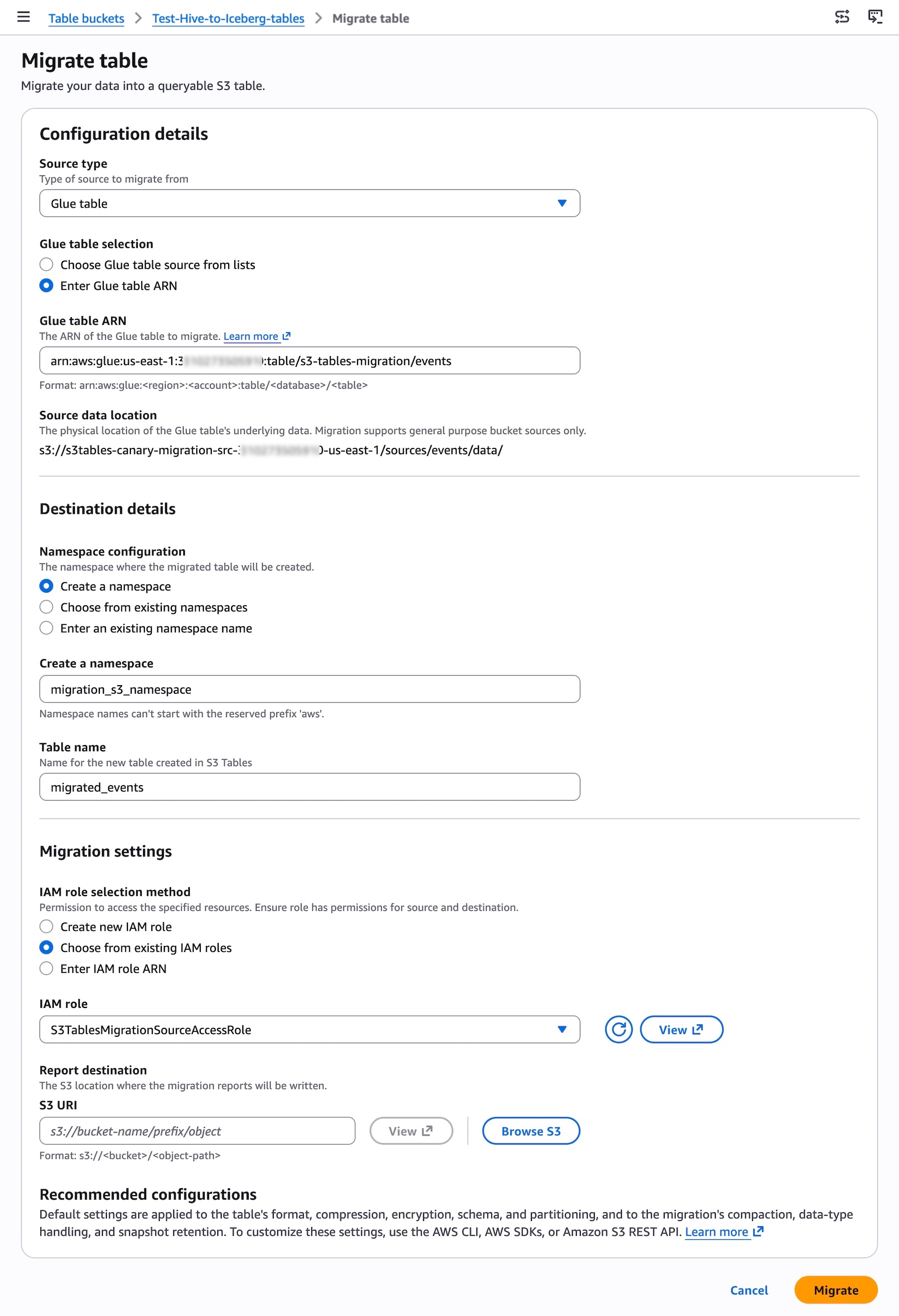
For database administrators and data architects who prefer graphical user interfaces, the process can be executed directly within the Amazon S3 console. By selecting a destination table bucket and clicking "Create table from migration," users can define namespaces, set up recommended default configurations optimized for query performance, and monitor progress metrics through visual dashboards.
For automation enthusiasts and DevOps engineers seeking programmatic control, the migration can be executed via the AWS Command Line Interface (AWS CLI), AWS Software Development Kits (SDKs), or the Agent Toolkit for AWS. By defining a comprehensive JSON configuration file—specifying IAM roles, encryption parameters, storage class configurations, maintenance policies, and reporting buckets—engineers can invoke commands such as start-table-migration and sync-table-migration to orchestrate massive datasets programmatically.
Additionally, developers utilizing modern coding assistants and AI-driven agents—such as Kiro or the AWS Model Context Protocol (MCP) Server—can leverage specialized analytics skills provided in the Agent Toolkit for AWS. These specialized tools offer step-by-step guidance, built-in safety guardrails, and automated API queries to assist engineering teams in troubleshooting, discovering regional availability, and executing seamless transitions.
Regional Availability and Launch Scope
At its initial launch, Amazon S3 Tables managed migration is widely available across a robust footprint of major global AWS Regions, ensuring that enterprises operating under strict data residency and compliance frameworks can utilize the feature. Supported regions include US East (N. Virginia, Ohio), US West (Oregon), Asia Pacific (Mumbai, Singapore, Sydney, Tokyo), and Europe (Frankfurt, Ireland, Stockholm).
The initial release specifically supports AWS Glue-registered Hive tables stored in the Parquet file format, residing within the same AWS account and AWS Region as the destination S3 Table bucket. This focused initial scope allows AWS to ensure maximum performance, stability, and data integrity while laying the groundwork for potential future expansions.
Implications and Industry Outlook
The introduction of managed Hive-to-Iceberg migrations via Amazon S3 Tables marks a significant milestone in the broader adoption of open table formats. For years, technical debt associated with legacy data architectures has acted as an anchor, slowing down enterprise analytics initiatives and forcing companies to maintain expensive, hybrid storage environments.
By abstracting away the complex plumbing of format conversion, schema mapping, and validation reporting, AWS has dramatically lowered the barrier to entry for data lake modernization. Organizations that previously deferred Iceberg adoption due to resource constraints can now plan systematic, low-risk upgrades with predictable costs and minimal operational disruption.
As enterprises increasingly rely on real-time analytics, machine learning pipelines, and unified data governance frameworks, the ability to effortlessly transition legacy assets into high-performance, open standards will be paramount. With this latest release, AWS is positioning Amazon S3 Tables not merely as a storage repository, but as an intelligent, automated bridge connecting the data architectures of the past with the scalable analytics demands of the future.