Titan of the Horizon: How the Historic Maiden Launch of NASA’s Saturn V Paved the Way for Humanity’s Greatest Leap

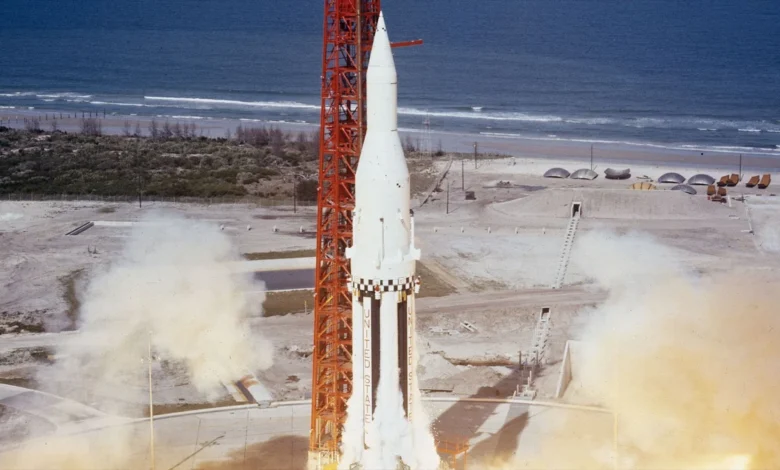
On November 9, 1967, a deafening tremor shook the wetlands surrounding Cape Canaveral, Florida, announcing the arrival of a machine unlike any the world had ever witnessed. NASA’s mighty Saturn V rocket—standing an awe-inspiring 363 feet tall, comfortably eclipsing the height of the Statue of Liberty—roared to life for its maiden flight, officially designated as Apollo 4. This uncrewed test flight marked a watershed moment in human engineering, setting the foundational stage for the Apollo program and, ultimately, humanity’s first footsteps on the lunar surface less than two years later.
Although modern aerospace achievements, such as SpaceX’s towering Starship megarocket, have since claimed the title of the largest and most powerful rockets ever built, the Saturn V reigned supreme for decades as an engineering marvel of the 20th century. Its unprecedented scale and raw power were absolute prerequisites for escaping Earth’s gravitational pull with the heavy payload required to carry astronauts, life support systems, and a lunar lander to the moon and back.
The Genesis of a Giant: Designing the Saturn V
The conceptualization of the Saturn V was rooted in the fierce geopolitical rivalry of the Space Race, a high-stakes competition between the United States and the Soviet Union during the Cold War. In May 1961, President John F. Kennedy challenged the nation to land a man on the moon and return him safely to Earth before the decade was out. To achieve this monumental goal, NASA needed a heavy-lift launch vehicle of staggering proportions.
Under the visionary leadership of German-American aerospace engineer Wernher von Braun, director of NASA’s Marshall Space Flight Center in Huntsville, Alabama, the Saturn V was conceived as a three-stage rocket fueled by cryogenic liquid oxygen and refined kerosene, alongside liquid hydrogen in its upper stages. The sheer logistical and technical challenges of building such a colossal vehicle demanded the creation of entirely new manufacturing facilities, testing grounds, and launch infrastructure.
To house and prepare the behemoth, NASA constructed Launch Complex 39 at what is now the Kennedy Space Center in Florida. In 1967, this sprawling spaceport was an untested frontier for orbital human spaceflight. The Apollo 4 mission would not only serve as the debut flight for the Saturn V rocket, but it would also be the very first launch conducted from the newly minted Florida complex.
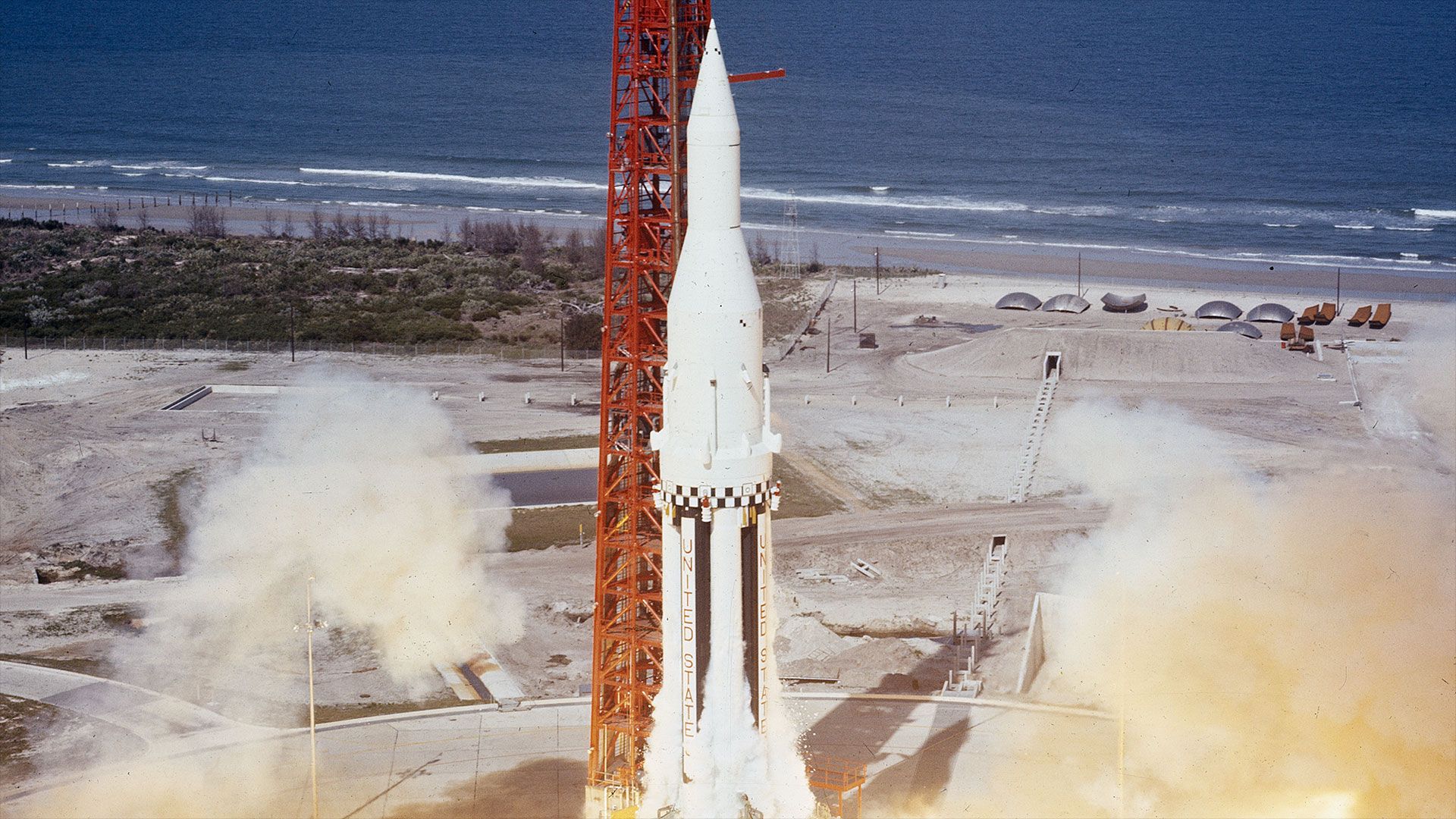
The Clamoring Dawn of Apollo 4
When the Saturn V ignited its five massive F-1 engines on November 9, 1967, the sensory impact on nearby observers and the surrounding environment was profound. The rocket generated an atmospheric shockwave and acoustic vibrations so intense that they rattled buildings miles away from the launch pad. The violent shaking triggered a sudden, cascading shower of dust and structural debris across the Kennedy Space Center, offering a stark physical demonstration of the rocket’s titanic power.
Despite the terrifying forces unleashed during ignition, the flight itself unfolded with remarkable precision. The mission was designed as an all-up test, meaning all three stages of the Saturn V, alongside the Apollo command and service modules, were tested simultaneously on a single flight—a risky strategy that bypassed the step-by-step testing of individual stages previously favored in rocketry.
The flight plan required the Saturn V to lift the uncrewed spacecraft into a low Earth orbit, coast for two orbits, and then fire its third stage to simulate a translunar injection. Following this, the spacecraft climbed to an apogee of over 11,000 miles above Earth before plunging back into the atmosphere at a blistering speed of nearly 25,000 miles per hour. This high-velocity atmospheric reentry test was critical to ensure that the heat shield of the command module could withstand the extreme thermal stress of returning from the moon.
After a mission duration of 8 hours and 36 minutes, the uncrewed command module successfully splashed down in the Pacific Ocean, where it was retrieved by the USS Bennington.
A Balm for a Troubled Agency
The resounding success of the Apollo 4 mission arrived at a profoundly fragile psychological moment for NASA. Just months prior, on January 27, 1967, the space agency had suffered a devastating catastrophe during a routine pre-flight ground test for the Apollo 1 mission. A flash fire broke out inside the closed-door command module, tragically claiming the lives of veteran astronaut Gus Grissom, space walk pioneer Ed White, and rookie astronaut Roger Chaffee.

The tragedy plunged NASA into a deep crisis, triggering intense congressional scrutiny, public doubt, and severe internal reviews regarding safety protocols and engineering oversight. Morale within the agency plummeted as the entire Apollo timeline was thrown into jeopardy.
Against this somber backdrop, the flawless performance of the Saturn V on November 9 served as an essential psychological and technical restoration. It proved that despite the heavy grief and setbacks of the Apollo 1 fire, the agency’s overarching engineering blueprint remained sound.
"It was really an expert launching all the way through from lifting off exactly on time to performance of every single stage," Wernher von Braun remarked in the immediate aftermath of the successful test.
George Mueller, NASA’s then-Associate Administrator for Manned Space Flight, echoed this sentiment, noting that the maiden voyage had drastically rehabilitated public and governmental trust in the management of the largest research and development undertaking in Western history.
The Ripple Effects: Paving the Way to Tranquility Base
The triumph of Apollo 4 unlocked the door for a rapid succession of increasingly ambitious flight tests. Just one year later, in December 1968, NASA utilized a Saturn V rocket to launch Apollo 8, sending astronauts Frank Borman, James Lovell, and William Anders to orbit the moon, capturing the iconic "Earthrise" photograph and proving that human life could safely journey beyond Earth’s immediate orbit.
Subsequent missions continued to validate the reliability of the heavy-lift vehicle. The culmination of this rapid evolutionary leap occurred in July 1969 with the flight of Apollo 11. Propelled by the thunderous force of a Saturn V, astronauts Neil Armstrong, Buzz Aldrin, and Michael Collins blasted off toward the lunar surface, fulfilling President Kennedy’s mandate and etching a permanent milestone into human history as Armstrong took his historic first steps on the dusty plains of the Sea of Tranquility.

In total, the Saturn V flew 13 times, successfully launching every crewed lunar landing mission of the Apollo program, as well as Skylab, America’s first space station, in 1973. Though the rocket was eventually retired due to shifting political priorities and the high costs associated with its operation, its legacy remains unmatched in the annals of aerospace history.
Looking Back to Look Forward
More than half a century after that crisp November morning in 1967, the maiden flight of the Saturn V continues to stand as a testament to what collective human ingenuity, rigorous engineering, and immense national resolve can achieve under intense pressure. The challenges faced by NASA in the late 1960s—balancing unprecedented technical ambition with uncompromising safety demands—echo through the modern era of commercial space exploration and NASA’s current Artemis program, which aims to return humans to the lunar south pole.
The roar that echoed across the Florida coastline on November 9, 1967, was not merely the sound of a new rocket finding its footing; it was the opening chord of humanity’s expansion into the cosmos, signaling that the Earth was no longer our species’ final boundary.