CueFlip revolutionizes the digital sheet music experience through intelligent audio-aligned page turning technology

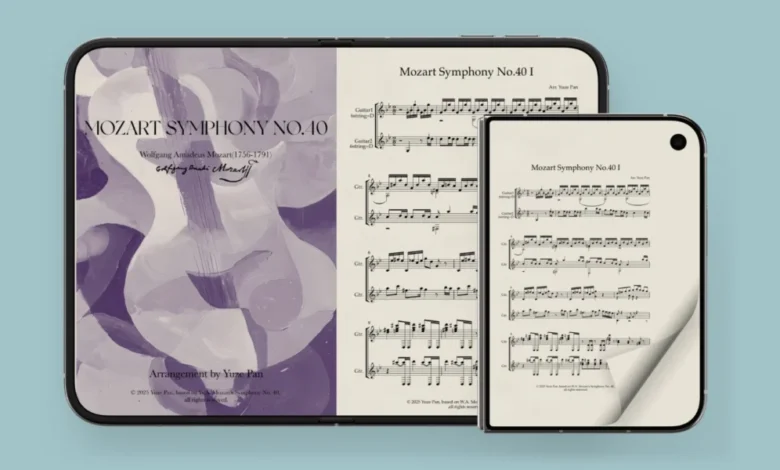
The act of reading sheet music has remained largely stagnant for centuries, yet the digital transition has introduced a persistent ergonomic friction point: the physical necessity of pausing a performance to turn a page. For professional musicians and students alike, this interruption breaks the continuity of a musical phrase and introduces a cognitive burden during high-pressure rehearsals or performances. CueFlip, a newly released application for iOS and iPadOS, seeks to eliminate this barrier by utilizing advanced audio-alignment algorithms that listen to a performer in real-time to trigger page turns automatically.
Developed by 15-year-old classical guitarist and software developer Yuze Pan, the application represents a significant departure from traditional static PDF readers. Unlike existing solutions that rely on fixed timers—which often fail to account for the natural fluctuations in tempo (rubato) inherent in expressive performance—CueFlip functions as an adaptive, context-aware companion. By mapping the digital score to the actual sonic output of the performer, the software ensures that page transitions occur in precise synchronization with the music, regardless of how a performer chooses to speed up or slow down during a movement.
The Chronology of Development
The genesis of CueFlip is rooted in the practical requirements of the Primal Guitar Quartet, of which Pan is a member. The development cycle began in earnest during 2025, a year characterized by iterative failures as the young developer grappled with the complexities of digital signal processing and machine learning in a live acoustic environment. Early prototypes struggled with background noise and the unpredictability of live performance settings.
In May 2026, a second, more rigorous phase of development commenced. Abandoning previous methodologies, Pan pivoted to modern research regarding audio alignment—the technical process of synchronizing a score with a corresponding audio stream. Throughout the summer and autumn of 2026, the application underwent a "field test" protocol. Every new build was brought to the Primal Guitar Quartet’s daily rehearsals in Beijing, where it was subjected to the scrutiny of professional-grade performance requirements. This iterative feedback loop—moving from theory to daily, real-world application—was instrumental in refining the software’s responsiveness and stability.

Technical Architecture and Functional Features
At its core, CueFlip operates on a sophisticated "teach-and-perform" architecture. Users begin by providing the application with a reference performance—either a live recording or a session during a rehearsal. During this process, the user marks the specific moments where page turns are required. The software then generates an internal map of the audio cues associated with those turns. Once trained, the application requires no further manual input; it listens to the performer’s output and triggers the turn when the corresponding audio signature is detected.
Beyond its primary function as a page-turner, CueFlip incorporates a comprehensive musicology suite. It features an integrated dictionary capable of translating and defining over 20,000 musical terms. This is particularly relevant for students and professionals who frequently encounter instructional terminology in Italian, German, French, and other languages. The application’s optical character recognition (OCR) capabilities allow it to scan physical or digital scores, identify foreign terms, and provide instant translations in up to 13 languages. This bridge between performance and pedagogy addresses a significant pain point for musicians working with historical or international scores.
The application also prioritizes accessibility and redundancy. Recognizing that no automated system is infallible, CueFlip includes a "wink" gesture control mechanism powered by the device’s Face ID sensors. A wink with the right eye triggers a forward page turn, while a left-eye wink navigates backward. This provides a secondary layer of control that keeps the performer’s hands on their instrument. Furthermore, for users who prefer traditional hardware, the software maintains full compatibility with standard Bluetooth page-turning pedals.
Supporting Data and Market Context
The digital sheet music market has expanded rapidly over the last decade, driven by the ubiquity of tablets in music conservatories and professional orchestras. Market research indicates that the "music notation software and apps" segment is expected to see a compound annual growth rate (CAGR) of approximately 6% through 2030, as educational institutions shift away from paper-based libraries to reduce costs and improve accessibility.
However, the "page-turning" niche within this market has historically been dominated by two categories: manual Bluetooth pedal hardware and rigid, time-based software. The former requires additional hardware expenditure, while the latter is often viewed as inadequate for classical performance, where tempo is fluid rather than metronomic. By leveraging machine learning to solve the alignment issue, CueFlip enters a space where user frustration with legacy software is high.

The application is currently available on the App Store for iPhone and iPad devices running iOS or iPadOS 16.4 or later. The developer has adopted a "freemium" model: the free tier allows users to import PDFs, annotate scores, and utilize the automatic page-turning feature for a single score. The "Pro" tier, priced at $4.99 per month or $29.99 per year, unlocks the full dictionary suite, unlimited automatic page turns, and advanced gesture-control features.
Implications for Music Education and Performance
The emergence of student-led, high-utility software like CueFlip highlights a broader trend in the tech industry: the democratization of specialized tools through accessible mobile platforms. Historically, advanced audio-alignment software was the domain of high-end, desktop-based digital audio workstations (DAWs) or expensive, proprietary hardware systems used by professional symphony orchestras. By bringing this technology to the iPad, developers like Pan are lowering the barrier to entry for soloists and chamber musicians.
The implications for music pedagogy are particularly noteworthy. By providing immediate, context-aware translations and definitions of musical terminology directly on the score, the software functions as an integrated tutor. Students can progress through complex pieces without the constant disruption of consulting physical dictionaries or external applications, effectively keeping them in a state of "flow"—the optimal state of concentration required for mastering difficult musical passages.
Industry analysts suggest that as audio-alignment technology continues to mature, we may see a shift in how orchestral performances are managed. If automated page-turning becomes as reliable as the proposed CueFlip system, it could lead to the total digitization of music libraries in professional settings, reducing the weight of physical scores and simplifying the logistics of complex, multi-movement works.
Professional Reception and Future Outlook
While the application is in its early stages of public release, the initial reception within the developer community has been focused on the efficacy of its "taught" alignment system. Critics note that the primary challenge for the software will be maintaining accuracy in environments with high ambient noise or during performances involving multiple instruments where the audio "bleed" might interfere with the microphone’s input.

The developer has stated that the current roadmap for CueFlip includes further refinement of the alignment algorithms to improve performance in ensemble settings. As the user base grows, the crowdsourced data—provided that privacy and copyright protocols are strictly maintained—could further refine the software’s ability to recognize various instrument profiles, from the percussive attack of a guitar to the sustained, breath-driven notes of a woodwind instrument.
In conclusion, CueFlip represents a thoughtful synthesis of human performance and machine learning. By addressing the physical, ergonomic, and educational challenges of reading sheet music, the application provides a compelling case for the continued integration of specialized software into the classical music tradition. As the divide between physical performance and digital utility narrows, tools like CueFlip will likely become essential components of the modern musician’s toolkit, ensuring that the technology behind the music is as sophisticated as the music itself.
Related posts: