Cosmic Pile-Ups in the Early Universe May Solve the Mystery of Supermassive Black Holes and JWST’s Little Red Dots

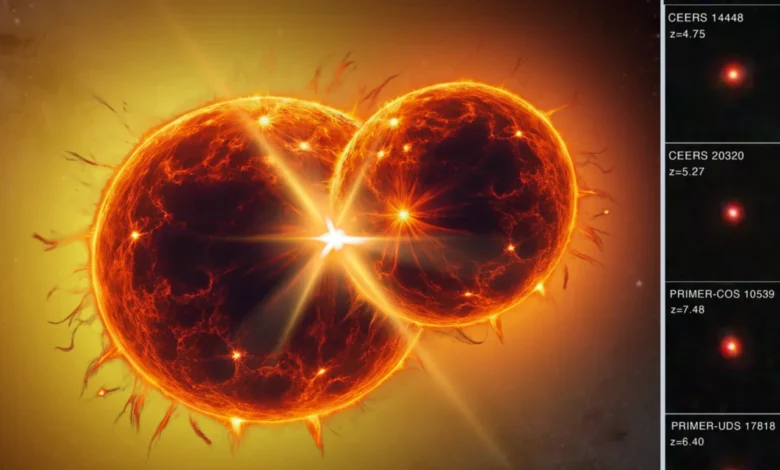
Recent astrophysical simulations suggest that high-frequency stellar collisions were common occurrences in the formative stages of the universe. This newly modeled cosmic phenomenon offers a compelling explanation for two of modern astronomy’s most persistent enigmas: how supermassive black holes achieved their immense scale in a remarkably short timeframe, and the true nature of the elusive Little Red Dots observed by the James Webb Space Telescope (JWST).
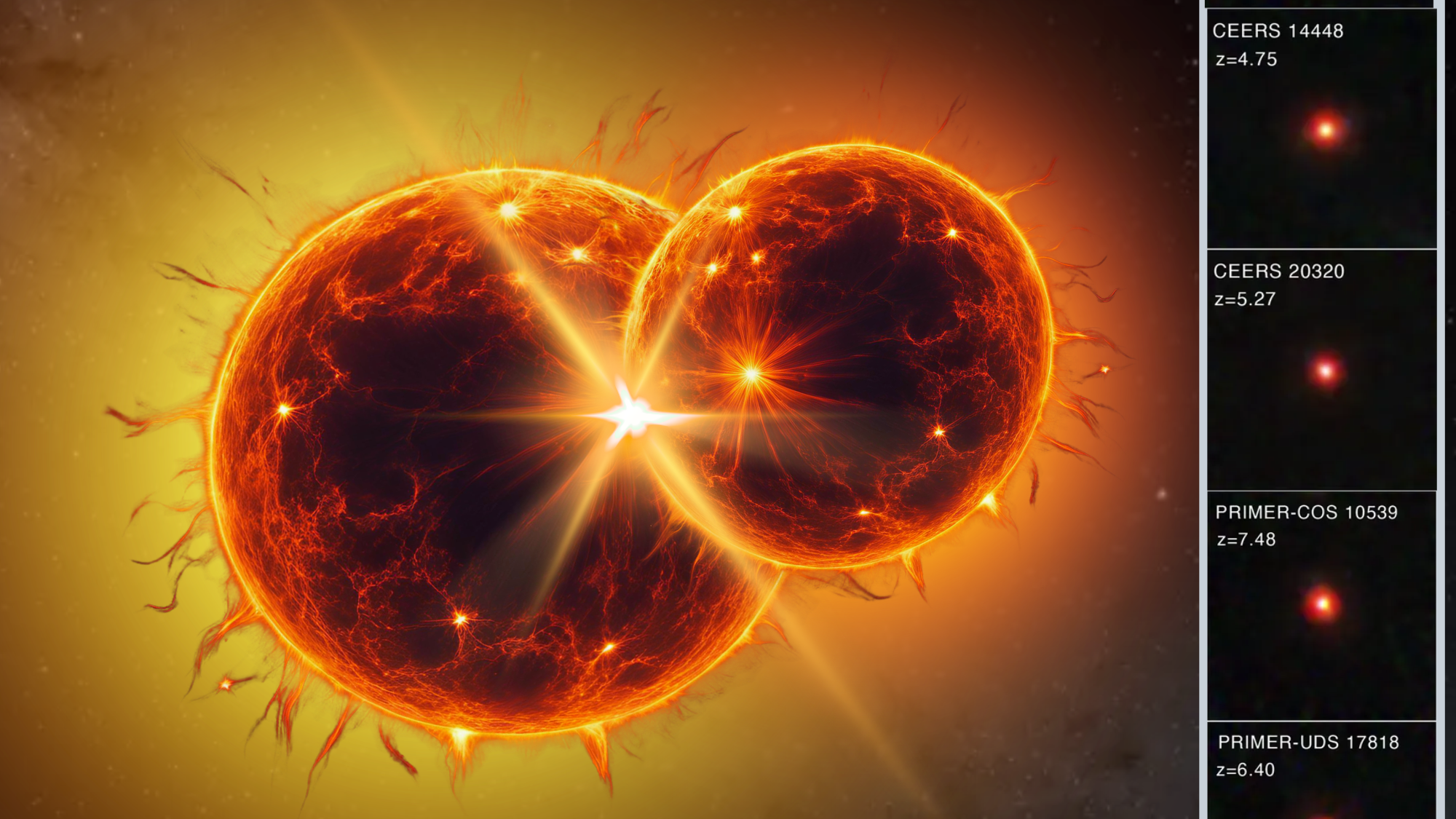
A research team utilizing advanced computational simulations to model the early cosmos discovered that primordial stellar systems were densely packed environments. In these hyper-concentrated regions, stars frequently collided. While high-speed impacts proved catastrophic, resulting in the complete destruction of the participating celestial bodies, lower-velocity encounters fostered a continuous process of stellar merging.
These repeated mergers birthed singular, hyper-massive stars with masses comparable to entire stellar clusters. According to theoretical stellar models, these gargantuan bodies possessed no evolutionary alternative at the end of their lifespans other than gravitational collapse, directly forging intermediate-mass black holes. Scientists theorize these entities served as the necessary "seeds" for the supermassive black holes that dominate the centers of modern galaxies.
The findings, published on October 26 in The Astrophysical Journal, provide a missing link in cosmic evolution. Researchers from the University of California, Los Angeles (UCLA), spearheaded the investigation, shedding light on physical conditions that cannot be replicated in the contemporary universe.
The Chronology of an Impossibly Fast Cosmic Growth
For decades, standard astrophysical models dictated that supermassive black holes—objects holding masses millions or billions of times that of our sun—required at least one billion years of continuous feeding, gas accretion, and black hole mergers to reach their gargantuan sizes. However, this established timeline was thrown into disarray following the operational deployment of the JWST in 2022.
Almost immediately, the infrared observatory began identifying fully formed supermassive black holes residing in galaxies existing less than one billion years after the Big Bang. Under conventional laws of cosmic evolution, these structures simply should not have had enough time to grow.
To bridge this chronological gap, astrophysicists hypothesized that these titans did not originate from standard stellar-mass black holes—which typically form from the collapse of single massive stars and weigh between 10 and 100 solar masses. Instead, they proposed the existence of intermediate-mass black holes (IMBHs) as initial seeds, scaling anywhere from 100 to 100,000 solar masses.
Yet, identifying a viable mechanism to manufacture these intermediate seeds in the early universe remained a hurdle—until now. The new UCLA simulations demonstrate that densely packed primordial star clusters naturally accelerate the formation of IMBHs through runaway stellar collisions long before standard galactic evolution takes hold.
Decoding the Little Red Dots
Beyond the black hole growth timeline, the new research addresses another major puzzle for JWST researchers: the widespread presence of "Little Red Dots."
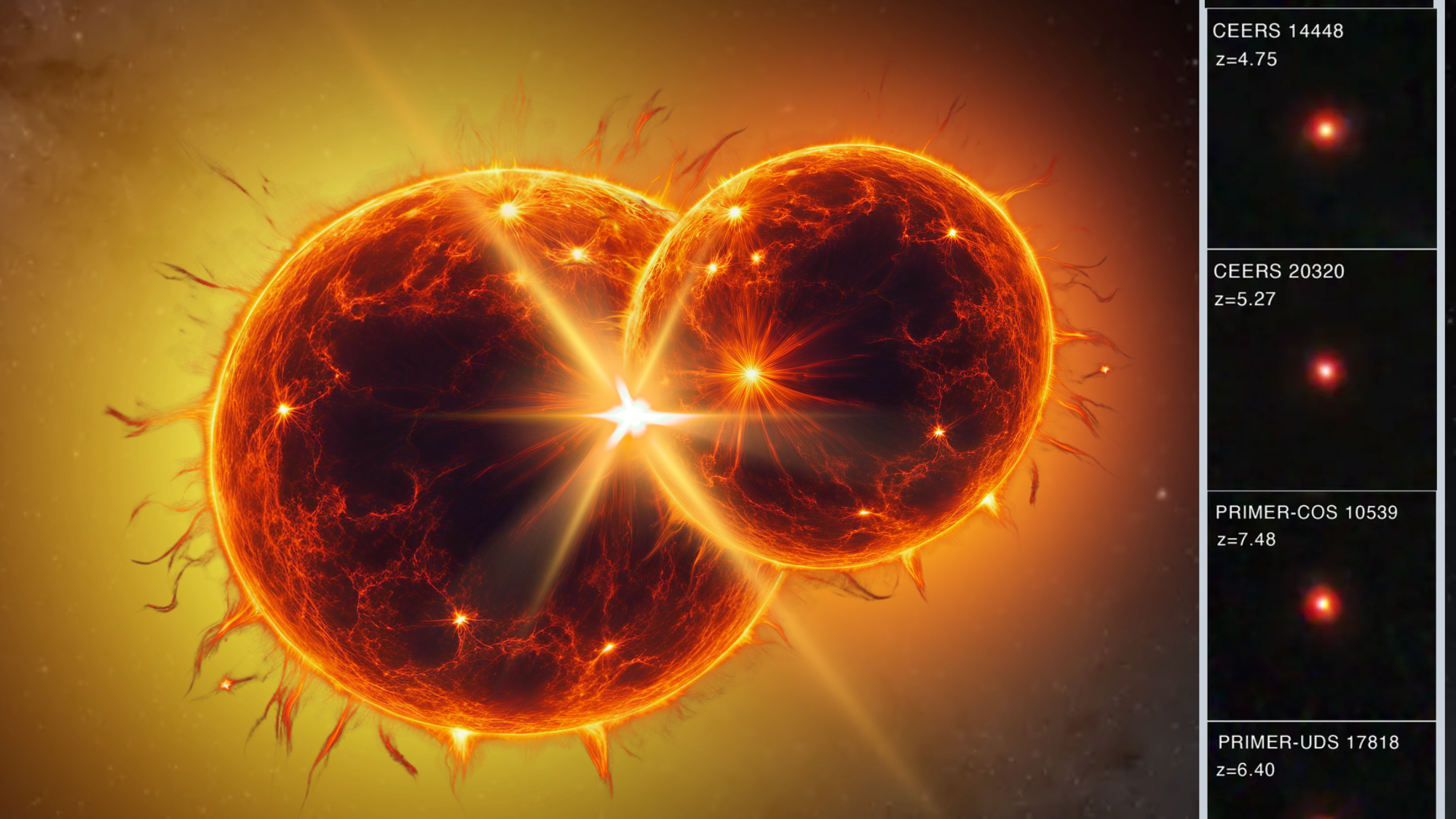
Ever since the space telescope commenced its deep-field surveys, astronomers have cataloged numerous ultra-compact, intensely red objects populating the early universe. These formations have sparked intense debate across the scientific community, often likened to the ancient parable of the blind men attempting to describe an elephant, with each researcher interpreting the data differently depending on the specific observational wavelength or property being analyzed.
While several hypotheses have attempted to categorize Little Red Dots—ranging from dust-obscured starburst galaxies to overfed active galactic nuclei—the UCLA simulations suggest a unifying explanation. According to the research team, these objects may represent the exact dense star clusters experiencing runaway stellar collisions that eventually collapse into intermediate-mass black holes.
This hypothesis also resolves a secondary mystery regarding Little Red Dots: their abrupt disappearance. Observations indicate that these compact red objects vanished from the cosmos by the time the universe reached two billion years of age.

The researchers explain this demographic shift through the changing environmental conditions of the expanding universe. Less than one billion years post-Big Bang, the cosmos lacked structured spiral galaxies, featuring instead chaotic, hyper-dense nurseries ideal for frequent stellar collisions. As the universe expanded and cooled, these volatile clusters evolved into more stable, orderly galaxies. The physical conditions required to sustain Little Red Dots and fuel repeated stellar mergers ceased to exist, causing the objects to fade from the astronomical record as they transitioned into more mature galactic systems.
Implications for Modern Astrophysics
The implications of these simulations extend far beyond cataloging ancient stellar mechanics. They highlight a fundamental operational difference between the early universe and the modern cosmos.
While dense stellar environments continue to exist today—most notably in the core regions of contemporary galaxies—they no longer produce hyper-massive stellar mergers. Modern galactic centers already host fully formed supermassive black holes. The immense gravitational influence exerted by these central black holes accelerates orbiting stars to extreme velocities. Consequently, any stellar collisions occurring in the modern universe are high-speed, destructive impacts that shatter stars rather than fusing them into over-massive precursors.
By establishing that the chaotic infancy of the universe acted as an accelerated manufacturing plant for black hole seeds, the UCLA study provides a robust theoretical framework that aligns observational data from the JWST with theoretical astrophysics. As researchers continue to analyze incoming deep-space data, these simulation models will serve as a critical benchmark for understanding how the foundational structures of our universe were assembled in its earliest epochs.