Epic Games CEO Tim Sweeney claims Valve’s Steamworks has stifled industry innovation for years by creating a closed ecosystem


The ongoing debate regarding the structure of digital distribution in the PC gaming industry has intensified following renewed criticisms from Epic Games CEO Tim Sweeney. In a series of public exchanges on social media, Sweeney leveled pointed accusations against Valve Corporation, asserting that its ubiquitous platform, Steam, has fundamentally held back the gaming industry by trapping developers within the proprietary, "walled garden" of Steamworks. This latest confrontation, sparked by a discussion involving former Epic Games staff, highlights a long-standing ideological and commercial schism between the two industry titans regarding platform openness, revenue sharing, and the future of cross-platform connectivity.
The Catalyst: A Debate on Revenue and Distribution
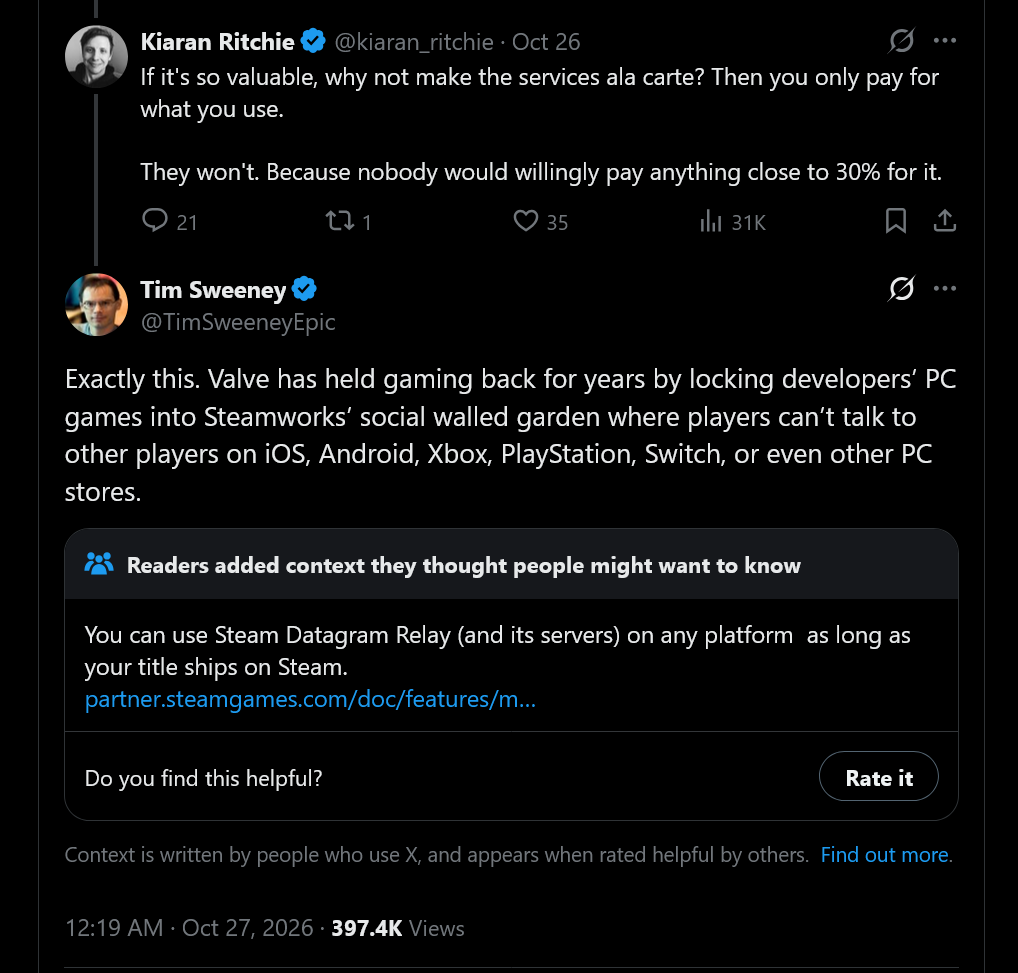
The discourse was ignited by Kiaran Ritchie, a former principal animation programmer at Epic Games, who utilized the platform X (formerly Twitter) to criticize the industry-standard 30% revenue commission that Valve collects on sales through its storefront. Ritchie argued that the technical requirements for building a digital distribution platform have become commoditized, noting that services like Cloudflare make data egress costs negligible in the modern era.
Ritchie posited that developers are currently in dire need of a platform that allows them to retain a larger share of their earnings, which would theoretically foster a more diverse and financially stable ecosystem for game creators. He suggested that the primary barrier to a market shift is not technological, but psychological and social: the deep-seated "network effects" and the consumer attachment to their existing libraries of games on Steam. According to this view, Steam’s value proposition has been reduced to its massive user base, rather than any unique technological infrastructure that would justify a 30% tax on revenue.
Sweeney’s Critique: The "Walled Garden" Argument
Tim Sweeney, who has been a vocal critic of closed platform ecosystems—most notably in his high-profile legal battles against Apple and Google regarding mobile application stores—leaped into the conversation to reinforce Ritchie’s points. Sweeney’s argument focuses specifically on Steamworks, the suite of tools and services that Valve provides to developers, which includes matchmaking, authentication, and social features.
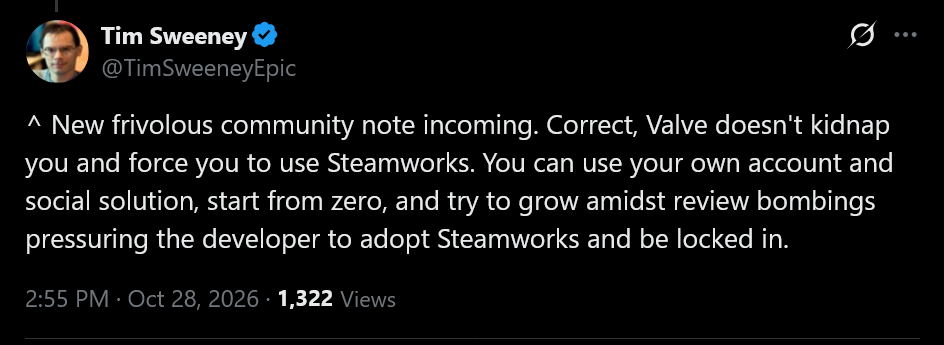
Sweeney contends that by encouraging or effectively requiring the use of these tools, Valve has created a "social walled garden" that fragments the gaming community. He argues that this system inhibits natural interaction between players across different platforms, such as Xbox, PlayStation, Nintendo Switch, and even other PC storefronts. In Sweeney’s estimation, the reliance on Steamworks prevents the development of a truly open, interconnected gaming landscape where social graphs and matchmaking are platform-agnostic.
When challenged by users who pointed out that many developers use Steamworks primarily for authentication and crossplay, Sweeney dismissed these rebuttals as inaccurate. He maintained that core social functionalities—such as friend lists, cross-platform communication, and universal social presence—are deliberately siloed within the Steam ecosystem, thereby hindering the broader progress of the industry.
Chronology of the Conflict
The tension between Epic Games and Valve is not a new phenomenon; it represents a decade-long struggle for dominance in the PC market.
- 2018: Epic Games launched the Epic Games Store (EGS) with a disruptive business model, charging developers only a 12% commission compared to the industry-standard 30%. This move was explicitly designed to challenge Valve’s market dominance.
- 2019–2021: Epic utilized aggressive strategies, including exclusive game releases and free weekly game giveaways, to incentivize user migration to its platform.
- 2021: During a conference in Seoul, South Korea, Sweeney began publicizing his critique of the "duopoly" power held by Apple and Google, eventually expanding these criticisms to include Valve’s control over the PC market.
- 2024: The latest exchange on X serves as a continuation of these grievances, with Sweeney arguing that the industry remains shackled by the dominance of legacy platforms that utilize "network effects" to maintain control rather than competing on open-market merits.
Industry Data and Economic Context
To understand the weight of these claims, one must examine the current state of digital distribution. According to industry reports, Steam remains the undisputed leader in PC gaming, with concurrent user counts frequently exceeding 30 million. This scale provides a massive, built-in audience for developers, which is why the 30% cut remains a standard, albeit contested, expense.
From a developer’s perspective, the decision to use Steamworks is often pragmatic. It provides an immediate, out-of-the-box solution for critical features such as cloud saves, anti-cheat integration, and community forums. While critics like Sweeney argue this is a form of "lock-in," proponents of the current system note that for small-to-mid-sized independent developers, the time and financial resources required to build an equivalent, reliable backend are prohibitive.
Epic Games has attempted to address this with "Epic Online Services" (EOS). This toolkit is designed to be platform-agnostic, allowing developers to implement social features and matchmaking that work across Steam, EGS, and consoles. Despite this, adoption has been uneven, as many developers prioritize the ease of use and the massive, pre-existing social network provided by Steam.
The Counter-Arguments and Market Realism
Critics of Sweeney’s stance often point to the inherent irony in his arguments. While he condemns Valve for its influence, his own company has been criticized for its push toward AI-generated content and the continued use of store-exclusivity deals, which some developers argue is just another form of platform gatekeeping.
Furthermore, Valve’s defenders argue that the company has used its profits to fund significant advancements in the industry, such as the development of the Proton compatibility layer, which has made the Linux-based Steam Deck a viable gaming device. By pouring resources into open-source software, Valve has arguably expanded the reach of PC gaming more than any other entity in the last five years.
Future Implications for the PC Market
The clash between Epic and Valve highlights a critical inflection point for the gaming industry. As the market matures, the demand for interoperability—the ability to carry social connections, achievements, and assets across different storefronts—is growing.
If Sweeney’s vision of an open ecosystem gains traction, it could lead to a future where storefronts compete strictly on the quality of their client software and the fairness of their revenue splits, rather than the "moat" of a proprietary social network. However, for this to occur, developers must be willing to abandon the convenience of established ecosystems in favor of more modular, independent backends.
The current situation remains a stalemate. Valve continues to enjoy the support of the majority of the PC gaming population, who prioritize the convenience and library integration that Steam offers. Meanwhile, Epic Games continues its campaign to reshape the economics of the industry, positioning itself as the champion of developer freedom.
As the industry grapples with the rise of AI-driven development and the increasing blurring of lines between mobile, console, and PC gaming, the debate over who controls the "social plumbing" of these platforms will likely become even more intense. Whether or not Valve’s model is truly "holding gaming back," it is clear that the status quo is under more scrutiny than at any point in the platform’s twenty-year history. The ultimate resolution will likely not be determined by public rhetoric, but by the developers who decide where to publish their games and the players who decide where to spend their time and money.