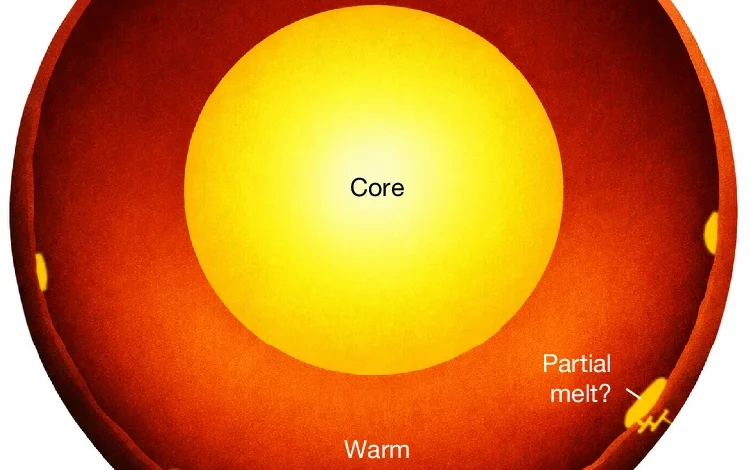
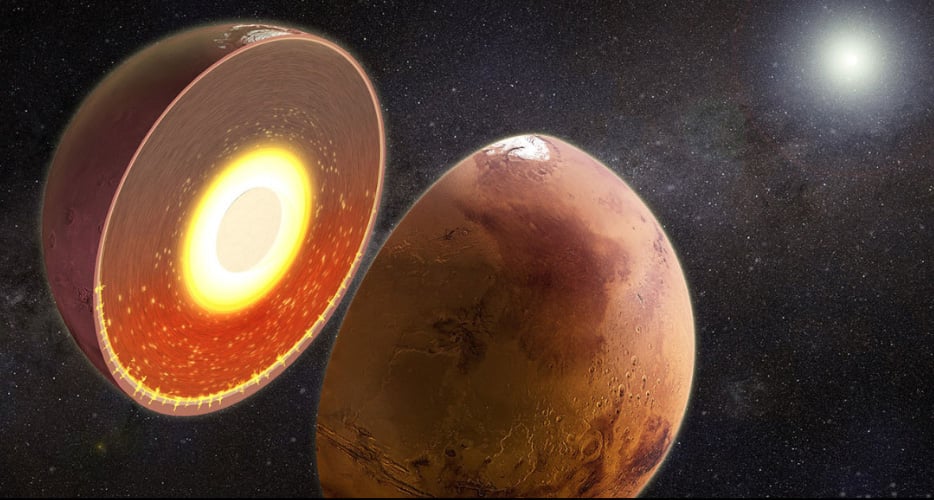
A team of planetary scientists from the University of Arizona and Brown University has uncovered evidence of a significant heat anomaly residing deep within the mantle of Mars. By utilizing a sophisticated analytical technique known as "tidal tomography," lead researcher Alexander Byrne and his colleagues have identified a subsurface region in the southern hemisphere that registers between 200 and 400 degrees Celsius warmer than the surrounding mantle. This discovery, which has profound implications for our understanding of Martian thermal evolution, suggests that the Red Planet is not as geologically dead as previously assumed.
The research, published in the journal Nature, synthesizes 16 years of precise orbital tracking data gathered by a fleet of NASA spacecraft, including the Mars Global Surveyor, Mars Odyssey, and the Mars Reconnaissance Orbiter. By analyzing how the gravitational pull of the Sun periodically deforms the planet, the researchers were able to "peer" into the Martian interior, mapping variations in density and temperature that were previously invisible to surface-level observation.
The Mechanics of Tidal Tomography
The core of this discovery lies in the concept of tidal forcing. Because Mars does not possess a perfectly circular orbit, its distance from the Sun fluctuates as it completes its yearly revolution. As the planet moves through its elliptical path, the gravitational influence of the Sun periodically shifts, subtly stretching and compressing the planet’s mass. This phenomenon creates a "tidal bulge"—a temporary deformation of the planet’s shape that varies in intensity throughout the Martian year.
"As Mars travels around the Sun, the Sun’s gravity gently stretches and squeezes the planet," explains Nick Wagner, a postdoctoral researcher at Brown University who contributed to the study. "Because Mars’ orbit is not a perfect circle, the strength of this pull changes over the course of a Martian year, so the amount that Mars deforms changes as well. This tidal bulge causes mass inside the planet to shift slightly, producing tiny changes in its gravitational pull."
These microscopic variations in gravity directly affect the velocity of orbiting spacecraft. When an orbiter passes over a region with slightly higher density or a warmer, more buoyant mantle section, its speed is marginally altered. By meticulously measuring these velocity fluctuations over nearly two decades, the team was able to construct a "tomographic" map of the Martian mantle, identifying the southern thermal anomaly as a region where the planet’s response to tidal stress deviates from the global average.
Chronology of the Discovery
The identification of this anomaly represents the culmination of a long-term data collection effort. The timeline of this research is rooted in the early 2000s, with the Mars Global Surveyor (MGS) providing the foundational gravity datasets. Subsequent missions, such as the Mars Odyssey (launched in 2001) and the Mars Reconnaissance Orbiter (arrived in 2006), provided the high-resolution tracking necessary to refine these measurements.
In 2024, the research team began integrating these multi-decadal datasets into a unified tidal model. By late 2025, the researchers identified consistent "noise" in the gravity field that could not be explained by surface topography or crustal thickness alone. The final analysis, completed in mid-2026, confirmed that this signal was not an instrument error but a consistent, deep-seated thermal feature located beneath the southern highlands.
Comparative Planetology and Terrestrial Parallels
The discovery of internal heating on Mars invites comparisons to other bodies in the solar system that exhibit similar, if more extreme, tidal dynamics. The most notable example is Io, the innermost moon of Jupiter. Io is caught in a gravitational tug-of-war between Jupiter and its neighboring moons, Europa and Ganymede. This constant tidal flexing generates immense internal friction, which fuels the most intense volcanic activity in the solar system.
While Mars is far less geologically active than Io, the principle remains the same. On Earth, researchers have successfully used similar techniques to map the interior. Harriet Lau, a geophysicist at Brown University and mentor to the team, has previously utilized GPS data to constrain the buoyancy of massive, continent-sized "blobs" of material deep beneath the Pacific Ocean and Africa, known as Large Low Shear Velocity Provinces (LLSVPs).
"What’s interesting is that on Earth, there is also a compositional component to these anomalies, meaning it’s not just a temperature difference," Wagner noted. "I suspect this Martian anomaly may also possess a compositional component, such as a difference in silicate minerals or trapped primordial heat, but definitive confirmation will require further missions and perhaps future seismic landers."
Geodynamic Implications
The presence of a localized hot spot in the southern hemisphere raises fundamental questions about how Mars formed and evolved. The southern hemisphere is characterized by a significantly thicker crust compared to the northern plains—a geological "dichotomy" that has puzzled planetary scientists for decades.
One working hypothesis is that the thermal anomaly is a remnant of the planet’s earliest history, perhaps dating back to its formation 4.5 billion years ago. If a heat reservoir has persisted for that long, it suggests the thick southern crust may have acted as a thermal blanket, insulating the mantle and preventing the heat from escaping into space. Alternatively, the anomaly could be the result of an ancient, cataclysmic impact that reorganized the mantle’s internal structure, creating a localized upwelling of warmer material.
Preliminary modeling suggests this heat may be inducing partial melting of the rock beneath the crust. However, unlike on Earth, where such melting often results in volcanic eruptions, the Martian crust appears to be too thick or rigid to allow this magma to reach the surface. Instead, the upwelling likely stalls, contributing to the thickening of the southern highlands and potentially driving the localized, enhanced magnetization observed in the region.
Future Directions for Tidal Tomography
The success of the tidal tomography method in this study marks a significant milestone in planetary science. It demonstrates that we do not necessarily need to land a drill on a planet to understand its interior; rather, we can use the planet’s own orbital mechanics as a diagnostic tool.
The implications for upcoming missions are substantial. The European Space Agency’s Jupiter Icy Moons Explorer (JUICE), which is currently en route to the Jovian system, will employ specialized radio science experiments to map the gravitational field of Ganymede. By applying tidal tomography to Ganymede, scientists hope to determine the existence and depth of the moon’s hypothesized interior ocean and the thickness of its outer icy shell.
Similarly, future Mars missions could leverage this technique to resolve lingering mysteries regarding the Red Planet’s crustal dichotomy and internal tectonic activity. Researchers are already planning follow-up studies to refine the thermal models of the Martian mantle, specifically investigating whether the identified anomaly is connected to deep-seated volcanic processes that may have shaped the planet’s surface millions of years ago.
Conclusion
The "warm heart" of Mars, as described by the research team, serves as a vital reminder that our neighboring planet is a complex, dynamic world. By bridging the gap between historical gravity data and modern computational modeling, the team has provided a new window into the Martian past. Whether this heat is a leftover relic from the dawn of the solar system or evidence of more recent, hidden geological processes, it is clear that the internal structure of Mars holds the key to answering broader questions about the evolution of terrestrial planets. As we look toward future missions to the icy moons of the outer solar system and continued exploration of the Red Planet, tidal tomography stands out as an essential tool for mapping the hidden, churning interiors of the worlds that orbit our Sun.
Related posts: