Graphify and the Evolution of Semantic Knowledge Graphs for AI-Assisted Software Development

As modern software systems increase in structural complexity, the limitations of traditional file-based development workflows have become a bottleneck for artificial intelligence. Developers often struggle to provide Large Language Models (LLMs) with the comprehensive, cross-file context required to make accurate architectural decisions. Graphify, an open-source project launched in April 2026, has emerged as a significant technical solution to this challenge. By converting monolithic codebases, technical documentation, and unstructured data into queryable, multimodal knowledge graphs, the utility facilitates a transition from linear file browsing to sophisticated, graph-based navigation. Released under dual MIT and Apache-2.0 licenses, Graphify has rapidly gained traction, securing thousands of GitHub stars within its first ten days of availability and establishing itself as a pivotal tool in the nascent ecosystem of agentic coding assistants.
The Architectural Shift: Moving Beyond Token-Heavy Context
For years, coding assistants have operated on a "flat" model, viewing repositories as isolated pools of text. This approach necessitates either massive token consumption—where entire directories are fed into a model’s context window—or reliance on keyword-based retrieval, such as simple grep searches, which frequently fail to capture deep semantic relationships or cross-file dependencies.
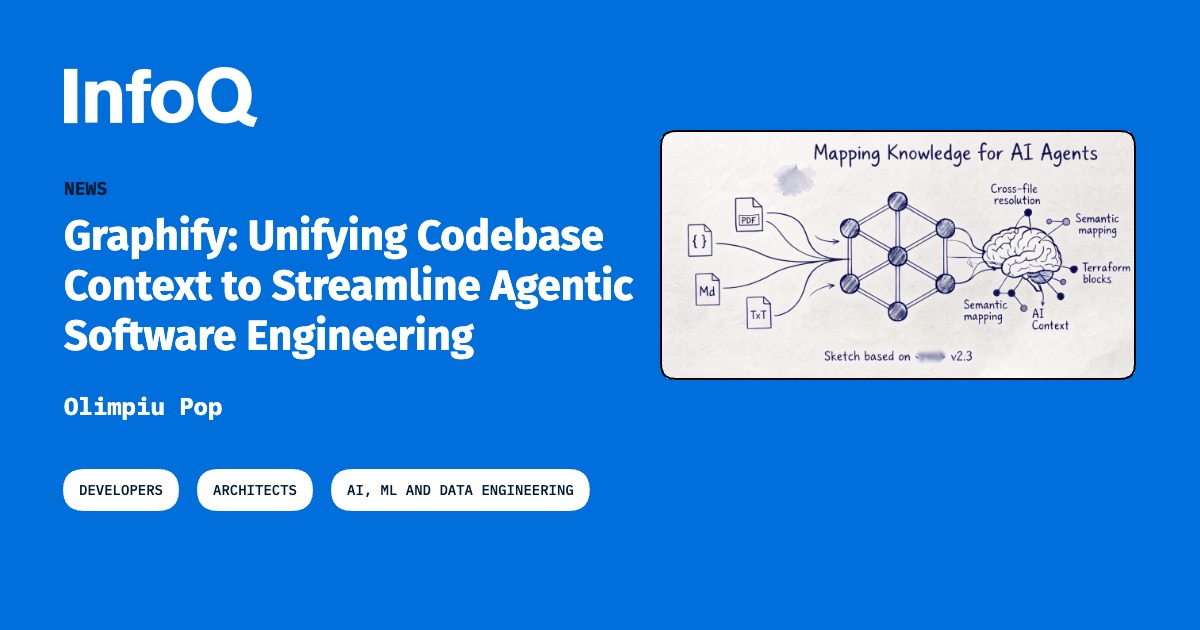
Graphify addresses this by executing a multi-stage pipeline. The tool scans a target directory, extracts structural elements through tree-sitter—an incremental parsing library—and pairs these with semantic cues derived from documentation. The resulting data is then organized into a unified graph, clustered through community detection algorithms. By transforming repositories into a web of nodes and edges, Graphify allows AI agents to navigate the codebase using structural logic rather than brute-force string matching. This optimization not only reduces token usage but also improves the reasoning capabilities of agents like Claude Code or custom LLM-based assistants integrated via the Model Context Protocol (MCP).
Chronology and Rapid Iteration
The development of Graphify is characterized by an unusually fast-paced release cadence. Since its inception in April 2026, the project has maintained a rhythm of multiple updates per month, reflecting the urgent demand for better codebase orientation tools.
- April 2026: Initial public launch of Graphify. The repository gains rapid community adoption, reaching significant GitHub star milestones within ten days.
- May–July 2026: Early development cycles focused on stabilizing the core pipeline, improving the extraction of AST (Abstract Syntax Tree) data, and expanding support for multi-language environments.
- August 2026: The introduction of more sophisticated parsing logic, specifically targeting infrastructure-as-code (IaC) and cross-file method resolution.
- September 2026: A series of high-impact updates refined the tool’s ability to handle complex generic types, external receiver tracking in Kotlin, and C++ scope-qualified routing, signaling a shift toward enterprise-grade robustness.
This trajectory illustrates a project moving quickly from a prototype proof-of-concept to a specialized utility capable of handling the nuances of polyglot software environments.
Technical Advancements in Parser Intelligence
The most recent iterations of Graphify have shifted focus from basic structural mapping to deep semantic intelligence. A primary pain point for developers has been the loss of context when infrastructure configurations are decoupled from application logic. The recent integration of Terraform block attribute preservation allows infrastructure configurations to remain queryable alongside standard source code, ensuring that an AI assistant can correlate a change in code with its corresponding cloud resource configuration.
Furthermore, the engineering team has implemented targeted upgrades for specific programming languages:
- Rust: The tool now includes split implementation block support for generic types, a critical feature for mapping the complex traits and lifetimes found in Rust ecosystems.
- Kotlin: External receiver tracking ensures that extension functions—a staple of the language—are correctly mapped to their target classes.
- C++: Scope-qualified static call routing enables the tool to resolve dependencies that were previously opaque to simple indexers.
- PHP & Markdown: New features include embedded script indexing within PHP files and smart Markdown code span tracking, which maps documentation references directly to code symbols, effectively bridging the gap between "what the docs say" and "what the code does."
Benchmarking Performance and Quantitative Impact
To validate its efficacy, the Graphify team has conducted rigorous benchmarking against traditional repository navigation methods. The data suggests that graph-based context significantly outperforms naive retrieval methods in key-fact coverage and accuracy.
In first-party benchmarks, Graphify reported a LOCOMO recall@10 of 0.497. In quality assurance (QA) accuracy tests, the tool achieved a 45.3% success rate, and it scored 76% on a 50-question LongMemEval-S subset. Perhaps most telling is the performance lift in ERPNext key-fact coverage, where the tool improved from 70.8% to 82.0% across a six-question benchmark set. These figures suggest that by providing a structured roadmap of the codebase, Graphify allows LLMs to retrieve relevant information with higher precision, thereby reducing the hallucination rates often associated with large-context prompts.
Community Reception and Integration Friction
While the conceptual architecture of Graphify has been widely praised, the community consensus remains nuanced. Technical reviews, such as those featured on Kevin Kinnett’s blog and various Reddit threads within r/ClaudeAI, highlight a divide between the tool’s "visionary" potential and its current daily usability.
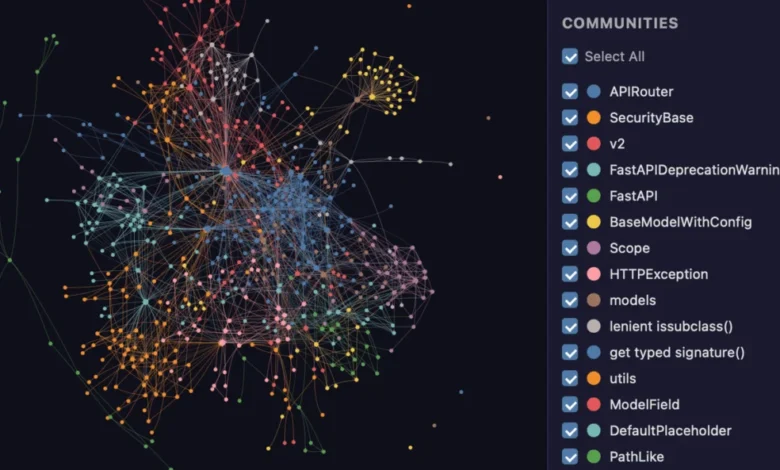
Proponents of the tool emphasize its utility in large-scale repo orientation and architectural reviews, where understanding the relationship between distant modules is essential. The ability to visualize the codebase—where every node represents a concept and colors represent detected communities—provides a high-level view that is otherwise difficult to achieve in modern IDEs.
However, developers have also noted "early-tool adoption friction." Some users argue that for mid-sized repositories, traditional grepping or standard IDE navigation tools remain faster for day-to-day coding tasks. There is an expressed desire for more seamless integration into existing developer environments. As the community continues to test the tool, the discourse has centered on finding the "sweet spot" where the graph-based navigation becomes a default part of the workflow rather than an auxiliary step. The consensus is that as the parsing backend evolves and the latency of graph generation decreases, these integration hurdles will likely subside.
Broader Implications for Agentic Coding
The rise of Graphify represents a broader industry trend toward "agentic" software development. As developers transition from being mere code-writers to code-reviewers and system architects, the need for tools that manage complexity on their behalf is paramount. By providing a structured, queryable knowledge graph, Graphify serves as a foundational layer for the next generation of AI-native IDEs.
The ability to perform cross-file resolution and map documentation to code is no longer a luxury; it is becoming a requirement for maintaining large-scale distributed systems. If the current trajectory of Graphify continues, it is plausible that such knowledge-graph technology will become a standard component of software engineering toolchains, eventually replacing static file-indexing systems.
The project is currently accessible on major operating systems, including macOS, Windows, and Ubuntu/Linux, and can be installed via uv. As the open-source community continues to contribute to the codebase, the integration of Graphify with popular AI coding assistants is expected to deepen, likely leading to more intuitive and context-aware development experiences. For now, the tool stands as a testament to the fact that when it comes to AI-assisted coding, the quality of the context provided to the model is just as important as the model’s inherent capabilities.
Related posts: