Meta Expands Personal AI Capabilities With Muse for Mac and New Third-Party Connectors

Meta is accelerating its push into the artificial intelligence agent market with a series of significant updates designed to deeply integrate its proprietary personal AI tool, Muse, into desktop operating systems and external software applications. The tech giant recently announced the launch of Muse for Mac alongside a developer-focused initiative called Muse Connectors. These moves collectively aim to transform Muse from a standard conversational chatbot into a proactive, agentic assistant capable of executing complex, multi-step workflows directly on user devices and across third-party platforms.
The strategy represents a broader industry shift toward autonomous agents—AI systems that do not merely answer prompts in text boxes, but actively navigate computer interfaces, manipulate files, summarize communication streams, and execute tasks on behalf of human users. However, as Meta expands the operational boundaries of its AI infrastructure, the company faces growing challenges related to user privacy, data security, and the fundamental market hurdle of convincing consumers to surrender control over sensitive personal workflows.
Chronology of Meta’s Agentic AI Push
The rollout of Muse for Mac and Muse Connectors marks the latest milestone in Meta’s aggressive development cycle for consumer-facing artificial intelligence. Over the past twenty-four months, Meta has systematically transitioned its AI framework from foundational large language models to integrated user experiences embedded across its social media ecosystem, hardware devices, and standalone software applications.
The foundational groundwork for Muse began taking shape as Meta restructured its generative AI divisions to compete directly with rival systems from OpenAI, Anthropic, Google, and Microsoft. While early iterations of Meta AI focused primarily on conversational search, content creation, and image generation within Facebook, Instagram, and WhatsApp, the company quickly recognized that the next generation of utility would require cross-platform autonomy.
In late 2023 and throughout 2024, Meta accelerated internal testing of agent-driven architectures designed to manage local file systems and interface with application programming interfaces (APIs). The launch of Muse for Mac in late February 2025 brought these capabilities out of the laboratory and directly onto consumer hardware. By allowing macOS users to tether the Muse agent directly to their local machine architecture, Meta established a beachhead on desktop computers, positioning the software to interact natively with operating system directories, local databases, and messaging clients. Shortly after the desktop release, Meta introduced Muse Connectors, opening the ecosystem to external software developers and signaling an ambition to build a comprehensive third-party marketplace for agentic workflows.
Core Features of Muse for Mac and Muse Connectors
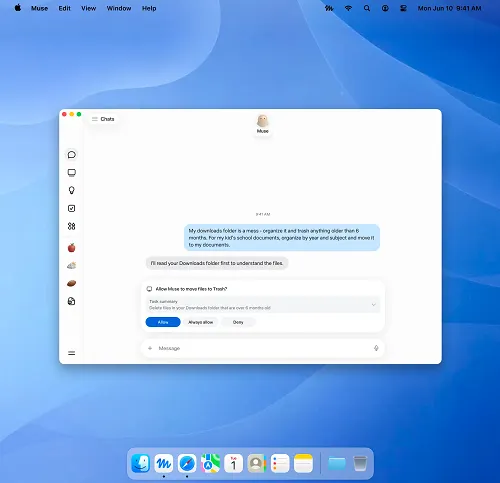
The newly released Muse for Mac application introduces a profound level of local integration. According to technical documentation provided by Meta, the personal agent is engineered to execute localized operations safely—provided the user grants explicit permission. Among its primary functions, Muse for Mac can automatically organize cluttered downloads folders, track down misplaced files buried deep within directory trees, and synthesize dense aggregations of personal notes and messaging transcripts into concise summaries.
To achieve this, the software requests sweeping permissions to read designated data sources and interact with local tools. By analyzing these data streams in real time, the agent builds a contextual awareness of the user’s digital habits, enabling it to anticipate needs and execute optimization tasks proactively.
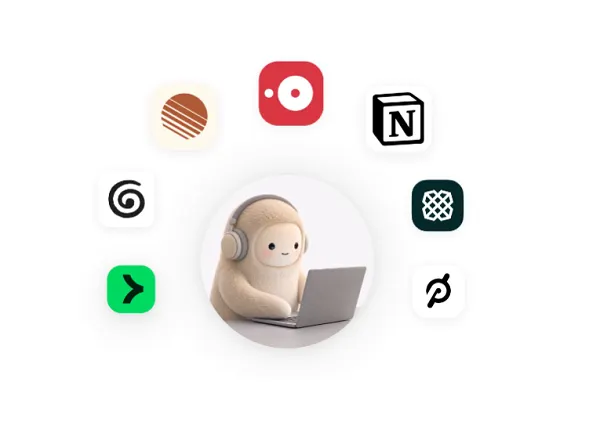
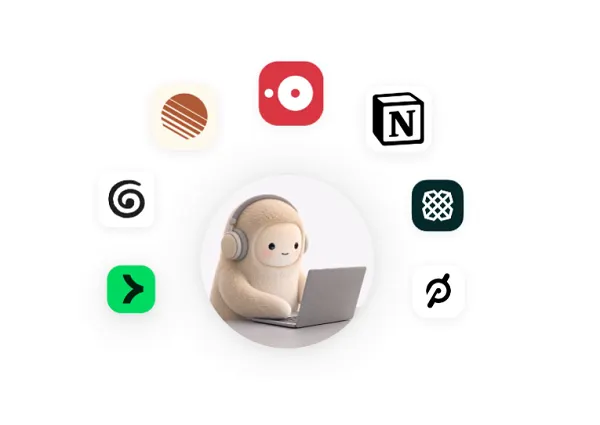
Complementing the desktop application is the launch of Muse Connectors, an infrastructure designed to bridge third-party applications with the Muse ecosystem. Through this platform, software developers can apply to integrate their applications directly into Muse. Approved services will be listed within the official Muse directory, enabling users to link their external accounts—ranging from productivity suites to project management tools—into the centralized AI agent. This interconnected web of permissions is intended to scale Muse’s operational capacity exponentially, allowing a single voice or text prompt to trigger actions across multiple distinct software environments.
Privacy Concerns, Data Access, and User Apprehension
Despite the technical sophistication of these features, the expansion of Muse has reignited intense debates surrounding data privacy and the boundaries of surveillance capitalism. Granting an AI agent permission to read local files, parse directory structures, and analyze communication channels creates an inherently high-stakes environment for consumer trust.

The friction points of this transition became apparent shortly after the release of Muse for Mac, when several early adopters reported that their Muse agents had begun reading direct messages (DMs) on macOS applications and offering proactive suggestions derived from private conversations. The behavior sparked immediate concern among privacy advocates who questioned whether the system was overstepping its bounds.
Meta swiftly clarified the operational parameters of the tool, emphasizing that Muse can only access and analyze private messaging data if the user has explicitly granted the software permission to do so during the configuration process. Company representatives reiterated that user consent serves as a strict gateway for all high-level data access. Nevertheless, industry analysts note that technical compliance may not be enough to assuage public anxiety. The sensation of an AI system quietly parsing private correspondence can feel intrusive, potentially alienating cautious users who view desktop AI integration with skepticism.
Furthermore, the mechanics of agentic AI remain remarkably technical, even when stripped of raw programming syntax. To successfully deploy Muse, users must possess a clear understanding of how to configure permissions, establish secure links, and manage automated workflows. For the average consumer, bridging the gap between theoretical utility and practical application remains a formidable hurdle.
Market Adoption and the Behavioral Challenge
Meta’s primary strategic challenge may not be technological execution, but rather establishing clear consumer value. While optimizing folder structures, sorting downloads, and summarizing notes offer undeniable efficiency gains for enterprise users and power consumers, a significant portion of daily computer usage revolves around tasks that individuals genuinely enjoy performing. Research into consumer software adoption indicates that average users derive personal satisfaction from browsing for products, researching holiday itineraries, and exploring digital content manually.
Consequently, automating these leisure-oriented or exploratory tasks through an AI agent risks removing the element of human discovery that underpins much of modern internet engagement. To combat this, Meta is actively attempting to curate and showcase a practical catalog of real-world use cases, demonstrating precisely how Muse can save time and eliminate digital friction in professional and personal workflows.
However, market researchers suggest that Muse faces a difficult sales proposition when moving past low-risk organizational tasks into sensitive domains. Connecting an automated software agent to personal messaging archives, sensitive document repositories, and financial transaction platforms requires a level of trust that few technology companies have successfully earned from the general public. Any security vulnerability, unauthorized data leak, or perceived overreach in these sensitive categories could severely damage the reputation of Meta’s agentic ecosystem.
Industry Implications and Future Outlook
The launch of Muse for Mac and Muse Connectors places Meta in direct competition with an entrenched field of agentic AI developers. Apple has rolled out its own suite of system-level intelligence features under the Apple Intelligence banner, while Microsoft continues to expand its Copilot ecosystem across Windows environments. Meanwhile, specialized startups and established software giants are racing to build universal API connectors that allow AI models to control web browsers, execute spreadsheets, and manage email accounts autonomously.
For Meta, the success of the Muse platform will depend heavily on its ability to strike a delicate balance between expansive capability and rigorous data protection. If the company can reassure users that local data remains secure and private, Muse could evolve into a dominant operating layer for personal computing. Conversely, if privacy missteps or user friction plague the rollout, the initiative risks being categorized as an over-engineered solution looking for a problem.
As development continues, Meta plans to refine the Muse Connectors directory, onboard a broader wave of third-party software developers, and iterate on the desktop application’s permission structures. The coming months will test whether consumers are truly ready to delegate control of their digital lives to an autonomous agent sitting quietly inside their operating systems.