Court-Ordered Seizure of Radaris.com Marks a Landmark Turning Point in the Battle Against Commercial Data Brokers


For years, the consumer data broker Radaris.com maintained a notorious reputation for ignoring consumer opt-out requests and stonewalling efforts to scrub personal information from its vast network of people-search engines. That era of impunity came to an abrupt halt when a state court judge ordered the transfer of radaris.com—along with more than a dozen associated sister domains—directly to the plaintiffs in a high-stakes privacy lawsuit. The unprecedented ruling stems from persistent evasiveness, complex corporate shell games, and alleged violations of a strict New Jersey privacy statute designed to protect law enforcement personnel and public officials from targeted harassment and digital exposure.
The legal showdown underscores the rising friction between aggressive consumer privacy advocates and a secretive, multi-million-dollar data broker ecosystem. As states increasingly step into a legislative vacuum left by the federal government, the fallout from the Radaris seizure signals a potential watershed moment for digital privacy enforcement in the United States.
Chronology of a Legal Battle: From 2017 to the Radaris Seizure
The legal pressure mounting against Radaris and its operators is the culmination of years of persistent litigation, investigative reporting, and strategic maneuvering.
In 2017, the company faced a class-action lawsuit (Huebner v. Radaris, LLC) that it temporarily lost due to a failure to appear and contest the claims in court. When plaintiffs attempted to collect a $7.5 million default judgment, the court ordered the domain registry Verisign to transfer radaris.com to the plaintiffs. However, defense counsel Val Gurvits of the Boston Law Group successfully appealed the verdict, arguing that the lawsuit had failed to name the true corporate owner of the domain—a Cyprus-registered entity known as Bitseller Expert Limited—thereby violating due process rights. The judge halted the transfer, and the plaintiffs ultimately opted not to refile.
Sensing a vulnerability, the operators shifted corporate entities. Control of Radaris transitioned to Andtop Company, an entity established in the Marshall Islands in October 2020. This kicked off what plaintiffs’ counsel describes as an ongoing "island-hopping" strategy of corporate obfuscation.
In February 2024, Atlas Data Privacy Corp—a firm dedicated to enforcing New Jersey’s stringent privacy statutes—filed a fresh lawsuit against Radaris. Just weeks later, investigative journalist Brian Krebs published an in-depth profile exposing the true masterminds behind the operation: Igor and Dmitry (also known as Dan) Lubarsky, Russian-born brothers residing in Massachusetts. The investigation revealed that the brothers operated a sprawling network of people-search engines and online dating affiliates, utilizing a fictitious CEO named "Gary Norden" to court investors and mislead the public.
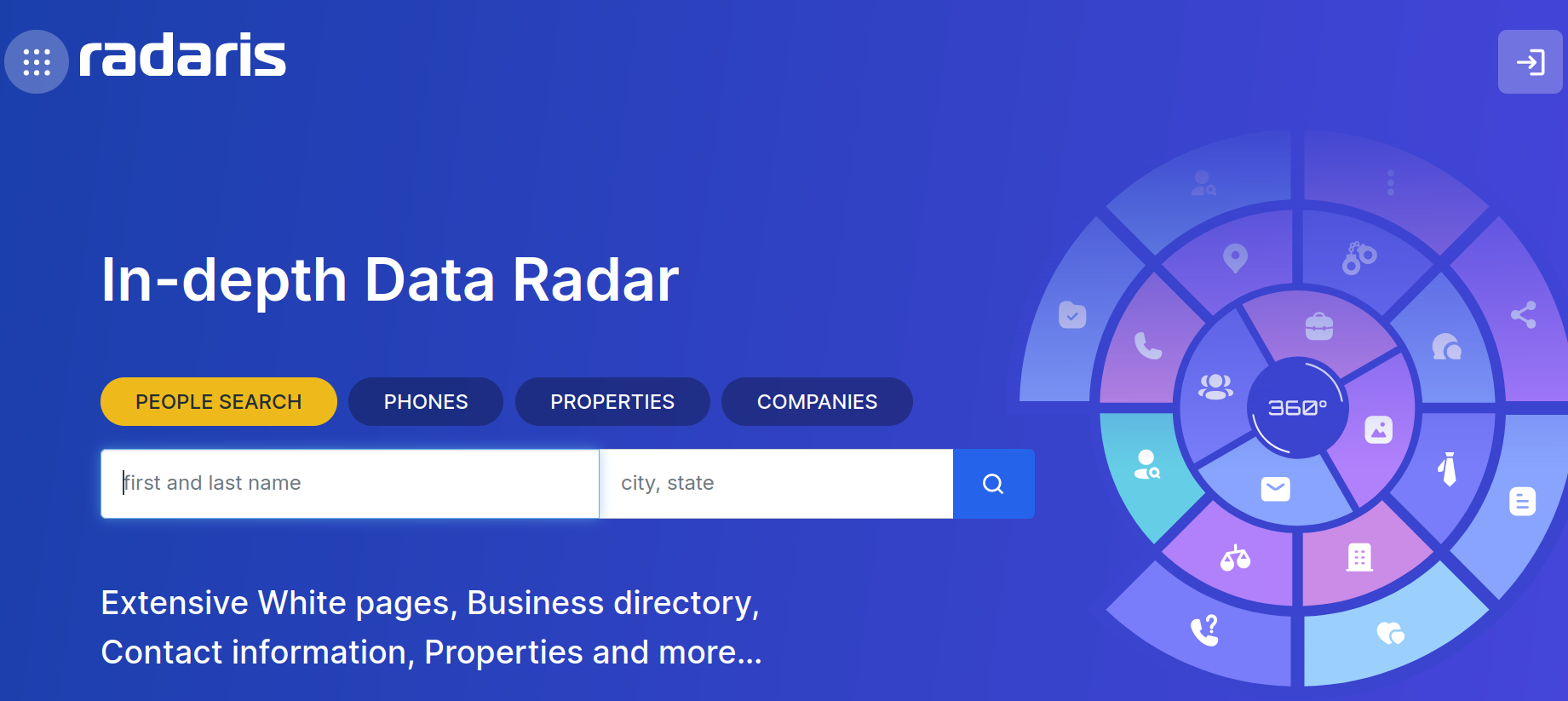
Faced with mounting scrutiny, Atlas expanded its legal action in June 2025, broadening the scope of the lawsuit to encompass a web of interconnected corporate shells. Following repeated failures by the defendants to mount a legitimate, transparent defense or properly identify their corporate framework, a New Jersey judge issued a default judgment. On August 26, the court authorized the transfer of radaris.com and 14 associated domains to Atlas. Today, visitors to radaris.com are met not with public records dossiers, but with a direct notice detailing the court-ordered domain transfer.
Anatomy of a Corporate Shell Game
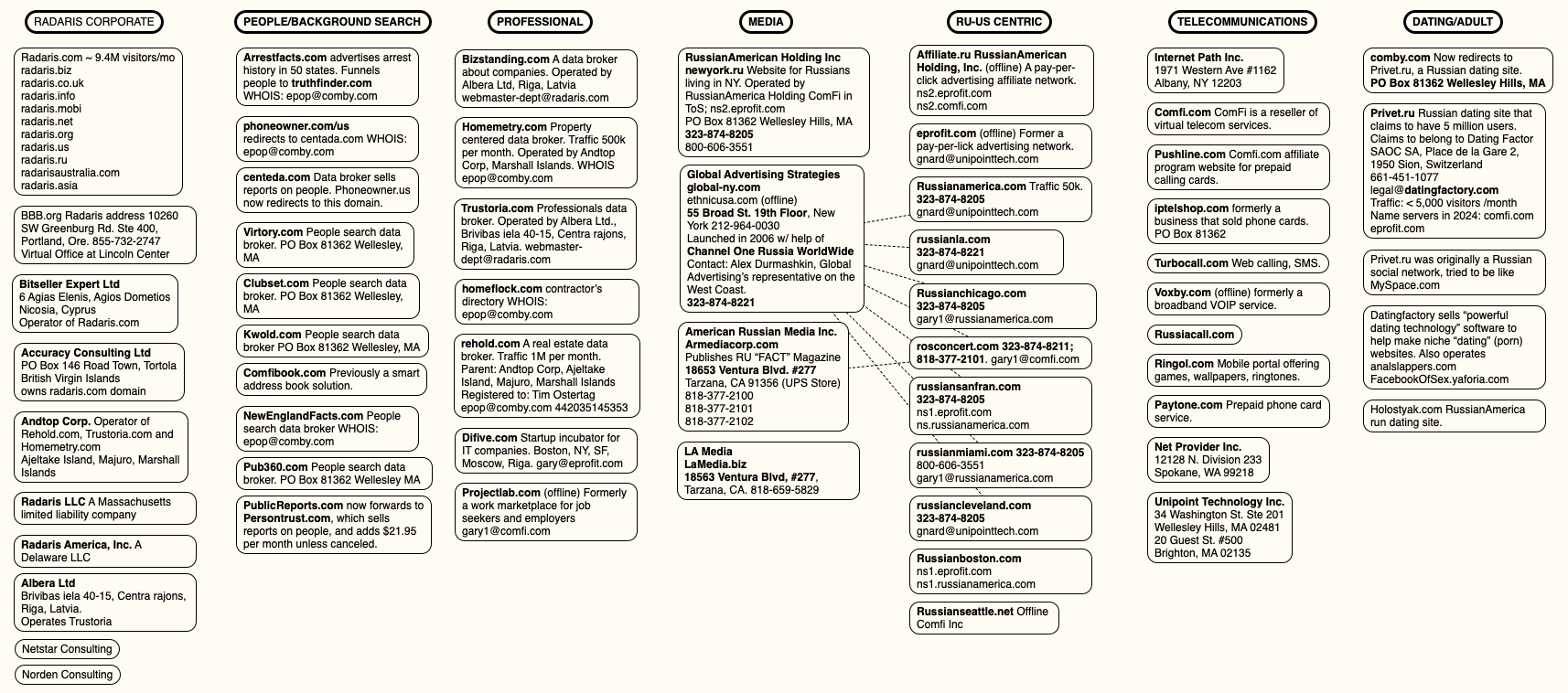
The mechanics behind the Radaris empire involve a sophisticated web of international shell companies designed to frustrate litigants and shield the true beneficiaries from liability. According to extensive discovery documents obtained by Atlas—including more than 10,000 emails, bank records, and payment processor logs—dozens of nominal legal entities are controlled by the same small core of administrators operating out of the Boston area.
Court filings and investigative findings link radaris.com and at least 25 other people-search websites to a centralized administration utilizing shared financial accounts, virtual office addresses, and infrastructure managed through specific mail domains such as difive.com, centerex.com, and pub360.com. The nominal legal fronts identified in the documents include Radaris America, Inc., Bitseller Expert Limited, Digital Orbit Corp, Core Solutions Group Inc., Lucky Solutions Inc., Virtura Corp, Veripages Inc., Nuform Solutions Inc., Growth Data Advisors Inc., and Property Experts, Inc.
Matt Adkisson, president and CEO of Atlas, described the defense strategy as an endless shell game. According to Adkisson, whenever a legal judgment loomed near, the operating entities would be dissolved or replaced with newly minted corporations in offshore jurisdictions such as the Marshall Islands, the British Virgin Islands, or the Seychelles. In one instance, after defense attorneys claimed a newly formed Marshall Islands entity was managing the platform, private investigators discovered the company did not legally exist at the time of the claim.
Financial Footprint and Industry Partnerships
The internal corporate documents recovered during the litigation shed rare light on the lucrative economics of the people-search industry. According to Atlas’s analysis of the internal communications, Radaris.com generates approximately $42,000 per month in revenue. Meanwhile, sister site Veripages.com pulls in roughly $45,000 monthly, largely driven by lucrative marketing and advertising partnerships with the Lifetime Value Company—a prominent data marketing firm operating brands like PeopleLooker, PeopleSmart, NumberGuru, and the automotive history platform Bumper.
Furthermore, the documents revealed that the Radaris ecosystem pulls in up to $25,000 per month through partnerships with Onerep, a prominent privacy service that assists consumers in removing their information from data broker sites. Investigative reports previously revealed that Onerep’s founder had simultaneously launched and operated multiple people-search entities, including Nuwber, creating a controversial business model where companies profit both by publishing personal data and by charging users to take it down.

Daniel’s Law and the Constitutional Showdown
At the heart of the New Jersey litigation is Daniel’s Law, a statute enacted following a tragic shooting at the home of federal judge Esther Salas, which resulted in the death of her son and serious injury to her husband. The law explicitly grants state law enforcement officials, judges, prosecutors, and their immediate families the right to have their personal information completely expunged from commercial people-search directories. Crucially, the statute provides teeth by levying fines of $1,000 per violation against data brokers that willfully ignore removal requests.
However, the broader data broker industry has launched an aggressive counter-offensive. More than 150 data broker firms currently facing litigation under Daniel’s Law have banded together to challenge its constitutionality. At least 70 of these lawsuits have been removed to federal court, with industry groups arguing that broad restrictions on publishing publicly available records violate the First Amendment and constitute an unconstitutionally restrictive overreach.
While the U.S. Court of Appeals for the Third Circuit weighs the merits of the New Jersey statute, the legal battle lines are hardening nationwide. At least 14 other states have passed legislation modeled after Daniel’s Law, while other jurisdictions face immediate judicial roadblocks. For instance, in August 2025, a federal district court ruled West Virginia’s version of Daniel’s Law facially unconstitutional under the First Amendment. Legal scholars widely anticipate that the constitutional validity of these state-level privacy protections will ultimately be decided by the U.S. Supreme Court.
Defense Response and Continuing Appeals
Legal representation for the defendants has strongly contested the legitimacy of the recent New Jersey rulings. Val Gurvits, who previously represented Radaris, declined to comment on the latest developments, noting that the matter had been transferred to attorney Victor Worms.
In response to inquiries, Worms asserted that the New Jersey court erred by transferring radaris.com to Atlas as part of a default judgment against "Radaris.com," which he contends is a non-entity lacking the legal capacity to sue or be sued.
"We have made a motion to vacate that default judgment on the grounds that it is void since a non-entity has no legal capacity to sue or be sued," Worms stated. "We also intend to pursue all appropriate appeals because we believe the transfer of Radaris.com amounts to a forfeiture in violation of various constitutional principles."
Broader Implications for 21st-Century Digital Privacy
The seizure of radaris.com highlights the systemic limitations of relying on piecemeal state legislation to combat an aggressive, multi-billion-dollar commercial data broker industry. Privacy experts point out that as long as state and federal laws exempt records categorized as "public documents"—such as voting registries, property deeds, marriage certificates, motor vehicle records, and court filings—commercial entities will find legal avenues to aggregate and monetize personal dossiers.
Justin Sherman, a privacy expert and author of the forthcoming book "The Middlemen," notes that federal lawmakers face intense, coordinated lobbying from big tech, social media platforms, cryptocurrency firms, and artificial intelligence developers who fiercely oppose restrictive federal data privacy standards.
"The average person can look at Daniel’s Law and have a perfectly normal reaction, which is that everyone should be covered, not just police and judges," Sherman observed. "But we don’t need more wake-up calls. We’ve had eight million wake-up calls already on the need for better privacy laws. The lack of comprehensive federal privacy law is not for a lack of knowledge, and anyone claiming otherwise is either not reading the news or kidding themselves."
Until Congress passes comprehensive federal data protection legislation that addresses the root mechanisms of data harvesting and commercial exploitation, people-search enterprises are likely to continue adapting their tactics. Nevertheless, for the victims of online harassment and the public officials targeted by data brokers, the surrender of radaris.com demonstrates that even the most deeply entrenched digital empires can be held accountable when plaintiffs commit the necessary time, resources, and legal grit to pierce through the corporate shell game.