SonicWall SMA1000 Zero-Day Vulnerabilities Exploited for Weeks, Leading to Custom Malware Deployment by Sophisticated Threat Actor UTA0533


A sophisticated threat actor, identified by incident response firm Volexity as UTA0533, successfully exploited two previously undisclosed zero-day vulnerabilities within SonicWall’s SMA1000 Secure Mobile Access (SMA) appliances for weeks. These critical security flaws allowed the attackers to establish root access and deploy custom-designed malware on affected VPN infrastructure, posing a significant risk to organizations reliant on these devices for secure remote access. The exploitation campaign began as early as June 22, 2026, long before SonicWall publicly acknowledged the vulnerabilities and released patches.
The vulnerabilities, tracked as CVE-2026-15409 (a critical server-side request forgery, or SSRF) and CVE-2026-15410 (a high-severity command injection flaw), specifically targeted SMA1000 models 6210, 7210, and 8200v. These appliances are vital components of many enterprise networks, serving as gateways for remote employees to securely access internal resources. The successful exploitation of such edge devices can provide attackers with a strategic foothold, enabling lateral movement, data exfiltration, or further network compromise.
The Unfolding Chronology of a Zero-Day Attack
The timeline of this sophisticated attack reveals a prolonged period where organizations were vulnerable without awareness or available remediation.
- June 22, 2026: Volexity’s investigation, conducted in collaboration with SonicWall, pinpointed this date as the earliest observed sign of compromise. This indicates that UTA0533 had discovered and operationalized the zero-day exploits well in advance of any public disclosure. For weeks, the threat actor operated undetected, installing custom malware and maintaining persistent access on compromised SonicWall SMA1000 appliances.
- Early July 2026 (Inferred): SonicWall likely began its internal investigation or became aware of potential exploitation, possibly through internal telemetry, customer reports, or direct intelligence sharing from security partners like Volexity. The nature of zero-day attacks often means that discovery comes from observing unusual activity rather than traditional vulnerability scanning.
- Mid-July 2026: SonicWall publicly issued a warning about active exploitation of previously undisclosed vulnerabilities in an exploit chain affecting SMA1000 Secure Mobile Access appliances. At this stage, while confirming the zero-day nature of the attacks, specific technical details on the exploitation methods or the identity of the threat actor were not disclosed.
- Simultaneously with Public Warning: SonicWall released crucial patches, urging customers to install updates immediately. The patches were made available in versions 12.4.3-03453 and 12.5.0-02835, specifically addressing the identified security flaws. This swift release of patches is a standard, critical step in containing zero-day threats once they are identified.
- July 17, 2026: Volexity published its detailed report, titled "Proxying to Compromise: SonicWall Secure Mobile Access 0-Day Exploitation." This report provided the comprehensive technical breakdown of the exploit chain, the custom malware used, and attributed the attacks to the threat actor UTA0533. Volexity’s deep forensic analysis of logs, disk images, and memory from compromised appliances was instrumental in uncovering the full scope and methodology of the attacks.
Dissecting the Exploit Chain: A Two-Stage Compromise

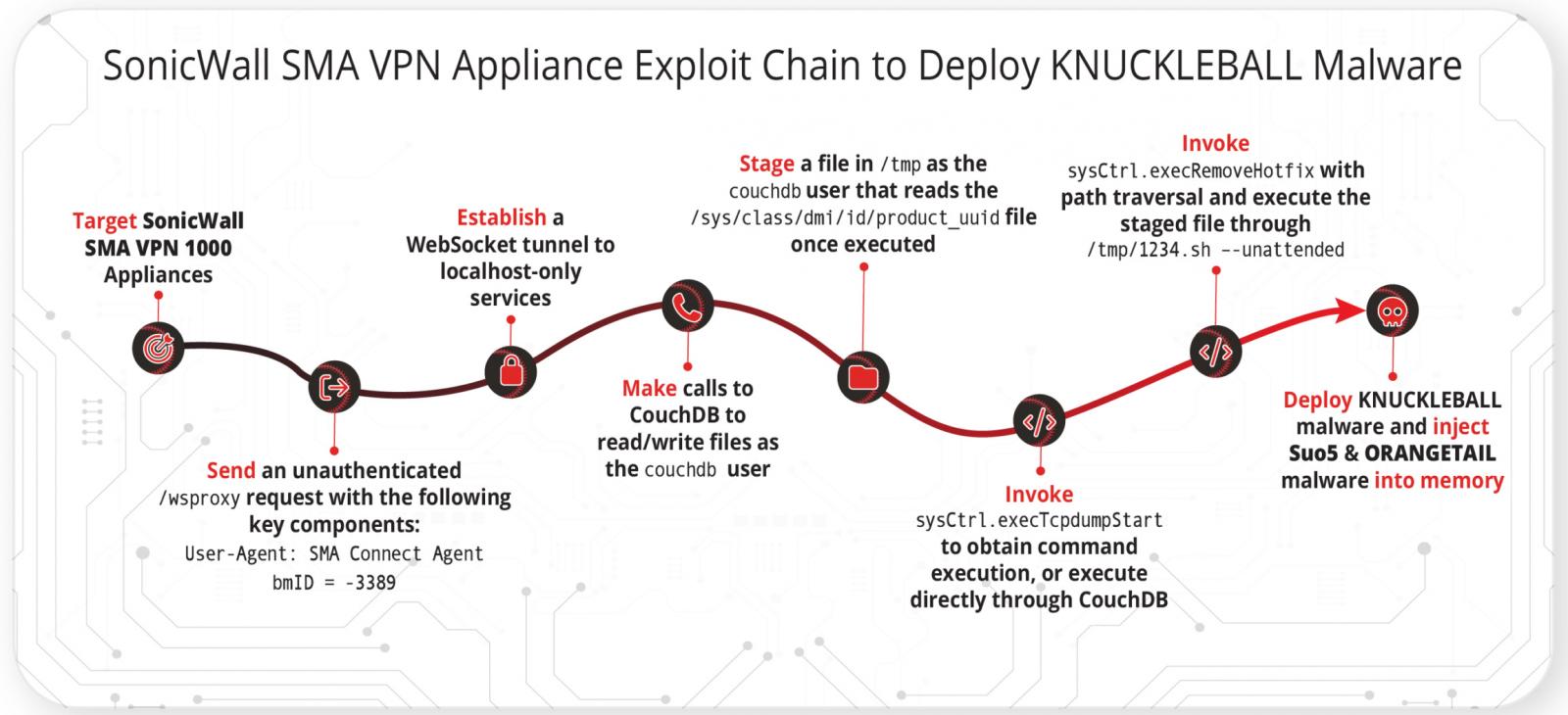
Volexity’s meticulous analysis shed light on the intricate, multi-stage attack chain employed by UTA0533, demonstrating a significant level of technical sophistication. The attackers leveraged two distinct vulnerabilities in sequence to achieve full control over the target appliances.
-
Stage 1: Server-Side Request Forgery (SSRF) via CVE-2026-15409
The initial point of compromise involved CVE-2026-15409, a critical server-side request forgery vulnerability. The threat actors exploited the SMA1000’s/wsproxyendpoint. This particular endpoint, intended for legitimate internal proxying functions, was abused to establish unauthenticated WebSocket tunnels. Crucially, this allowed UTA0533 to bypass security controls and access internal services that should have been restricted to the appliance itself. This exposure effectively turned the SMA appliance into a proxy for the attackers, granting them access to internal applications like CouchDB and the device’s management service.CouchDB, an open-source NoSQL database, often stores configuration and operational data within such appliances. By querying CouchDB, the attackers successfully extracted the appliance’s
product_uuid. This unique identifier proved essential for the subsequent stage of the attack, acting as a key to unlock further access. While the precise method used to exploit CouchDB forproduct_uuidextraction remains under investigation, its successful acquisition underscores the efficacy of the initial SSRF exploit. -
Stage 2: Command Injection via CVE-2026-15410
With theproduct_uuidin hand, UTA0533 proceeded to the second, equally critical stage: exploiting CVE-2026-15410, a high-severity command injection vulnerability. This flaw was leveraged through the Appliance Management Console’ssysCtrl.execRemoveHotfixRemote Procedure Call (RPC) method. By injecting malicious commands into this method, the attackers were able to execute arbitrary commands with root privileges on the SonicWall appliance. Gaining root access signifies complete control over the device, allowing the threat actor to manipulate system configurations, install software, and essentially operate as the legitimate administrator.The successful chaining of these two vulnerabilities highlights a well-researched and carefully executed strategy. The SSRF provided the necessary reconnaissance and internal access to gather crucial information (
product_uuid), which then facilitated the command injection for elevated privileges. This multi-step approach is characteristic of advanced persistent threat (APT) groups seeking stealth and deep compromise.
The Anatomy of Custom Malware: KNUCKLEBALL, Sou5, and ORANGETAIL

Upon achieving root access, UTA0533 wasted no time in establishing persistence and further entrenching themselves within the compromised appliances. They deployed a suite of custom-designed malware specifically tailored for SonicWall SMA1000 environments.
- KNUCKLEBALL (deploy_new.py): This serves as the initial dropper. It’s a custom malware component responsible for deploying the subsequent, more specialized payloads. Its name reflects its function as the first point of delivery for the more potent tools.
- Sou5 (agent_wp8.jar): This Java-based malware family functions as a sophisticated reverse proxy. Its primary purpose is to allow the attackers to tunnel traffic through the compromised SMA appliance. This creates a covert communication channel, enabling UTA0533 to maintain persistent access to internal network resources without directly exposing their command-and-control (C2) infrastructure. A reverse proxy also helps in evading network detection systems that might flag direct outbound connections from internal networks.
- ORANGETAIL (agent_wp9.jar): Another Java-based malware, ORANGETAIL, operates as a custom webshell. Webshells are powerful tools that provide remote administrative access to a web server. In this context, ORANGETAIL allowed the attackers to send encrypted Java payloads to the compromised appliance and dynamically execute them within an HTTP session. This provides a flexible and robust mechanism for issuing commands, exfiltrating data, or deploying additional tools on the fly, all while potentially blending in with legitimate web traffic.
Beyond these core malware families, Volexity’s investigation also uncovered additional malicious activities:
- Nginx Configuration Modification: The attackers modified the appliance’s nginx configuration. Nginx is a popular web server, and by altering its configuration, UTA0533 exposed the ORANGETAIL webshell remotely, ensuring persistent and easily accessible control over the compromised device.
- ROOTRUN: This is a privilege-escalation tool deployed by the attackers. While root access was initially gained through the exploit chain, ROOTRUN likely serves as a mechanism to maintain or re-establish root privileges, or to facilitate the execution of commands as root in various contexts, ensuring robust control throughout the compromise lifecycle.
The Threat Actor: UTA0533’s Sophistication and Intent
Volexity characterizes UTA0533 as a highly sophisticated threat actor, a conclusion drawn from the intricate exploit chain, the custom nature of the malware, and the targeted approach. The development of zero-day exploits requires significant resources, technical expertise, and a deep understanding of the target system’s architecture. The fact that the malware was specifically designed for SonicWall SMA VPN appliances further underscores their dedication and focus.
Despite the high level of technical sophistication displayed in gaining initial access and establishing persistence, Volexity noted that the threat actor was "less successful" at spreading into victims’ internal networks beyond the initial VPN appliance compromise. This observation is crucial. While the initial breach was profound, effective network segmentation, robust internal monitoring, or perhaps the early detection and remediation efforts following SonicWall’s advisory might have limited the broader impact. However, even limited internal access can be devastating, leading to data theft or the establishment of long-term espionage capabilities.
SonicWall’s Response and Remediation
Upon identifying the active exploitation, SonicWall acted swiftly to address the vulnerabilities. The immediate release of patches for SMA1000 versions 12.4.3-03453 and 12.5.0-02835 was a critical step in mitigating the threat. The company’s urgent recommendation for customers to install these updates underscores the severity of the flaws and the ongoing risk.
In addition to patching, SonicWall also collaborated with incident response firms like Volexity to understand the full scope of the attacks. This collaboration is vital for intelligence sharing, allowing for a comprehensive analysis of the threat, attribution where possible, and the development of effective countermeasures. For affected organizations, the remediation process extends beyond simply applying patches; it necessitates thorough forensic investigations to identify any signs of compromise, remove persistent malware, and ensure no lingering backdoors remain.
Broader Implications for Network Security
This incident serves as a stark reminder of the persistent and evolving threat landscape, particularly concerning critical network infrastructure. VPN appliances, firewalls, and other edge devices are prime targets for sophisticated adversaries due to their direct connection to both external and internal networks.
- The Pervasive Threat of Zero-Days: The exploitation of zero-day vulnerabilities, where attackers leverage flaws unknown to the vendor or the public, represents one of the most challenging threats to defend against. Organizations have no opportunity to patch or prepare until the vulnerability is discovered, often through active exploitation. This necessitates a proactive security posture, including advanced threat hunting, robust logging, and continuous monitoring for anomalous behavior.
- VPNs as High-Value Targets: The COVID-19 pandemic significantly accelerated the adoption of remote work, making VPNs an indispensable component of corporate IT infrastructure. This increased reliance has also elevated their status as high-value targets for nation-state actors and sophisticated criminal groups seeking to bypass perimeter defenses and gain access to sensitive organizational data.
- The Importance of Incident Response and Threat Intelligence: The collaboration between SonicWall and Volexity highlights the critical role of specialized incident response firms in dissecting complex attacks. Their ability to conduct deep forensic analysis and share actionable threat intelligence is invaluable for the broader cybersecurity community, enabling other organizations to protect themselves more effectively.
- Layered Security and Segmentation: While UTA0533 demonstrated significant technical prowess in compromising the SMA appliances, their limited success in spreading internally underscores the importance of layered security and network segmentation. Isolating critical systems, implementing strict access controls, and segmenting networks can significantly hinder an attacker’s ability to move laterally even after an initial breach.
- Vigilant Patch Management: Despite the challenges of zero-days, the incident reinforces the fundamental importance of prompt patch management. Once a patch is available, its immediate deployment is paramount to closing known vulnerabilities and preventing further exploitation. Organizations must have robust processes in place to rapidly identify and update critical infrastructure components.
- Supply Chain Security: Attacks on widely used network appliances also raise concerns about supply chain security. While not a direct supply chain attack in the traditional sense, the compromise of a foundational network device like the SonicWall SMA1000 highlights how a single point of failure in a widely adopted product can have far-reaching consequences across numerous organizations.
In conclusion, the exploitation of SonicWall SMA1000 zero-day vulnerabilities by UTA0533 represents a significant cybersecurity event. It underscores the constant need for vigilance, rapid response, and a multi-faceted approach to security that combines robust patching with advanced threat detection, incident response capabilities, and a deep understanding of the evolving tactics of sophisticated adversaries. Organizations utilizing SonicWall SMA1000 appliances are strongly advised to ensure their systems are fully patched to the latest versions and to conduct thorough forensic analyses for any indicators of compromise.