From Kitchen Sink to Lunar Descent: Katie Spicer’s Journey to the Artemis Moon Landers

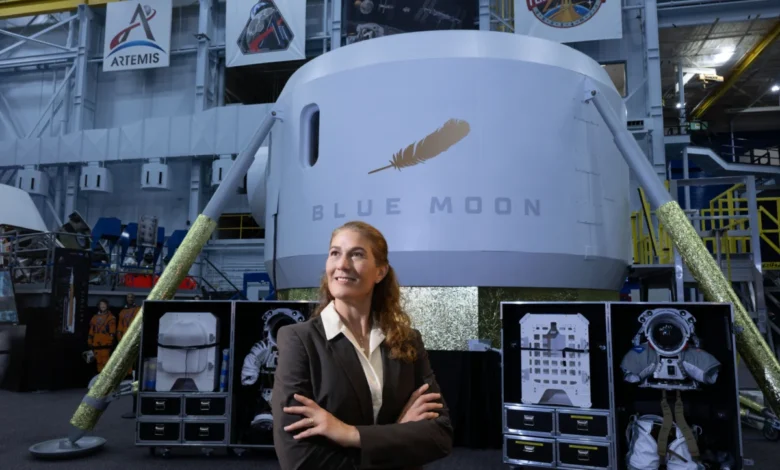
The trajectory of space exploration is rarely a straight line, but for Katie Spicer, the path from household management to the pinnacle of aerospace engineering serves as a testament to the transformative power of dedication and technical rigor. Currently serving as the NASA lander integration lead for Blue Origin’s Blue Moon Mark 2 lander, Spicer is a critical architect of the hardware that will facilitate the return of humanity to the lunar surface. As NASA moves toward the Artemis III mission and beyond, Spicer’s role within the Flight Operations Directorate at the Johnson Space Center (JSC) represents a vital bridge between theoretical engineering and the practical, often unforgiving, realities of life in deep space.
A Career Defined by Unconventional Growth
Spicer’s professional evolution is distinguished by its lack of traditional pedigree. Having earned a bachelor’s degree in microbiology from the Pennsylvania State University, she did not follow the standard path of an aerospace engineer. Instead, she spent several years as a full-time homemaker, raising three children. Her entry into the aerospace sector was humble; she began her tenure at NASA in a part-time capacity at the historic Life Sciences Laboratory.
At the time, her responsibilities included cleaning laboratory equipment and assisting scientists in maintaining the integrity of sensitive experiments. This period was significant not only for her professional start but for its historical gravity; she worked in the very facility that once housed Apollo-era Moon rocks and served as the quarantine site for astronauts returning from lunar missions. This foundational experience instilled in her a deep respect for the legacy of space exploration and the meticulous nature of operational safety.
Her transition from laboratory maintenance to space operations began with the International Space Station (ISS) program. Working with Human Research Facility racks, she developed an expertise in managing complex payloads, bridging the gap between ground-based scientists and astronauts operating in microgravity. By 2018, her performance and technical acumen led her to the Mission Control Center, where she embarked on a grueling five-year certification process to become a flight controller. Achieving the highest level of certification in the "front room"—the high-pressure environment of the Mission Control flight control room—required Spicer to self-educate on complex engineering principles. Her ability to "speak engineer" without a formal degree has since become a hallmark of her leadership style, allowing her to facilitate communication between diverse technical teams.
The Blue Moon Mark 2 and the Artemis Architecture
The Blue Moon Mark 2 lander, a cornerstone of NASA’s Artemis human landing system (HLS) strategy, is a sophisticated spacecraft designed to transport crews to the lunar surface. As the integration lead, Spicer is responsible for ensuring that the vehicle’s design is not merely compliant with structural requirements but is fundamentally operable by human beings in a high-stakes, low-gravity environment.
The development timeline for the Blue Moon lander is aggressive. The current phase involves the refinement of a streamlined lander test article, which will undergo rigorous testing for the Artemis III mission—a rendezvous and docking flight in low Earth orbit. Following this milestone, the program will pivot toward the development of a fully functional lander capable of a crewed descent to the lunar South Pole, currently projected for 2028.
Spicer’s work involves granular evaluation of the lander’s human-machine interface (HMI). Her daily responsibilities include:
- Ergonomic Assessments: Analyzing the placement of handles, handrails, and control interfaces to ensure ease of use for astronauts wearing pressurized suits.
- Microgravity Operational Logic: Testing the functionality of push-button displays and digital interfaces under conditions where traditional leverage is absent.
- Human Factors and Hygiene: Optimizing waste management and personal hygiene systems within the restricted volume of the spacecraft to ensure long-term mission viability.
- Procedural Integration: Developing training protocols that allow crews to internalize complex systems operations, ensuring they can respond effectively to emergencies.
Contextualizing the Artemis Mission Objectives
The Artemis program represents a fundamental shift in NASA’s approach to lunar exploration. Unlike the Apollo era, which was defined by short-duration "flags and footprints" sorties, Artemis is designed to establish a sustained, long-term presence on the Moon. This shift has profound implications for spacecraft design, shifting the priority from simple survival to long-term habitability and productivity.
The lunar South Pole, the primary target for Artemis missions, is of immense scientific and strategic interest due to the presence of water ice in permanently shadowed regions. Extracting and utilizing this resource is a critical component of NASA’s broader "Moon to Mars" strategy. By developing the infrastructure required for lunar operations, NASA and its commercial partners, such as Blue Origin, are creating a blueprint for the eventual crewed exploration of the Red Planet.
From a data perspective, the integration of commercial landers into the Artemis architecture is a calculated risk-reduction strategy. By leveraging the expertise of private industry, NASA can focus its resources on mission-critical systems and safety, while fostering a competitive and robust space economy. The "commercial provider" model, which includes both SpaceX and Blue Origin, allows for redundant capabilities, ensuring that the mission timeline remains resilient even if one system experiences technical delays.
Professional Perspectives on the Human Element
Industry analysts and NASA officials often highlight that the greatest challenge in spaceflight is not the propulsion or the navigation, but the human interface. As Spicer frequently notes, a design may meet every mechanical specification on paper, but if the astronaut cannot comfortably operate the system during the fatigue of a landing sequence, the mission is compromised.
"I look at the design of everything Artemis crews will touch, work with, or interface with to ensure systems will function the way crews will need them to," Spicer remarked during a recent project briefing. Her philosophy underscores a shift in aerospace engineering toward "crew-centric design." This approach assumes that human error is a design flaw, not an operator failure. By involving someone with a background in operations, science, and life support, NASA ensures that the Blue Moon lander is optimized for the psychological and physical reality of the lunar surface.
Broader Implications for Aerospace Innovation
The inclusion of individuals with non-traditional paths like Spicer’s within the upper echelons of flight operations is becoming increasingly common as the aerospace sector expands. This diversity of thought is essential for solving the "wicked problems" associated with interplanetary travel.
The implications of the Artemis program extend well beyond the lunar surface. The economic benefits, including the creation of high-tech manufacturing jobs and the advancement of materials science, are significant. Moreover, the technological breakthroughs necessitated by the harsh lunar environment—such as advanced radiation shielding, autonomous navigation, and regenerative life support—have direct applications for sustainability and efficiency on Earth.
As the Artemis III mission approaches, the integration of the Blue Moon lander will serve as a bellwether for the future of spaceflight. The collaboration between NASA’s flight controllers and Blue Origin’s engineering teams represents a new standard of public-private partnership. For Spicer, the view from the ground is as profound as the one she hopes the astronauts will have from the surface.
"I’m reminded of the great responsibility that NASA has in this endeavor, of the legacy of the courageous Apollo crews who went before, and inspiring the next generation of space explorers to keep going and reaching for the stars," she said.
Future Milestones in Lunar Exploration
The roadmap for the remainder of the decade is dense with critical testing milestones. Following the initial integration phase, the program will enter a period of "Integrated Vehicle Testing," where the Blue Moon lander will be subjected to simulated lunar conditions. This includes vacuum chamber testing, vibration and acoustic stress tests, and final human-in-the-loop evaluations.
These steps are designed to ensure that when the hatch finally opens on the Moon, the transition from the lander to the lunar surface is seamless. As Spicer and her team continue to monitor the rapid evolution of the Blue Moon design, the focus remains steadfast on the 2028 target. By then, the lessons learned from the Apollo program, the ISS, and the current development cycles of the Artemis landers will have converged into a new era of human exploration—one where the gap between the scientist in the lab and the explorer on the Moon has been bridged by the diligent, detail-oriented work of those in the flight control room.