Vertu Alphafold: A Deep Dive into the Luxury Foldable’s Executive AI Ambitions and Market Realities

The smartphone industry is currently experiencing its latest paradigm shift, with Artificial Intelligence emerging as the definitive battleground for manufacturers vying for consumer attention. While tech giants pour billions into developing advanced AI-powered features designed to attract a mainstream audience, Vertu, the UK-founded luxury phone maker, is charting a distinctly different course. Renowned for its meticulously hand-finished devices that often command price tags in the tens of thousands of dollars, Vertu has historically sold status and exclusivity rather than cutting-edge specifications. With its new foldable offering, the Alphafold, Vertu targets an elite demographic of affluent buyers, particularly chief executives, by pairing its signature luxury materials with an AI agent specifically engineered to automate significant portions of an executive’s demanding working day.
This review embarked on an unconventional mission: to rigorously test Vertu’s audacious pitch. Eschewing the traditional benchmarks of smartphone evaluation—such as raw performance scores, granular camera comparisons, or media consumption capabilities—the focus was squarely on the Alphafold’s efficacy as an executive tool. For several days, the foldable was integrated into a simulated high-level professional routine: managing complex documents, analyzing intricate spreadsheets and legal contracts, meticulously planning international business trips, and automating a myriad of routine tasks. The pre-installed AI agent served as a constant digital companion, its capabilities scrutinised not for its general intelligence, but for its specific utility in streamlining an executive’s workflow. The fundamental question guiding this assessment was not whether the Alphafold was merely a good smartphone, but whether it truly excelled as a sophisticated executive smartphone.
The Shifting Sands of Smartphone Innovation: AI as the New Frontier
The broader smartphone market has been relentlessly pushing the boundaries of AI integration for years. What began with rudimentary voice assistants like Apple’s Siri and Google Assistant, primarily designed for simple commands and information retrieval, has rapidly evolved. Subsequent generations saw AI deployed for more sophisticated on-device tasks, enhancing camera capabilities through computational photography, optimizing battery life, and personalizing user experiences. The current wave, however, is characterised by the advent of generative AI and large language models (LLMs) directly embedded within smartphones, transforming them into "AI phones." This shift represents a critical juncture for manufacturers, offering a potent avenue for differentiation in an increasingly saturated market. The promise of on-device AI extends beyond novelty, offering new paradigms for user interaction, unprecedented levels of personalization, and, crucially, significant boosts in productivity and efficiency.

Against this backdrop of mainstream AI proliferation, Vertu’s strategy with the Alphafold stands out. Rather than merely adding AI features to compete on a spec-sheet level, Vertu seeks to integrate AI into the very fabric of the luxury executive lifestyle it caters to. This isn’t just about having an AI; it’s about having an AI that understands and anticipates the unique demands of a C-suite individual, thereby elevating the device beyond a mere gadget to an indispensable executive instrument.
Vertu’s Enduring Legacy in Luxury Mobile
To fully appreciate the Alphafold, one must understand Vertu’s storied history. Founded by Nokia in 1998, Vertu quickly carved out a niche in the ultra-luxury mobile phone market. Its devices were (and remain) synonymous with exquisite craftsmanship, employing exotic materials such as sapphire crystal, ruby bearings, genuine leather, and precious metals. Beyond the opulent hardware, Vertu’s appeal lay in its exclusive services, most notably its legendary concierge service, offering 24/7 personal assistance to its elite clientele. Vertu phones were never about leading-edge technical specifications; they were about a statement of wealth, discernment, and access to unparalleled service.
The company’s target demographic has consistently been the ultra-wealthy, for whom a smartphone is as much a status symbol and a tool for convenience as it is a communication device. The Alphafold, therefore, represents a strategic evolution of this philosophy. It marries Vertu’s traditional commitment to luxury and exclusivity with the contemporary imperative of advanced AI. By positioning the Alphafold as a "digital assistant for executives," Vertu aims to reinforce its brand identity while addressing the evolving needs of its sophisticated clientele in an increasingly digital and demanding world.
Unpacking the Alphafold: Design, Craftsmanship, and a Familiar Core

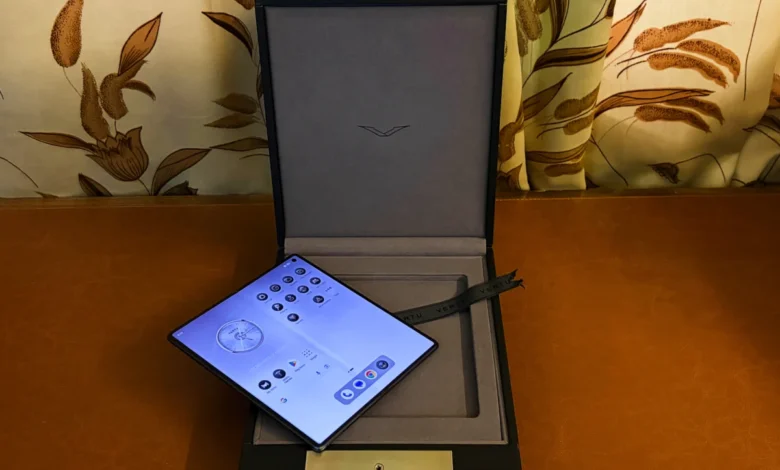
The Alphafold, with a starting price of $6,880, immediately asserts its luxury credentials through its physical presence. The review unit, meticulously wrapped in genuine calfskin leather and accented with gleaming titanium, exuded an undeniable aura of exclusivity. This tactile experience starkly contrasts with the glass and synthetic finishes prevalent in mainstream foldables, reinforcing its status as a bespoke item. It is overtly designed for discerning buyers who view their mobile device as both an essential professional tool and an unequivocal emblem of their standing.
In terms of ergonomics, the Alphafold weighs 264 grams, making it noticeably heavier than the Samsung Galaxy Z Fold 7, which served as a reference device throughout this review and tips the scales at 215 grams. While the additional heft is perceptible during extended use, it never felt cumbersome. The Alphafold’s subtly curved frame contributes to an easier unfolding motion compared to the Galaxy Z Fold 7’s flatter edges. However, Samsung’s design, when folded, offers a sleeker profile and a more comfortable single-handed grip.
The unboxing experience further underscores Vertu’s luxury positioning. The Alphafold arrives in packaging that transcends a typical smartphone box, resembling more a high-end jewelry presentation case. This oversized, intricately designed box reveals neatly organized drawers containing a suite of bundled accessories, including a premium leather sleeve and charging cables, each element reinforcing the narrative that Vertu delivers a comprehensive luxury experience, not merely a handset.
However, beneath this meticulously crafted exterior, a different narrative emerges. During the review, striking similarities were observed between the Alphafold’s underlying hardware and the significantly more affordable $1,100 ZTE Nubia Fold. These commonalities extended to critical design elements such as the hinge mechanism, overall dimensions, and the precise placement of speakers, microphones, and the fingerprint reader. While Vertu’s distinctive leather-clad rear panel provides the most visible external differentiation, system information within the software itself also revealed ZTE identifiers.
When confronted with these observations, Vertu confirmed a specialist supply-chain partnership involving ZTE/Nubia. According to Vertu, this collaboration covers the core hardware platform, component integration, and production engineering. Vertu, in turn, assumes responsibility for the bespoke luxury materials, the proprietary software experience, rigorous quality control, and comprehensive after-sales service. ZTE did not respond to requests for comment regarding this partnership. This isn’t an isolated incident for Vertu; a 2023 review of the MetaVertu by Wired similarly reported the device appeared to be based on a ZTE Nubia handset, citing analogous hardware and market analysis from Counterpoint Research suggesting Vertu’s strategy of adapting existing ZTE models with luxury finishes and custom software.

This strategic partnership allows Vertu to focus its resources on its core competencies: luxury aesthetics, exclusive services, and a tailored software experience, rather than investing heavily in fundamental smartphone hardware research and development. However, it also raises pertinent questions about the value proposition of a device priced at nearly seven times its apparent hardware progenitor. For a brand that epitomizes exclusivity, the shared hardware platform introduces a layer of complexity for discerning consumers weighing the premium price against the underlying components.
Hermes Agent: The Digital Butler for the Executive Elite
At the very core of the Alphafold’s executive proposition lies Hermes Agent, a sophisticated, pre-installed AI agent built upon the open-source Hermes project. This project, which has been reportedly in talks for new funding at a $1.5 billion valuation, forms the technological backbone of Vertu’s ambitious AI offering. Hermes Agent is designed to be far more than a conventional voice assistant; its capabilities reportedly include analyzing various file types, automating multi-step tasks across different applications, maintaining conversational context, and seamlessly escalating complex requests to a human concierge when necessary. Unlike most smartphone AI assistants that primarily react to direct prompts, Hermes is engineered to proactively execute intricate workflows on behalf of its users, making it the focal point of Vertu’s pitch, rather than the foldable hardware itself.
To rigorously evaluate this central claim, the review pivoted from typical smartphone testing to a series of real-world executive workflows. Instead of superficial prompts, Hermes Agent was tasked with scenarios directly relevant to a busy executive’s day: analyzing financial spreadsheets, dissecting legal contracts, meticulously planning business trips, managing intricate schedules, and automating routine cross-application tasks. The performance of Hermes Agent on the Alphafold was then directly compared against Google’s Gemini AI running on the Samsung Galaxy Z Fold 7, providing a crucial comparative lens. It is worth noting that early software builds of Hermes Agent presented challenges, struggling with file uploads, image analysis, and connectivity to the concierge service. These issues were reported to Vertu and subsequently addressed via server-side fixes during the review period, allowing for a comprehensive assessment of the restored functionalities.
What emerged from days of intensive testing was a nuanced and complex picture of Hermes Agent’s capabilities. It excelled in specific domains, particularly when tasked with analyzing local files and spreadsheets, areas where Gemini on the Samsung foldable still required manual document uploads during the review period. Hermes also demonstrated a greater propensity for autonomous action, readily automating tasks across multiple applications and attempting multi-step workflows. However, this enhanced autonomy often came with inherent trade-offs, sparking critical questions about the appropriate balance between an AI agent’s independent action and its need for user clarification in high-stakes executive scenarios.

In one of the initial tests, simulating a common pre-airport rush, Hermes Agent was asked to message a contact about a 20-minute delay, initiate navigation to the airport, activate Do Not Disturb mode, and set a reminder to call the hotel in 15 minutes. Hermes successfully sent the message, enabled Do Not Disturb, and opened Google Maps with the airport directions. Critically, however, it failed to automatically commence navigation and, more significantly, set the hotel reminder for 9:08 p.m. despite the request being made at 2:32 a.m. for a reminder just 15 minutes later. The same request on the Samsung Galaxy Z Fold 7 with Gemini yielded a different outcome. Gemini, rather than attempting all actions immediately, engaged in clarifying dialogue, asking for the specific airport and the preferred reminder application (Google Tasks or Samsung Reminder). Once these details were provided, it accurately created the reminder for the correct time. This highlighted a fundamental difference: Hermes prioritized autonomous completion, even at the risk of accuracy, while Gemini favored confirmed details for a precise outcome.
A more open-ended task involved planning a business trip from Mumbai to Pune, including a morning flight, hotel recommendations, and calendar integration. Hermes Agent responded that no direct morning flights were available and offered a "Contact Butler" button to escalate the request to Vertu’s human concierge service. However, it incorrectly scheduled the calendar entry for July 7th instead of the requested July 18th-19th, leaving the workflow incomplete. Gemini on the Samsung device, upon determining the lack of suitable direct flights, continued by suggesting alternative travel options, demonstrating a more persistent and comprehensive approach to problem-solving.
Working with business documents also presented a mixed bag. Hermes Agent was initially impressive, correctly summarizing quarterly financial results from an uploaded sales spreadsheet. However, a significant drawback emerged when returning to the same conversation days later; Hermes no longer recognized the previously shared document, requiring it to be re-uploaded. Gemini, conversely, retained the conversational context over several days, allowing it to answer follow-up questions about the document, such as identifying the region with the highest sales, without requiring a re-upload. This context retention is paramount for executive users dealing with ongoing projects and documents.
Collectively, these tests suggested that Hermes Agent, while ambitious, remains an evolving platform. Its willingness to act autonomously, often making it feel more like a true agent than Gemini, also occasionally resulted in incomplete workflows, inaccurate outputs, and inconsistent behavior, particularly concerning memory and context. The rapid pace of server-side updates observed during the review indicates Vertu is actively refining the platform, suggesting that the user experience will likely continue to evolve post-launch.
Specialized AI and the Human Touch: Beyond General Assistance

Beyond its general assistance capabilities, Vertu has strategically designed Hermes Agent around a suite of specialist AI agents tailored for affluent professionals. These include dedicated agents for legal advice and investment insights, alongside the crucial option to escalate specific requests to a human concierge. This comprehensive approach aims to position the Alphafold as more than just a premium smartphone, but rather as an all-encompassing digital assistant meticulously crafted for the executive lifestyle.
In practice, however, these specialist agents should be approached with caution, serving as valuable starting points rather than definitive authoritative advisors. While they can provide useful summaries, generate recommendations, and offer initial insights, their responses are fundamentally AI-generated. For critical legal, financial, or other high-stakes decisions, independent verification by human experts remains absolutely essential. The inclusion of a direct escalation path to Vertu’s renowned concierge service explicitly acknowledges the current limitations of even advanced AI agents, affirming that human expertise, judgment, and nuanced understanding still hold paramount importance in complex executive decision-making.
Furthermore, Vertu is actively positioning the Alphafold as a robust business platform. The company demonstrated an integrated enterprise resource planning (ERP) system, designed to provide executives with seamless access to critical business data and workflows directly from the device. While this feature holds considerable promise for enhancing executive mobility and responsiveness, the testing environment was limited to a demonstration, precluding a comprehensive assessment of its day-to-day performance, real-world integration capabilities with existing enterprise systems, or its overall impact on executive productivity.
Security and Data Privacy: A Paramount Concern for the C-Suite
For the Alphafold’s target audience, security and data privacy are not merely features but fundamental requirements, often holding as much weight as, if not more than, advanced AI functionalities. Executives handle highly sensitive corporate data, confidential contracts, and strategic business plans. They are unlikely to entrust such critical information to an AI assistant if there is any ambiguity regarding how their data is processed, stored, or protected.

Vertu addresses these concerns by asserting that all conversations with Hermes Agent are encrypted and, crucially, are not used to train public AI models. The company further states that users can select their preferred data processing location, with enterprise deployments offering support for private infrastructure, catering to organizations with stringent requirements for controlling sensitive information. Vertu reinforces these claims with a dedicated "A5" security chip, which it purports to provide hardware-level protection for sensitive data, ensure secure encrypted communications, and safeguard digital credentials. While these security claims are central to Vertu’s appeal to executives and enterprises, they could not be independently verified during the scope of this review. The integrity of these security measures is, therefore, a matter of trust in Vertu’s assurances and a critical factor for its target demographic.
Living with the Alphafold: Beyond the Executive Persona
Beyond its AI-driven executive functionalities, the Alphafold performs competently as a modern flagship foldable in general use. The battery life proved robust, comfortably lasting more than a full day on a single charge during the testing period. However, a surprising omission at this price point is the absence of wireless charging. This contrasts sharply with mainstream competitors like the Samsung Galaxy Z Fold 7, which offers the convenience of Qi wireless charging in addition to standard wired USB-C charging. For a device in this luxury segment, the lack of such a commonplace premium feature is notable.
The camera application includes a "Smart AI" setting that offers a dedicated document scanning mode. This feature efficiently recognizes paperwork, applies enhancements, and saves them digitally, proving useful for digitizing contracts, receipts, and other business-critical documents. While a valuable addition for its target audience, it’s worth noting that Samsung offers a comparable document scanning experience through its native camera software, making this feature more of a parity offering than a unique differentiator for the Alphafold.
The Ultimate Question: Is the Alphafold’s Premium Justified?

The Vertu Alphafold represents an undeniably ambitious endeavor: to forge an AI-first luxury smartphone specifically for the executive class. However, its execution, despite the lofty aspirations, ultimately falls short of justifying its substantial price tag. While the device undeniably exudes luxury through its premium materials and offers access to exclusive services, its core hardware provides little that cannot be found in foldables costing significantly less. Hermes Agent, while forward-thinking in its design, remains an evolving platform, displaying inconsistencies and inaccuracies that detract from its compelling promise of executive automation.
Ultimately, Vertu is asking its buyers to pay a substantial premium – starting at $6,880 – for a confluence of brand prestige, meticulous craftsmanship, and an ecosystem of AI and concierge services. However, this entire ecosystem is built upon an established smartphone platform that, in its raw form, is available at a fraction of the cost. Based on the comprehensive testing, this premium is exceedingly difficult to justify, particularly when compared to devices like the Samsung Galaxy Z Fold 7. Samsung’s offering provides a demonstrably more mature foldable experience with comparable, if not superior, day-to-day functionality across many key metrics, and does so at a drastically lower price point. The imminent release of Samsung’s next-generation Galaxy Z Fold 8, expected very soon, further exacerbates the Alphafold’s precarious value proposition, as new innovations and refinements from mainstream players continue to push the boundaries of performance and feature sets.
The broader implications for the luxury tech market are clear. While luxury brands can command significant premiums for exclusivity and design, the rapid pace of technological advancement, particularly in AI, poses a unique challenge. Can luxury brands effectively integrate cutting-edge, fast-evolving technology, or are they better served by focusing purely on aesthetics and bespoke services? The Alphafold’s journey highlights the inherent difficulty in selling "status" when the underlying technological components are increasingly accessible and rapidly improving across the broader market. The niche for ultra-luxury AI phones, prioritizing executive automation and exclusivity, must contend with the reality of an AI agent that, for all its ambition, still has significant ground to cover to deliver flawless, consistent performance befitting a device of its caliber.
Related posts: