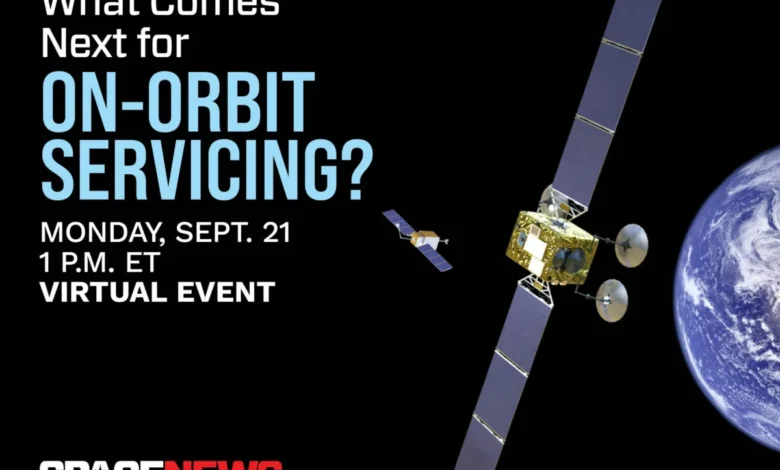
The burgeoning field of in-space logistics is shifting rapidly from theoretical engineering concepts to commercial reality, driven by pioneering missions that have successfully demonstrated autonomous rendezvous, proximity operations, on-orbit servicing, and space debris mitigation. As aerospace companies push the boundaries of what is possible beyond Earth’s atmosphere, industry leaders, policymakers, and defense strategists are turning their attention to the critical challenges that lie ahead. A forthcoming virtual industry event hosted by SpaceNews, scheduled for Monday, September 21, 2026, aims to dissect these challenges, exploring the technologies, regulatory frameworks, and economic models necessary to establish a fully functioning and sustainable in-orbit servicing ecosystem.
The 45-minute digital panel, running from 1:00 p.m. to 1:45 p.m. Eastern Time, arrives at a pivotal moment for the global space economy. While early milestones in orbital servicing have proven the technical feasibility of docking, refueling, and life-extension operations, the industry must now confront structural hurdles that will dictate its commercial viability. Key discussion points for the upcoming forum include identifying which specific market segments are poised to mature first, determining the technical standards required for multi-vendor interoperability, and formulating government incentives to stimulate sustained commercial investment.
The Evolution of In-Space Logistics
To understand the trajectory of the on-orbit servicing market, one must examine the rapid evolution of satellite operations over the past decade. Historically, spacecraft were designed as isolated, self-contained units with a finite lifespan dictated entirely by their onboard propellant reserves. Once a satellite exhausted its fuel or suffered a mechanical failure, it became space debris, prompting operators to maneuver the dead asset into a designated graveyard orbit or leave it to decay naturally in the upper atmosphere.
The paradigm began to shift significantly in the early 2020s through pathfinding missions that demonstrated the mechanics of robotic docking and life-extension vehicles. Companies such as Northrop Grumman, via its Mission Extension Vehicles (MEVs), proved that aging geostationary satellites could be physically grabbed and provided with new propulsion and attitude control. Concurrently, government agencies like NASA and the Defense Advanced Research Projects Agency (DARPA) launched initiatives aimed at standardizing robotic interfaces, inspection capabilities, and modular spacecraft design.
Despite these technological triumphs, the commercial landscape remains fragmented. Analysts point out that while the technology exists to service satellites, the economic incentives for routine commercial adoption are still taking shape. Operators of large commercial constellations—particularly those in Low Earth Orbit (LEO) managing thousands of broadband satellites—frequently weigh the cost of an on-orbit servicing mission against the economics of simply launching a replacement spacecraft. Consequently, identifying which market niches will achieve profitability first remains a central debate among industry stakeholders.
Standardization and Interoperability Challenges
One of the most pressing operational hurdles facing the on-orbit servicing sector is the absence of universal technical standards. As multiple private entities develop autonomous rendezvous and docking systems, the lack of standardized grapple fixtures, refueling ports, and data communication protocols poses a significant barrier to collaborative operations.
Without agreed-upon industry standards, vehicles built by Company A cannot physically interface with or service a client spacecraft manufactured by Company B. This proprietary fragmentation threatens to create isolated monopolies or limit the addressable market for servicing providers. During the upcoming September 2026 virtual event, industry experts are expected to address the urgent need for consensus-driven standards. Organizations such as the Consortium for Execution of Rendezvous and Servicing Operations (CONFERS) have been working to establish industry-led recommended practices, but widespread international adoption remains an ongoing process.
Furthermore, technical standards are intimately tied to safety and orbital sustainability. As traffic in LEO and Geostationary Earth Orbit (GEO) intensifies, proximity operations inherently carry collision risks. Establishing clear norms of behavior, sensor interoperability, and transparent communication channels between disparate satellite operators and servicing vehicles is paramount to preventing catastrophic orbital mishaps.

Economic Viability and Government Catalysts
The financial foundation of the on-orbit servicing ecosystem relies heavily on a delicate interplay between commercial enterprise and government patronage. Developing spacecraft capable of autonomously navigating, capturing, and servicing other orbital assets requires substantial upfront capital expenditure with extended return-on-investment timelines.
Governments—particularly through defense departments and space agencies—are acting as vital anchor customers. The United States Space Force, for instance, has increasingly emphasized the strategic necessity of resilient military operations in orbit. In an era where adversarial space capabilities pose direct threats to national security assets, the ability to inspect damaged or suspicious satellites, refuel maneuvering defense spacecraft, and dynamically reconstitute space architecture is viewed as an operational imperative.
Civil applications are expanding in parallel. The impending retirement of the International Space Station (ISS) and the planned transition to commercially owned and operated low Earth orbit destinations mean that private space stations will require robust logistics support. These commercial platforms will depend on automated cargo delivery, orbital debris removal services, and periodic maintenance to ensure continuous human habitation and scientific research. Moreover, as lunar exploration gathers momentum under programs like NASA’s Artemis, the demand for deep-space logistics, propellant depots, and surface servicing is projected to skyrocket.
Policymakers face the dual challenge of encouraging this high-tech commercial investment while avoiding overly burdensome regulatory frameworks that could stifle innovation. Tax incentives, public-private partnerships, and guaranteed procurement contracts from agencies like NASA and the Department of Defense are frequently cited by industry advocates as essential catalysts for market maturity.
Event Overview and Registration Details
The SpaceNews virtual event, titled "What Comes Next for On-Orbit Servicing?", is designed to cut through the technological hype and focus on the practical business models, policy shifts, and engineering milestones required to build a functioning orbital logistics economy.
Event Details:
- Date: Monday, September 21, 2026
- Time: 1:00 p.m. to 1:45 p.m. Eastern Time (ET)
- Format: Virtual panel discussion
- Availability: A full recording will be made accessible shortly after the live broadcast concludes for registered participants.
Industry professionals, researchers, defense analysts, and commercial stakeholders interested in the future of space infrastructure can register through the SpaceNews platform. By submitting registration details, attendees agree to standard privacy policies and terms of service, granting access to ongoing updates regarding the space sector’s most pressing developments.
As humanity’s footprint in space expands beyond simple observation and communication into permanent infrastructure, industrialization, and exploration, the ability to service, maintain, and manage assets in orbit will no longer be a novelty—it will be the fundamental backbone of the space age. The discussions on September 21 will offer critical insight into how the aerospace community intends to build that indispensable bridge to the future.