Kiteworks Lifts Precautionary Server Shutdown Advisory After Patched Vulnerability Triggers Global Alert

American technology enterprise Kiteworks has officially lifted a sweeping precautionary advisory that instructed thousands of corporate clients and government agencies worldwide to shut down their systems. The directive followed an urgent warning from federal intelligence authorities regarding a potentially imminent cyberattack targeting a critical software vulnerability.
The company, formerly known as Accellion, specializes in secure file-sharing infrastructure through its Private Content Network (PCN) platform. This unified ecosystem integrates enterprise email, secure file sharing, Managed File Transfer (MFT), application programming interfaces (APIs), and web forms. Serving a vast global footprint that includes numerous Fortune 500 corporations and public sector institutions, Kiteworks products manage sensitive communications and data for a user base exceeding 100 million individuals globally.
The rapid containment effort highlights the precarious nature of modern enterprise file-sharing networks, which remain prime targets for sophisticated cybercriminal syndicates specializing in data-theft extortion. Following a frantic weekend of emergency patch deployment and system monitoring, Kiteworks confirmed that all hosted customer environments have been brought back online safely, with no evidence of compromise detected across its global infrastructure.
An Urgent Warning and Global Shutdown Directive
The crisis began unfolding late last week when Kiteworks received critical intelligence from federal authorities warning of a potential zero-day exploit campaign targeting its software architecture. Recognizing the severe implications—given the sensitive nature of the data stored within its Private Content Networks—the secure software firm acted with extreme caution.
On Saturday, Kiteworks issued an urgent, worldwide directive urging customers to temporarily power down their servers for a mandatory six-hour window. The unprecedented precautionary measure was designed to neutralize any potential window of opportunity for threat actors attempting to exploit the suspected vulnerability before patches could be fully integrated and tested across all environments.
The sudden directive sent shockwaves through corporate IT departments and government agencies, forcing administrators to abruptly sever internet access to critical file transfer nodes. Such emergency interventions are rare in the enterprise software sector, underscoring the gravity of the intelligence received by Kiteworks leadership and federal cybersecurity agencies.
Swift Remediation and System Restoration
Despite the widespread disruption caused by the emergency shutdown, Kiteworks engineering teams worked around the clock to investigate the threat, develop countermeasures, and secure the affected software components.
The targeted vulnerability resided within a specific feature—specifically identified as Kiteworks Advanced Forms—which is utilized by less than one percent of the company’s total customer base. To address the issue, developers built, tested, and deployed a comprehensive software fix during the emergency shutdown window. Additionally, the company applied a robust secondary protective layer across all hosted and managed environments as an added defense-in-depth measure.
By Monday, following intensive continuous monitoring of all hosted systems, Kiteworks leadership announced that the threat window had closed without incident. Comprehensive diagnostic checks revealed zero abnormal network traffic, no anomalous behavioral patterns, and no indicators of compromise.
"Continuous monitoring throughout the period showed no abnormal activity, and the company has no indication that any Kiteworks or customer system was compromised," the company stated in an official release. "As of September 27th, the shutdown recommendation is now lifted for all customers. If you have not already restarted, you may bring your Kiteworks system back online."
While hosted environments were rapidly restored by the provider, self-hosted clients utilizing the Advanced Forms feature were advised to engage directly with customer support to ensure their localized patches were correctly applied. Kiteworks confirmed that all other company products and core software modules remained entirely unaffected by the flaw.
Landscape of Exposure: Shadowserver Statistics
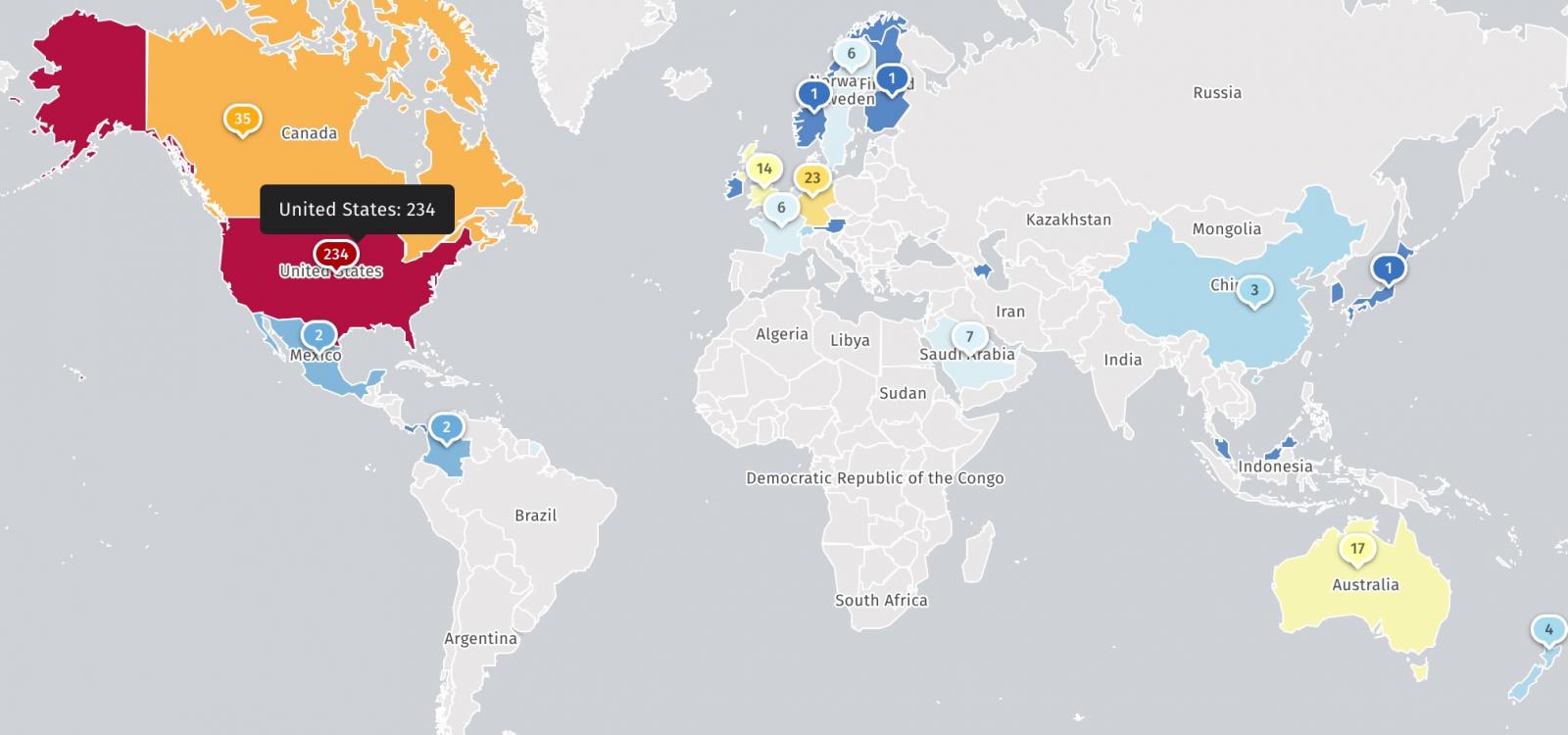
In the wake of the advisory, internet threat-monitoring watchdogs moved quickly to assess the global exposure of Kiteworks infrastructure. Data compiled by the non-profit security foundation Shadowserver revealed that nearly 400 distinct Kiteworks instances remained publicly accessible over the internet during the peak of the alert.
Geographical breakdowns of the exposed instances highlighted a heavy concentration in North America. Out of the roughly 400 detected servers, 234 were located within the United States. While Shadowserver’s telemetry identified these internet-facing nodes, the organization could not immediately differentiate between active production servers, corporate honeypots set up to trap malicious actors, and systems that had already received the emergency patches.
The presence of hundreds of publicly accessible enterprise file-transfer nodes emphasizes the ongoing challenge of perimeter defense. Because these platforms are explicitly designed to facilitate the movement of large volumes of external data, they inherently present a complex attack surface that requires constant vigilance, rapid patching, and rigorous network segmentation.
Ghosts of the Past: The Accellion Legacy and Clop Ransomware
The swift and aggressive response by Kiteworks was heavily influenced by the company’s past history under its former corporate identity, Accellion. The enterprise software vendor carries institutional memory of a major cyber security crisis that occurred several years ago, leaving a lasting impact on both the company and its high-profile clientele.
During that previous campaign, the notorious Clop ransomware and extortion gang launched a series of zero-day attacks targeting a 20-year-old legacy software product known as the Accellion File Transfer Appliance (FTA). At the time, Accellion reported that roughly 300 customers relied on the aging FTA platform. Of those, fewer than 100 organizations suffered direct breaches, and less than two dozen experienced significant data theft.
However, the ripple effects of the Clop campaign were profound. The data-theft extortion attacks compromised a vast array of high-profile entities that utilized the legacy software for secure transmissions. The list of impacted organizations read like a roster of global enterprise and public sector heavyweights, including cybersecurity firm Qualys, energy titan Shell, the Reserve Bank of New Zealand, retail conglomerate Kroger, telecommunications giant Singtel, the Australian Securities and Investments Commission (ASIC), the Office ofওয়া the Washington State Auditor, and numerous institutions of higher education.
The severity of those historical breaches prompted a coordinated international response. In February 2021, cybersecurity authorities belonging to the "Five Eyes" intelligence alliance—comprising the United States, United Kingdom, Canada, Australia, and New Zealand—issued a joint security advisory warning organizations of the Accellion FTA extortion tactics. The warning urged global companies to immediately block internet access to vulnerable legacy servers and expedite migration to modern, secure platforms.
Implications for Enterprise Security and File-Sharing Platforms
The recent near-miss involving Kiteworks illustrates a broader, systemic reality facing the modern digital enterprise: file-sharing and managed file transfer platforms are among the most lucrative targets in the cybercrime ecosystem.
Because these systems act as central repositories and transit hubs for confidential intellectual property, financial records, personally identifiable information (PII), and proprietary communications, successful infiltration yields immediate leverage for threat actors. Consequently, extortion gangs frequently prioritize zero-day research against enterprise collaboration and transfer tools, aiming to bypass traditional endpoint security and perimeter defenses.
The incident also underscores the shifting dynamics of threat intelligence sharing between government authorities and private software vendors. The proactive warning issued by federal intelligence agencies enabled Kiteworks to issue an anticipatory shutdown advisory before widespread exploitation could occur. This collaborative friction-reduction model represents an evolving standard in cyber defense, where preemptive operational disruption is increasingly utilized to thwart well-resourced criminal groups.
Furthermore, the event serves as a critical stress test for modern software supply chains. While Kiteworks successfully avoided a major security breach through rapid containment, transparency, and decisive action, the episode highlights the operational friction inherent in emergency mitigations. For enterprise clients, the mandatory shutdown reinforced the importance of robust business continuity planning, redundant communication channels, and agile patch management frameworks capable of operating at machine speed.
As Kiteworks continues to finalize its technical documentation regarding the patched vulnerability—including the assignment of a formal CVE (Common Vulnerabilities and Exposures) tracking identifier—the cybersecurity community remains watchful. Organizations utilizing enterprise file-sharing solutions are continually urged to deprecate legacy infrastructure, enforce strict network access controls, and maintain continuous monitoring to safeguard against emerging zero-day threats in an increasingly hostile digital landscape.