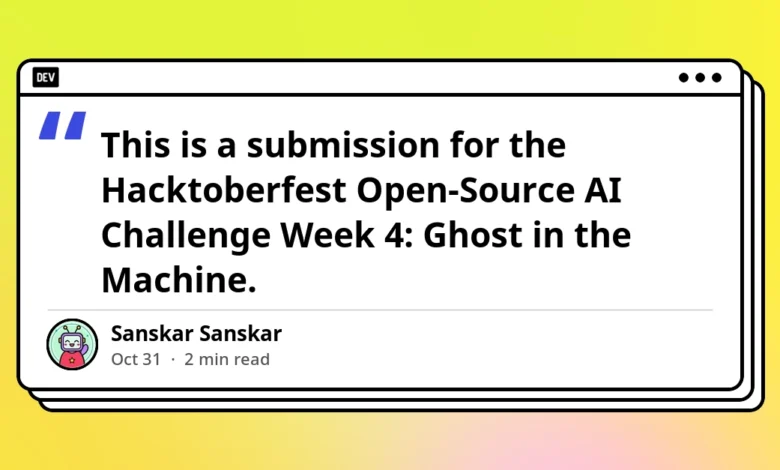
The intersection of artificial intelligence and human remembrance has yielded a novel application with the debut of Afterlight, a project developed for the final phase of the Hacktoberfest Open-Source AI Challenge. Centered around Week 4’s theme, "Ghost in the Machine," the software offers a private, locally hosted archive for everyday objects that evoke memories of specific individuals. Rather than attempting to simulate the deceased or generate synthetic consciousness—a common trope in speculative technology—Afterlight serves as a reflective tool for the living. By leveraging a local open-weight language model, the application translates personal narratives into museum-style catalog labels, reflective prose, and prompts designed to stimulate deeper recall, all while prioritizing data privacy and user ownership.
The project addresses a growing philosophical and technical concern within the artificial intelligence community: the boundary between technological assistance and the distortion of personal history. As generative AI increasingly permeates emotional and sentimental domains, Afterlight establishes a strict methodological framework that keeps human recollection at the center of the archiving process, utilizing machine intelligence solely as a stylistic assistant rather than a primary author of truth.
Background Context: The Evolution of Digital Remembrance and AI
The development of Afterlight occurs against a backdrop of rapid evolution in generative artificial intelligence and digital legacy products. Over recent years, technology sector developments have frequently leaned toward "grief bots" and AI simulations designed to mimic deceased individuals based on historical chat logs, voice recordings, and video data. These applications have sparked considerable ethical debate among psychologists, ethicists, and technologists regarding consent, psychological dependency, and the commodification of grief.
Conversely, cultural traditions such as Día de los Muertos (Day of the Dead) emphasize remembrance through physical objects, shared stories, and tangible offerings. Afterlight draws direct inspiration from this philosophy, interpreting "Ghost in the Machine" not as an invitation to resurrect personalities through algorithms, but as a cautionary inquiry into what technology should abstain from doing with human memory. By focusing on ordinary objects—such as a chipped ceramic cup or a worn book—the application grounds remembrance in physical reality rather than speculative digital recreation.
The choice of open-source and local execution models also reflects broader industry movements toward sovereign computing. As concerns mount over data privacy, cloud surveillance, and the environmental footprint of large-scale data centers, developers are increasingly turning to local inference architectures that operate entirely on consumer-grade hardware without transmitting sensitive user data to external corporate servers.
Technical Architecture and Chronology of the Challenge
Afterlight was conceptualized, built, and tested as part of the four-week Hacktoberfest Open-Source AI Challenge, an annual event that encourages collaborative software development and open-source contribution. The fourth week challenged participants to explore the thematic boundaries of autonomous systems, data permanence, and human-machine interaction.
The application’s architecture is designed for simplicity, transparency, and independence from cloud infrastructure. The core components include:
- Local Inference Engine: The system utilizes Ollama, a lightweight framework for running large language models locally, coupled with the Qwen3 1.7B open-weight model. This model runs entirely on the user’s local hardware—such as a standard laptop—requiring an initial download of the model weights before operating entirely offline.
- Backend Infrastructure: Eschewing complex database dependencies, the server is built using Python’s standard library, ensuring that the software remains maintainable and lightweight.
- Frontend Interface: The user interface is constructed using vanilla HTML, CSS, and JavaScript, eliminating the need for heavy frontend build pipelines, package managers, or external web dependencies.
- Data Storage: Memories, object descriptions, and generated labels are stored locally in a JSON file format. To preserve user privacy, the local data directory is intentionally excluded from the public GitHub repository via configuration settings, ensuring that personal archives are never accidentally committed to public code repositories.
Operational Workflow and User Experience
The user workflow within Afterlight is structured to maintain absolute transparency regarding the origin of text. When a user interacts with the application, the process follows a defined sequence:
- Object and Memory Input: The user inputs a description of an everyday object—such as a chipped teacup—alongside a personal narrative or memory associated with it.
- Local Processing: The input data is transmitted locally to the Ollama endpoint running the Qwen3 1.7B model. The system requests a structured output dividing the response into three distinct categories: a museum-style archive label, a reflective line, and a prompt designed to encourage further introspection.
- Draft Generation and Curation: The model’s output is presented to the user as an editable draft. Crucially, the user’s original text remains permanently visible alongside the AI-generated content.
- User Curation and Export: Users retain full editorial control. They can modify the model’s wording, delete individual records entirely, or export their complete archive. The system does not enforce encryption, functioning instead as a transparent local ledger rather than a heavily secured cryptographic vault.
Fact-Based Analysis of Implications and Findings
Testing the application revealed critical insights into the behavior of small-scale language models and the philosophical implications of AI-assisted writing. During initial testing with a sample teacup narrative, the Qwen3 1.7B model introduced embellishments and narrative details that the original author had not provided.
This behavioral artifact prompted a revision of the system prompts and reinforced the application’s core design philosophy: AI prose must be treated as a fallible suggestion rather than historical evidence. By maintaining the user’s unedited words side-by-side with the machine-generated draft, Afterlight prevents the algorithm from quietly rewriting personal history. This design choice addresses a fundamental risk identified by data ethicists—that users may unconsciously defer to machine-generated outputs, allowing synthetic phrasing to overwrite genuine memories over time.
Furthermore, the decision to rely on local inference rather than a cloud-based application programming interface (API) carries significant practical implications:
- Privacy Assurance: Intimate personal memories never leave the physical device of the user, mitigating risks associated with third-party data harvesting, cloud breaches, or corporate model training on private sentimental data.
- Economic Efficiency: Operating locally eliminates per-request API costs, ensuring the software remains perpetually free to use without subscription models or usage caps.
- Flexibility and Inspection: Developers and advanced users can inspect the underlying prompts, modify parameters, or swap the Qwen3 model for any other compatible local weight model via Ollama.
Broader Impact on the Open-Source AI Community
Afterlight exemplifies a growing shift within the open-source developer community toward intentional, human-centric software design. While much of the commercial AI landscape focuses on scaling model size, increasing parameter counts, and centralizing data processing in massive cloud server farms, projects like Afterlight demonstrate the viability of small, efficient models deployed at the edge.
By addressing sensitive themes such as memory and loss without resorting to emotional exploitation or synthetic impersonation, the project sets a precedent for ethical boundaries in consumer AI development. It highlights how open innovation can empower individuals to utilize advanced natural language processing tools on their own terms, maintaining data sovereignty and personal authorship.
As the software is made available via GitHub under open-source terms, its architecture provides a foundational template for other developers interested in local-first, privacy-respecting AI utilities. Whether applied to personal journaling, historical archiving, or creative writing, Afterlight demonstrates that the most effective role for artificial intelligence in preserving human experience is not to speak for the user, but to help the user articulate their own truths.
Related posts: