AWS Introduces Enhanced Custom Event Bus for Amazon EventBridge to Streamline Multi-Account Serverless Architectures

Amazon Web Services (AWS) has officially announced the launch of an enhanced custom event bus for Amazon EventBridge, a major architectural update designed to resolve long-standing operational challenges associated with scaling event-driven applications across complex, multi-account enterprise environments. The new feature arrives as organizations increasingly move away from monolithic infrastructures in favor of decentralized, microservices-based serverless models. By introducing a centralized, organization-wide event bus equipped with native event ordering, simplified subscriber management, and a modernized economic model, AWS aims to eliminate the intricate workarounds that platform engineering teams have historically relied upon.
The release addresses fundamental structural friction points that have emerged alongside the widespread adoption of serverless computing. Historically, organizations building event-driven systems on Amazon EventBridge began with a single custom event bus housed within a single AWS account—a configuration that functions efficiently under the purview of a single development team. However, as enterprise adoption scales, AWS security and architectural best practices mandate a multi-account strategy. To bridge the communication gap between isolated accounts, teams were previously forced to construct complex webs of multiple event buses connected through cross-account resource rules or bus-to-bus configurations.
This legacy workaround inadvertently reintroduced the very operational complexity that serverless architectures were engineered to remove. Platform engineering teams steadily lost centralized visibility into subscription topologies, compounding cross-account data routing fees accumulated rapidly, and teams requiring strict event sequencing were compelled to construct convoluted external mechanisms or migrate entirely to alternative messaging technologies. The newly released enhanced custom event bus directly targets these pain points by offering a unified infrastructure backbone capable of serving an entire AWS organization seamlessly.
Chronology and Evolution of EventBridge Architecture
The trajectory of Amazon EventBridge reflects the broader evolution of cloud-native computing over the past decade. Initially launched as Amazon CloudWatch Events, the service was rebranded and expanded into EventBridge to function as a serverless event bus connecting application data from AWS services, integrated Software-as-a-Service (SaaS) applications, and custom application data. As enterprises scaled their usage, the need for robust cross-account communication became paramount, leading to the introduction of resource-based policies and cross-account target routing.

Despite these incremental updates, the fundamental architectural paradigm remained decentralized at the bus level, requiring developers to manage distinct event buses per domain or account and wire them together explicitly. Over the subsequent years, feedback from enterprise platform teams highlighted that managing dozens—or even hundreds—of interconnected buses created administrative overhead, obscured event lineage, and complicated governance.
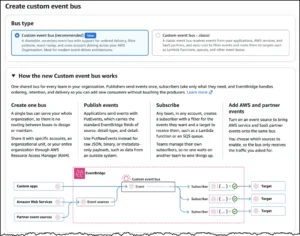
The development of the enhanced custom event bus represents a multi-year engineering response to these enterprise scaling bottlenecks. By shifting from a multi-bus dependency model to a unified, multi-tenant organizational bus architecture, AWS has redefined how disparate microservices communicate across enterprise boundaries. To maintain operational continuity, legacy workloads will remain fully supported under the newly designated "Custom event bus – classic" classification, allowing organizations to migrate to the enhanced architecture at their own operational pace.
Core Technical Enhancements and Architectural Capabilities
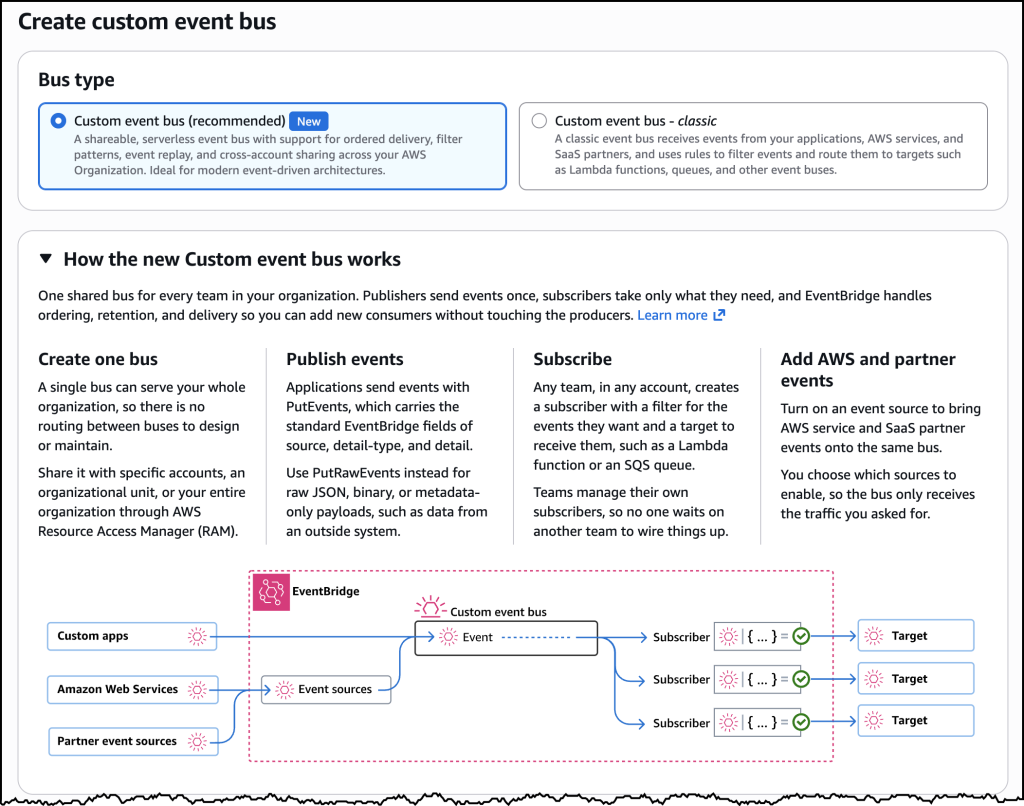
The enhanced custom event bus introduces several foundational capabilities engineered to streamline modern distributed systems. Chief among these is organization-wide sharing, facilitated natively through AWS Resource Access Manager (AWS RAM). Platform teams can now deploy a single event bus and authorize resource sharing across an entire AWS organization, specific organizational units, or individual AWS Identity and Access Management (IAM) principals. This integration eliminates the manual overhead of configuring cross-account permissions and eliminates the need for intermediate bus-to-bus routing layers. Publishers can broadcast events without prior knowledge of consuming entities, while downstream teams independently establish their own subscriptions.
To accommodate large-scale enterprises, the enhanced bus features a default quota of 10,000 subscribers per bus—with higher limits available upon request—significantly mitigating the architectural fragmentation previously driven by strict subscriber ceilings.
Furthermore, the architecture resolves the historical tension between asynchronous execution and strict event ordering. While event-driven design principles generally dictate that consumers operate asynchronously without regard to message sequencing, specific verticals—such as logistics, financial transaction processing, and inventory management—rely heavily on chronological integrity. The enhanced event bus accommodates both patterns concurrently. Publishers can append an optional EventGroupId attribute to outgoing payloads, instructing EventBridge to deliver events sharing identical identifiers in strict sequence to subscribers configured for ordered processing. Concurrently, other consumers on the same bus can process those identical events asynchronously.

Supporting this ordered processing capability, the enhanced bus integrates synchronous invocation mechanisms for targets such as AWS Lambda. This synchronous mode confirms successful downstream processing before acknowledging event receipt, effectively removing the common practice of positioning an Amazon Simple Queue Service (SQS) queue between an event bus and a Lambda function merely to guarantee delivery reliability.
Streamlined Subscriptions and Advanced Event Evaluation
Administrative simplification extends directly to consumer configuration through the introduction of the unified Subscriber resource. Previously, establishing filtered, reliable event delivery required the cumbersome orchestration of multiple discrete rules, targets, retry policies, and dead-letter configurations across disparate resources. The new Subscriber resource consolidates event filtering, target definition, retry parameters, and failure handling into a single, cohesive management unit. Additionally, variable start time configurations embedded within the subscriber architecture simplify the onboarding of new consumer applications and facilitate rapid event replay for disaster recovery or state rehydration.
Data governance and payload optimization have also been modernized through advanced evaluation features. Publishers can now activate content-based deduplication, empowering EventBridge to programmatically identify and discard duplicate event retries derived from identical payloads. By cryptographically hashing meaningful payload segments and collapsing matches received within a five-minute window, EventBridge delivers exactly-once processing semantics for erratic event sources, superseding the traditional at-least-once delivery model without requiring publishers to generate and track explicit idempotency tokens.
For downstream consumers requiring specific data schemas, the platform integrates JSONata expression support. Subscribers can dynamically reshape incoming payloads—extracting, renaming, or computing new field values—before the data reaches the designated target API. Moreover, native support for deserializing Apache Avro and Protocol Buffers formats into JSON allows consumers to execute fine-grained filtering and routing across complete binary event payloads without writing custom decoding middleware.
Economic Restructuring and Pricing Implications
Financial predictability has historically been a critical consideration in large-scale serverless deployments. Under legacy multi-bus configurations, cross-account and bus-to-bus routing fees frequently compounded, creating unexpected cost escalations for fast-growing enterprises.
The enhanced custom event bus introduces a transparent ingress and egress throughput pricing model designed to optimize economics at scale. Under this revised framework, publishers incur costs based strictly on the volume of events ingested, while subscribers pay for events successfully delivered. This decoupled pricing structure aligns infrastructure expenditures directly with organizational usage, providing clearer cost allocation metrics for internal chargeback models and eliminating the financial penalties associated with multi-account event distribution.
Industry Implications and Future Outlook
Independent cloud architects and enterprise technology analysts have noted that the launch of the enhanced custom event bus represents a mature phase in the lifecycle of serverless computing. As organizations transition from initial cloud migration experiments to massive, multi-departmental application ecosystems, platform engineering has emerged as a critical discipline. Tools that reduce cognitive load, enforce centralized governance, and remove unnecessary networking boilerplate are increasingly essential for maintaining engineering velocity.
By bridging the gap between decentralized team autonomy and centralized platform governance, AWS has provided a blueprint for enterprise event streaming that rivals dedicated, self-managed message brokers in capability while preserving the operational benefits of serverless infrastructure.
Availability and Regional Rollout
The enhanced custom event bus is commercially available immediately across a broad footprint of global AWS Regions, including US East (N. Virginia, Ohio), US West (Oregon), Europe (Ireland, Frankfurt, Stockholm, Spain), and Asia Pacific (Hong Kong, Malaysia, Mumbai, Singapore, Sydney, Thailand, Tokyo). Organizations can provision and manage the new resource via the AWS Management Console, the AWS Command Line Interface (AWS CLI), or standard EventBridge APIs. Comprehensive documentation and implementation guides are currently accessible via the official AWS documentation portal to assist engineering teams in planning their architectural migrations.